
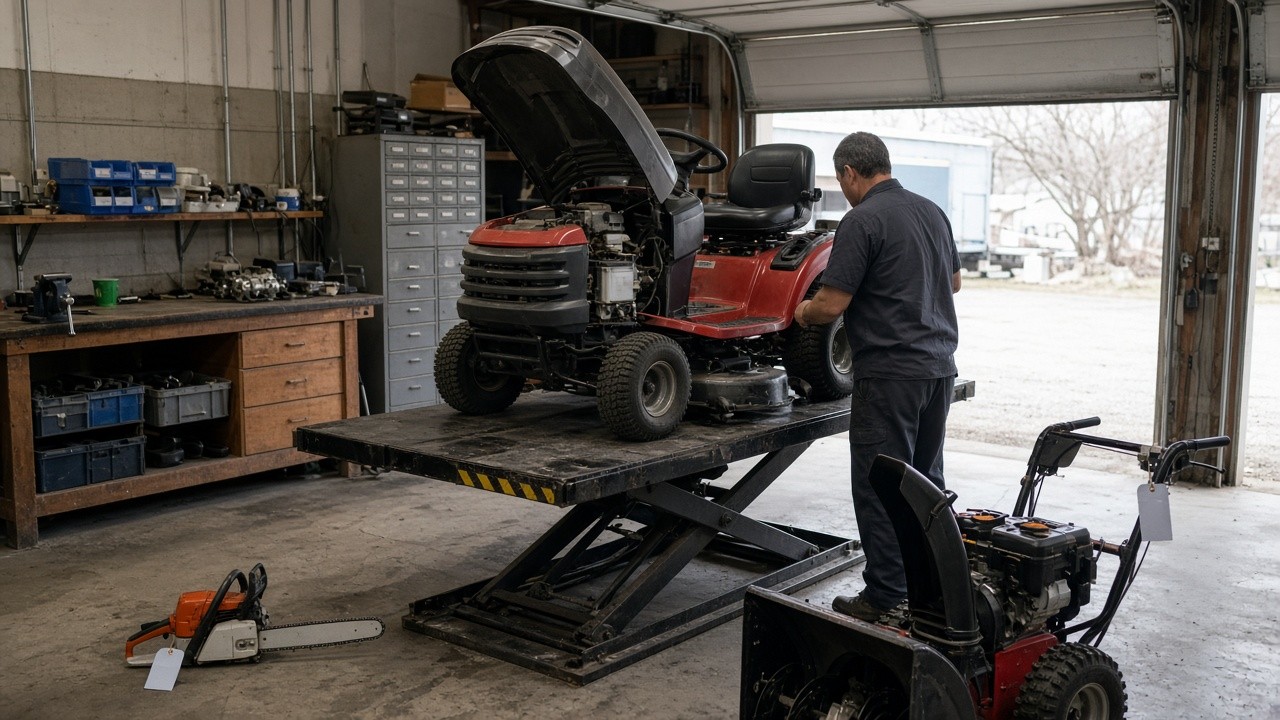
A small engine repair website should answer what a homeowner or landscaper asks before they haul equipment in: what kinds of equipment you fix, how long the wait is right now, what a tune-up includes, whether you pick up and deliver, how you quote a repair, what happens if they do not pick up the machine, whether you sell parts over the counter, your hours, which towns you serve, and how to drop off or book. Put those facts in plain text on pages you own. That is the marketing. Design is the layout that makes those facts easy to find and easy for search and AI to cite.
Small engine shops get buried twice a year. Every spring the mowers come in. Every fall the snowblowers do. The shop that posts its real wait time and a clear drop-off process spends less time on the phone and keeps customers happier through the rush.
Who is reading the site
Small engine traffic comes from a few groups.
Homeowners with a mower that will not start, a trimmer that sputters, or a snowblower that sat all summer. They search and ask AI things like lawn mower repair Iowa City, snowblower repair Marion, or small engine repair near me Davenport.
Acreage owners with riding mowers, zero-turns, compact tractors, UTVs, and chainsaws. They want to know if you handle bigger equipment and whether you pick up.
Landscapers and lawn crews who need fast turnaround on commercial mowers in season. Downtime costs them money.
Rural customers with generators, pumps, log splitters, and older equipment who want to know if you still work on it.
Iowa shops around Iowa City, Cedar Rapids, and the Quad Cities compete the same way small engine shops across the Midwest do: be honest about the wait, clear about what you fix, and easy to drop off with.
What the homepage has to say in the first screen
In plain HTML text:
1. Shop name, address, and the towns you serve 2. Equipment you fix: push mowers, riding mowers, zero-turns, snowblowers, trimmers, chainsaws, generators — only what you work on 3. Phone that reaches the counter 4. One clear button: Schedule a repair / Request pickup 5. Current turnaround (for example, “spring wait is running about two weeks”), and hours
Item five is the one to keep current. It is also the first thing many callers ask.
Publish the queue and turnaround
Say how your queue works:
- Whether you work first-come, first-served, or by appointment
- The current wait for standard repairs, updated weekly in busy seasons
- Whether commercial customers get priority or a separate line, and how that works
- Whether you offer off-season service specials to spread out the rush, stated as a program
- How you contact customers with a quote and when the machine is ready
A dated note like “updated Monday: about ten days for mowers” answers the question that fills your voicemail in April. It also tells search engines and AI that the site is kept up.
Say what a tune-up includes, and what you fix
Tune-up. “Tune-up” means different things at different shops. Write down what yours includes: oil, filters, spark plug, blade sharpening, carburetor cleaning, belts checked, fuel system checked. Say what is extra.
What you fix. List the equipment types you work on and the engine types you are set up for. List what you do not take, like very old equipment with no parts, certain machines that need dealer tools, or outboard motors. Say where you send people for those. A clear list saves you and the customer a wasted trip.
Warranty work. Say whether you are authorized to do warranty repairs for any manufacturers, only if true, and what the customer needs to bring.
Pickup, storage, and abandoned equipment
Pickup and delivery. Say whether you pick up, which towns, and how you schedule it. Many older customers and acreage owners with riding mowers will choose you for this alone.
Storage. Shops fill up. Say how long you hold a finished machine before you charge storage, described as a policy.
Abandoned equipment. Every shop ends up with machines that never get picked up. Say how you contact owners, how long you wait, and what happens after. Iowa and local rules may apply to abandoned property, so keep the policy on your work order and tell customers to read it. Having it on the site in plain words avoids hard conversations later.
Quotes. Say how you quote a repair, whether there is a diagnostic charge, and what happens when a repair would cost more than the machine is worth. Customers want an honest “it is time to replace it” when that is the answer.
Parts counter and seasonal care
Many customers only want parts or advice. Say whether you have a parts counter, its hours, and whether you can order parts for customers who work on their own equipment.
Seasonal care pages help too: how to store a mower for winter, how to get a snowblower ready, what to do about old fuel. These pages bring in searches in every season.
Service pages that match real jobs
- Lawn mower repair — push, self-propelled, riding, zero-turn
- Snowblower repair — single-stage and two-stage, fall prep
- Trimmers, blowers, and chainsaws — carburetors, starters, chains
- Generators — portable and standby, only if you service them
- Compact tractors and UTVs — only if you are set up for them
- Commercial mower service — priority, turnaround, fleet accounts
- Pickup and delivery — towns, scheduling
- Parts counter — hours, ordering
- Service areas — towns with real customers
Proof that belongs on a URL you own
- Photos of real repairs with equipment type in the caption: a cleaned carburetor, a replaced belt, a sharpened blade
- Photos of the shop and counter so people know where to come
- Reviews on a page you own, with town and equipment when allowed, plus a link to Google Business
- Manufacturer authorizations only if you actually hold them
- Your repair warranty and your storage and abandoned equipment policy in plain text
The drop-off path is the conversion
A good repair request form asks for:
- Name, phone, email
- Town
- Equipment type, make, and model number, with a photo of the tag
- What is wrong
- Drop-off or pickup
- Homeowner or commercial
- Any deadline, like needing a snowblower before a storm
Put the form on its own URL so Google Business posts and AI answers can link to it. Keep click-to-call in the header, and the shop address and hours on every page.
Content that feeds search and AI without theater
- Current repair wait times, updated weekly
- What our tune-up includes
- How to store your mower for an Iowa winter
- Why your snowblower will not start after summer
- Repair or replace? How we help you decide
- Short repair notes: equipment, problem, what we fixed
Your website stays the source of record for customers and for AI assistants like ChatGPT, Gemini, and Grok. Google Business, Facebook, and Nextdoor can point back to it. Keep your true hours, wait times, and policies on a page you own.
Bots now make a large share of web requests. People still bring mowers and snowblowers to local shops, and they still check the website before they load the trailer. Search is changing, and machines more and more decide which shop a homeowner hears about first. Plain-text equipment lists, wait times, policies, and real repairs on a domain you own keep you in that short list.
Design rules that fit the trade
- Fast on mobile
- Click-to-call in the header, with address and hours on every page
- High-contrast text and real photos with captions
- Navigation: What we fix, Current wait, Tune-ups, Pickup and delivery, Parts, Policies, Reviews, Schedule repair
- No fake reviews or dealer logos you do not carry
- You own the domain, hosting, and content
What Upley does for shops like this
Upley builds and hosts websites for Iowa and Midwest service businesses. For a small engine repair shop that means a wait time note you can update in a minute, clear equipment and tune-up pages, pickup and policy pages, a repair request path that takes photos from a phone, hosting that stays up for daily crawls, and an easy way to post repairs without turning your mechanics into marketers.
Same Iowa web team that ran Big Ten Web Design — design, hosting, SEO — plus the modern layer so search and AI can find the true file about your services, hours, and towns.
If your current site is a Facebook link and a phone number, start with the homepage five facts, a current wait note, and a tune-up page. Then build from the repair request form.
Book 30 minutes: /half-hour-meeting/ Call 319-535-2508 · aaron@upley.com Iowa City, Cedar Rapids, Quad Cities / Davenport