
A well drilling and pump company website should answer what a rural family asks before they call: what to check when the water stops, whether you take no-water calls after hours, whether you service their pump brand, what a new well involves, who gets the county permit, how water testing works, what to do with an old unused well, which counties you cover, and how to reach someone. Put those facts in plain text on pages you own. That is the marketing. Design is the layout that makes those facts easy to find on a phone and easy for search and AI to cite.
There are two very different customers here. One has no water right now and a sink full of dishes. The other is planning a house on acreage and will not need you for months. The website should give each of them a clear door.
Who is reading the site
Well and pump traffic is mostly rural and small town.
Families with no water, low pressure, sputtering taps, or a pressure tank that clicks on and off. They want help today and want to know if you come to their area. They search and ask AI things like no water well pump repair Johnson County, well pump service near Solon, or pressure tank replacement Cedar County.
Families building on acreage who need a new well. They are working with a builder and a septic installer and want to know the order of steps.
Buyers and sellers of rural homes who need a water test or well inspection for a sale or a lender.
Farm operations that need livestock wells, larger pumps, or service on older wells.
Owners of old farmsteads with an abandoned well they need to plug.
Iowa well companies around Iowa City, Cedar Rapids, and the Quad Cities compete the same way well contractors across the rural Midwest do: be findable by county, answer the phone when the water stops, and explain the process plainly.
What the homepage has to say in the first screen
In plain HTML text:
1. Company name and the counties you serve 2. Core work: pump repair and replacement, pressure tanks, new wells, water testing, well plugging — only what you do 3. Phone that reaches someone, with the no-water line if different 4. Two clear buttons: No water? Call now / Plan a new well 5. After-hours note if you take emergency calls, and certified, licensed, and insured if you can keep it honest
Give the no-water call its own page
The person with no water is stressed and searching on a phone. A page written for that moment does more than any slogan.
Put this on it:
- A short list of safe things to check first: is a breaker tripped, has the power been out, does the pressure tank gauge read zero. Keep it to checks a homeowner can do safely, and say when to stop and call.
- Your emergency hours and how after-hours calls work
- How you decide who goes first when many calls come in, like after a lightning storm or a long power outage
- Whether you carry common pumps and pressure tanks on the truck
- What the visit usually involves: testing the pump, checking the control box and wiring, pulling the pump if needed
- How the call-out works: say whether there is a trip charge and how the repair is quoted, without listing prices if you prefer not to
A family in the country will remember the company whose page helped them at 7 p.m. AI assistants asked “my well stopped working what do I do” will also find a clear, local, honest answer.
Explain what a new well involves
Building families want to know the steps and who does what. Write it down:
- How you pick the well location, and the setback distances from septic systems and other features that Iowa rules require
- Who applies for the county private well permit, and how long it usually takes
- Whether your drillers hold Iowa DNR well contractor certification, if they do
- What affects depth, cost, and timing in your area: local geology, aquifer, access for the rig — stated as factors, since every site differs
- What the finished job includes: casing, pump, pressure tank, line to the house, first water test
- How to coordinate with the builder, septic installer, and electrician
You do not need to publish prices. Describing the process honestly helps families plan and builds trust before the first call.
Water testing and well plugging
Many well sites skip these two pages, and both bring in customers.
Water testing. Say what you test for (bacteria, nitrate, or more), how samples are collected and handled, which lab you use, and how results are explained. Many Iowa counties run private well testing programs through their environmental health office. Link to the counties you serve so homeowners can check their options.
Well plugging. Old farmsteads often have unused wells, cisterns, or hand-dug wells that should be properly plugged. Say whether you plug wells, how the process works, and that plugging usually needs to follow county rules. Link to the county or DNR source.
Service pages that match real jobs
- No water and emergency pump service — as above
- Pump repair and replacement — submersible and jet pumps, brands you service
- Pressure tanks and controls — replacements, switches, pressure settings
- New well drilling — process, permits, what is included
- Water testing — what you test, lab, results
- Well inspections for home sales — what you check, report timing
- Well plugging — abandoned wells, cisterns
- Livestock and farm wells — only if that is real work for you
- Service areas — counties and towns with real jobs
Proof that belongs on a URL you own
- Photos of real jobs with county and job type in the caption: rig on site, pump pulled, new pressure tank installed
- Photos of the equipment you run
- Reviews on a page you own, with town and job type when allowed, plus a link to Google Business
- Certification facts and how to verify them
- Insurance facts
- Warranty terms in plain text for pumps, tanks, and new wells
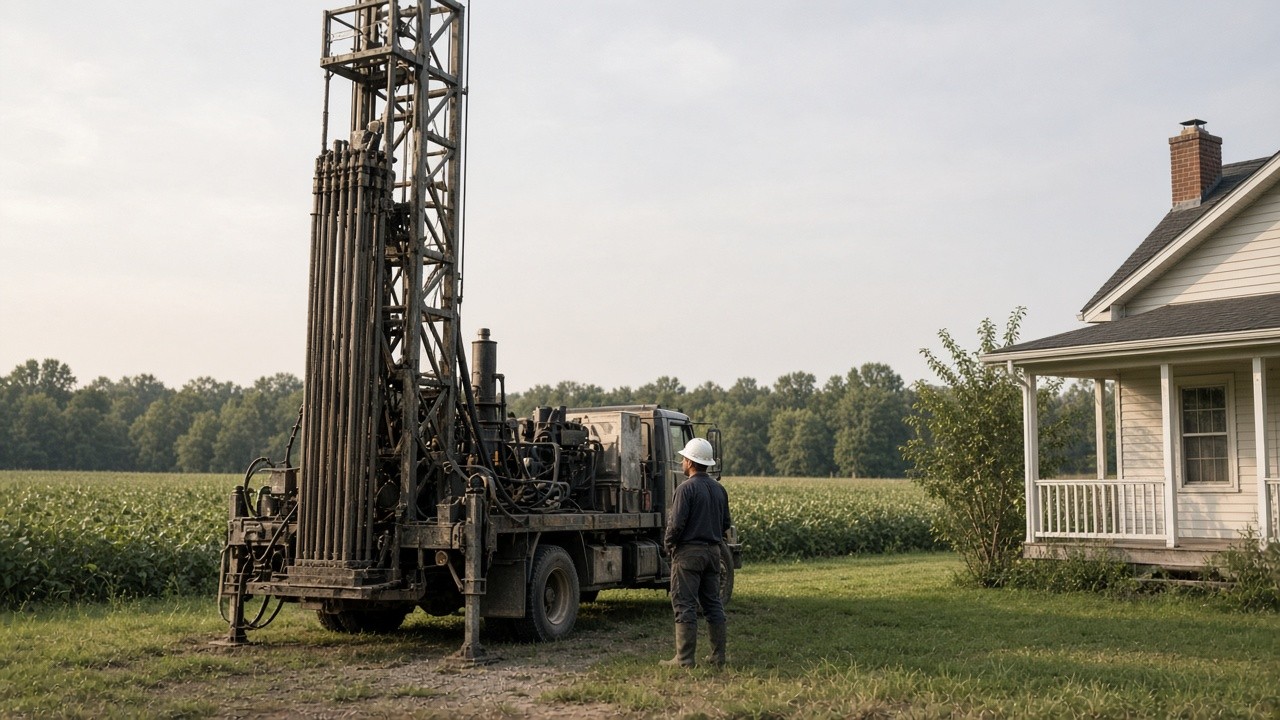
Photos of your rig in a real Iowa farmyard tell rural families you come out there.
The call path is the conversion
A good request form asks for:
- Name, phone, email
- Property address and county
- No water, low pressure, water quality, new well, testing, or plugging
- For no-water calls: when it stopped, any storm or power outage, what they have already checked
- Pump age and brand if known
- For new wells: build timeline and builder contact
Put the form on its own URL, and keep click-to-call at the top of every page. For a no-water call, the phone matters more than the form.
Content that feeds search and AI without theater
- What to check when your well stops working
- How a new well gets permitted and drilled in Johnson County
- Why your pressure tank clicks on and off, and what it means
- How often to test a private well in Iowa
- What to do with an old well on a farmstead
- Short job notes: county, problem, what we found, what we replaced
Your website stays the source of record for customers and for AI assistants like ChatGPT, Gemini, and Grok. Google Business and Facebook can point back to it. Keep your true counties, certifications, and emergency hours on a page you own.
Bots now make a large share of web requests. People still need well and pump service, and they still look a company up before they call, often from a phone in a house with no water. Search is changing, and machines more and more decide which companies a rural family hears about first. Plain-text counties, steps, emergency hours, and real jobs on a domain you own keep you in that short list.
Design rules that fit the trade
- Fast and light on mobile. Rural connections can be slow.
- Click-to-call in the header, with the no-water line next to it
- High-contrast text and real photos with captions
- Navigation: No water, Pumps and tanks, New wells, Water testing, Well plugging, Counties we serve, Reviews, Contact
- No fake reviews or certifications you do not hold
- You own the domain, hosting, and content
What Upley does for shops like this
Upley builds and hosts websites for Iowa and Midwest service businesses. For a well drilling and pump company that means a no-water page for the emergency, clear steps for new wells, county pages, a call path that works from a phone, hosting that stays up for daily crawls, and an easy way to post real jobs from the truck without turning your crew into marketers.
Same Iowa web team that ran Big Ten Web Design — design, hosting, SEO — plus the modern layer so search and AI can find the true file about your services, counties, and certifications.
If your current site is a phone number and a rig photo, start with the homepage five facts, a no-water page, and a new well page. Then build from the call path.
Book 30 minutes: /half-hour-meeting/ Call 319-535-2508 · aaron@upley.com Iowa City, Cedar Rapids, Quad Cities / Davenport