
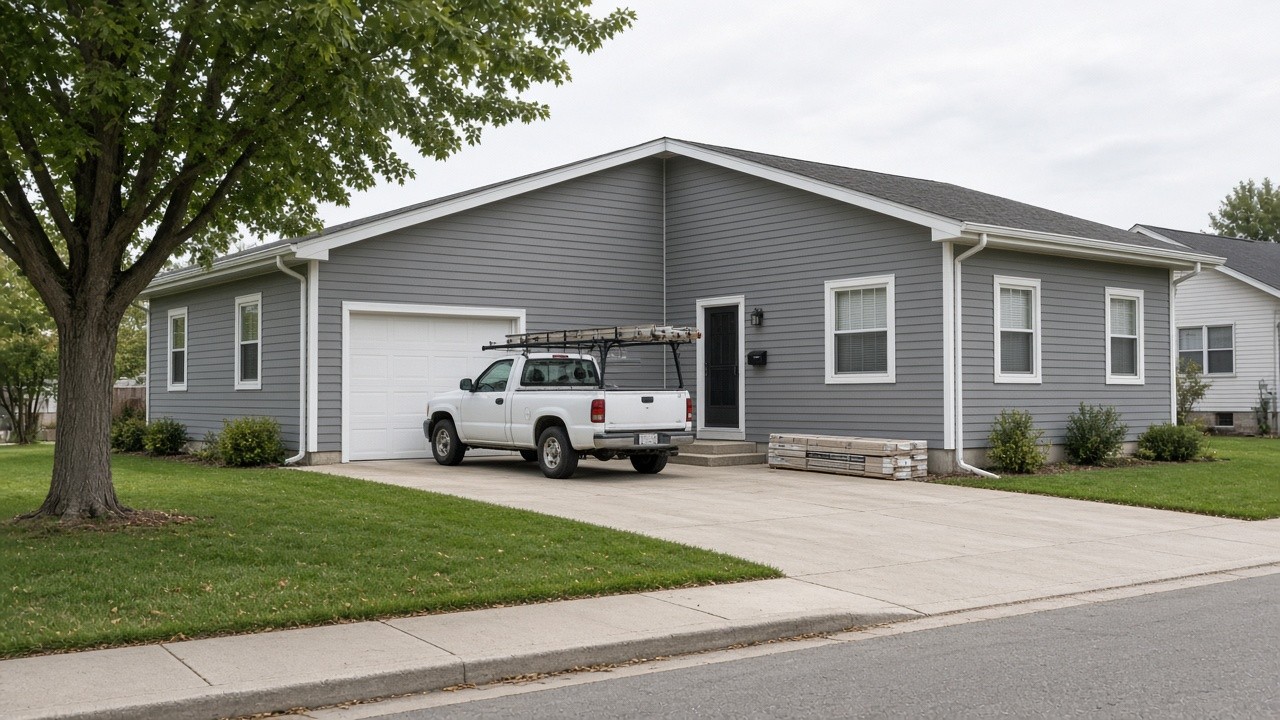
A siding contractor website should answer what a homeowner asks before they call: which materials you install, what finished houses in their town look like, whether you handle hail and wind claims, how you deal with matching old siding on a partial repair, how long a full-house job takes, whether you are licensed and insured, and how to book an estimate. Put those facts in plain text on pages you own. That is the marketing. Design is the layout that makes those facts easy to read on a phone and easy for search and AI to cite.
Siding is a job people look at from the street for the next twenty years. Your website should work the same way. Show the house, name the town, name the product and the color, and make the estimate path short.
Who is reading the site
Most siding traffic comes from three kinds of buyers.
Homeowners after a hailstorm or windstorm with dented, cracked, or missing panels. Some have already filed an insurance claim. Some are not sure whether the damage is enough to file. They want to know if you inspect for free, how you document damage, and whether you will work with their adjuster. They search and ask AI things like siding repair after hail Iowa City, siding contractor Cedar Rapids insurance, or who replaces siding in Marion.
Homeowners planning a full re-side on an older house. Faded vinyl, rotting wood lap, or old steel siding on a 1970s ranch. They are comparing materials and colors and usually taking their time. They want to see houses like theirs, finished, in towns they know.
Owners of rentals, small commercial buildings, and farm properties who need durable exteriors with little upkeep. They want material options, rough timelines, and proof you have done buildings like theirs.
Iowa shops serving Iowa City, Cedar Rapids, and the Quad Cities compete the same way siding companies across the Midwest do: show the finished house, prove the coverage area, then make the estimate easy to book.
What the homepage has to say in the first screen
In plain HTML text that search and AI can read:
1. Company name and the towns you work in 2. Core work: vinyl, fiber cement, engineered wood, steel, soffit and fascia, storm repair — only what you actually install 3. Phone that reaches someone who can book an estimate 4. One clear button: Free estimate / Schedule inspection 5. Hours, a storm-season note if you keep one, and one line on licensed and insured if you can keep it honest
If someone lands from Google Maps, a Google Business post, or an AI answer and cannot find those five things in ten seconds, the brand story below them will not get read.
The job gallery is your showroom
Most siding companies do not have a showroom people visit. The website does that job. Homeowners picking a color want to see it on a real house in Iowa light.
Build the gallery so people can use it:
- One entry per job, with town, material, product line, and color name in plain text
- Before and after from the same angle
- Close-ups of trim, corners, J-channel, and window wraps — the details that separate a careful crew from a fast one
- Soffit, fascia, and gutter work shown when it was part of the job
- A short note on what the house needed and how long the job ran
A homeowner in North Liberty who types “gray lap siding with white trim” into a search box should be able to find a real house you did. So should an AI assistant asked the same thing. That only happens when the words are written on the page under the photo.
Service pages that match how people search
One URL for each clear job:
- Vinyl siding — product lines you carry, thickness options if you explain them, color range, warranty basics
- Fiber cement and engineered wood — only if your crew installs them regularly, with care and painting notes
- Steel and metal siding — residential, farm, or outbuilding work if that is real for you
- Storm and hail damage repair — inspection steps, photo documentation, how you work with adjusters
- Soffit, fascia, and trim — including wrap work around windows and doors
- Partial repairs and matching — what you do when the original siding is discontinued
- Service areas — Iowa City, Coralville, North Liberty, Cedar Rapids, Marion, Davenport — towns where you have real jobs and photos
A single “Services” page that lists every siding word in one paragraph gives search and AI nothing specific to cite. Four honest pages with photos do.
Say how you handle matching and insurance
Two questions come up on almost every storm job, and most siding sites skip both.
Matching. When a few panels are damaged and the original product is no longer made, the homeowner wants to know what happens next. Say what you do in plain words: whether you try salvage from a less visible wall, whether you source close matches, and when you recommend replacing a full elevation. Keep it honest and let the insurance policy and adjuster decide what is covered.
Insurance. Explain your process without promising outcomes. What your inspection includes, what photos you take, whether you meet the adjuster on site, how supplements work if you file them, and what the homeowner pays for the deductible. Do not write copy that sounds like you can guarantee a claim. You cannot, and careful homeowners notice.
These two pages do more for trust than any tagline. They also give AI assistants a clear answer when someone asks how siding insurance claims work in Iowa.
Proof that belongs on a URL you own
- Real job photos with town, material, and color in the caption
- Reviews on a page you own, with town and job type when allowed, plus a link to Google Business
- License and insurance facts on a page you own — what you carry and how to verify it
- Manufacturer certifications only if you actually hold them, with the program named
- Warranty terms in plain text: what the manufacturer covers, what your workmanship warranty covers, and for how long
Stock photos of a perfect suburban house with no town and no crew teach nobody anything. Photos of your own work teach customers and AI what you actually finish.
The estimate path is the conversion
A good estimate form for a siding company asks for:
- Name, phone, email
- Address or town
- Storm damage, full re-side, partial repair, soffit and fascia, or outbuilding
- Photo upload of the house or the damage
- Whether an insurance claim is filed, planned, or not relevant
- Timeline: this month, this season, next year
- Material or color preference if they have one
Put the form on its own URL so Google Business posts and AI answers can link straight to it. Keep click-to-call in the header on mobile. After a big storm, the shop whose number is easy to find gets the first calls.
Content that feeds search and AI without theater
Useful posts for a siding company read like job notes:
- What a siding inspection after hail includes at your shop
- Vinyl vs fiber cement for an Iowa house — honest trade-offs you actually see
- What happens when your old siding is discontinued
- Short job write-ups: town, house age, material, color, what changed
- How long a full re-side takes, and what the homeowner needs to do beforehand
- Care notes: washing, what voids a warranty, what to watch after winter
Your website stays the source of record. Google Business, Facebook, and Nextdoor can point back to it. Do not leave your true towns, hours, and warranty facts sitting only in a Maps profile.
Bots now make a large share of web requests. People still re-side houses and still pick contractors carefully. More and more, machines decide which siding contractors a homeowner hears about first. Plain-text materials, towns, colors, and proof on a domain you own keep you in that short list.
Design rules that fit a trade brand
- Fast on mobile. People look at your gallery standing in their own driveway.
- Large, sharp photos with captions in real text underneath
- High-contrast text. No pale gray type over a busy hero image.
- Navigation: Services, Gallery, Storm damage, Service areas, Reviews, About, Estimate
- Click-to-call in the header
- No fake testimonials, invented badges, or manufacturer logos you are not certified for
- You own the domain, hosting accounts, and content if you ever change agencies
Pretty is fine once the facts are readable. A gallery with no towns or colors named is a missed estimate.
What Upley does for shops like this
Upley builds and hosts websites for Iowa and Midwest service businesses. For a siding contractor that means clear service and town pages, a job gallery that names material, color, and town, an estimate path that fits storm and planned work, hosting that stays up for daily crawls, and a simple way to post finished jobs from the truck without turning your crew into marketers.
Same Iowa web team that ran Big Ten Web Design — design, hosting, SEO — plus the modern layer so search and AI can find the true file about your work, towns, and hours.
If your current site has a stock house photo and a contact box, start with the homepage five facts and a gallery of ten real jobs with captions. Then build from the estimate form.
Book 30 minutes: /half-hour-meeting/ Call 319-535-2508 · aaron@upley.com Iowa City, Cedar Rapids, Quad Cities / Davenport