
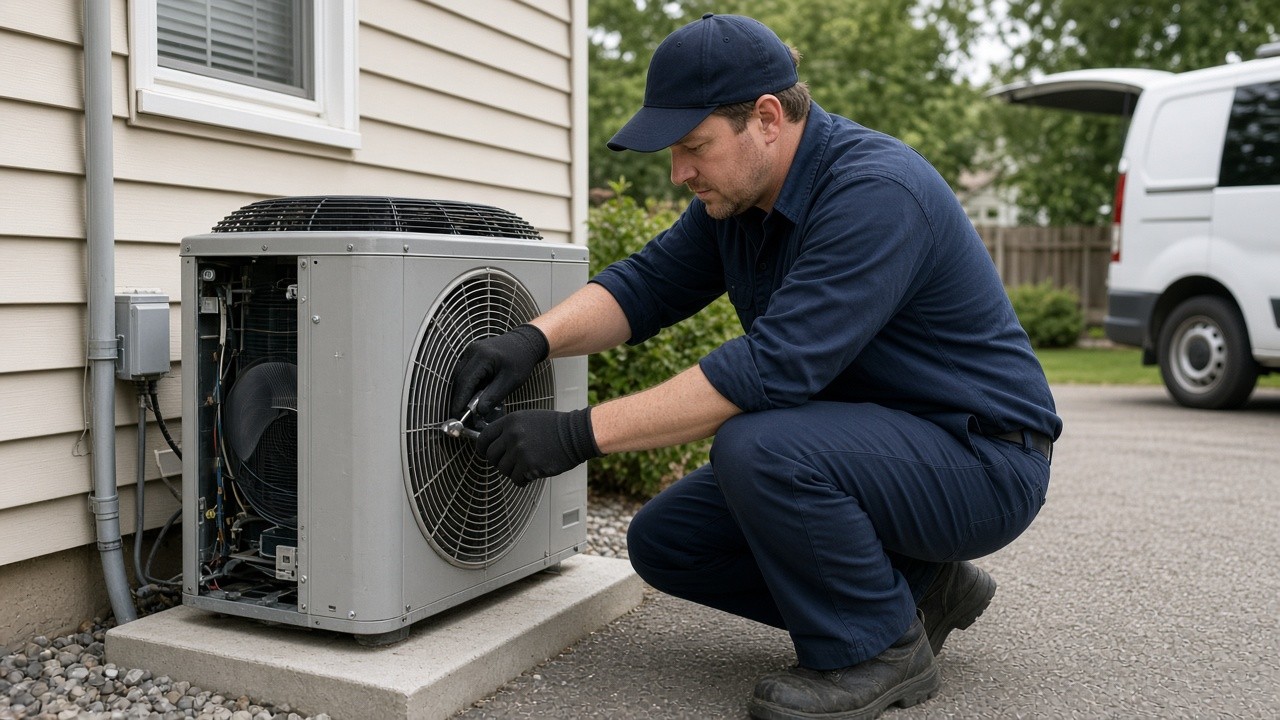
An HVAC contractor website should answer what a homeowner or light-commercial buyer asks before they call: what you install and repair, which towns you cover, whether you handle emergency or after-hours work, what brands and equipment you service, whether you are licensed and insured, and how to request a same-day call or a planned estimate. Put those facts in plain text on pages you own. That is the marketing. Design is the layout that makes those facts easy to find on a phone during a no-heat night and easy for search and AI to cite.
Stock handshake heroes and the word “comfort” do not win the call. Service pages, real job photos, and a clear phone path do.
Who is reading the site
Most HVAC traffic is two kinds of people, often on the same week.
Homeowners and property managers with a failed furnace, dead AC, or a strange noise. They want hours, same-day language you can keep, towns you actually cover, and a phone number that reaches a human. They search and ask AI things like furnace repair Iowa City tonight, AC not cooling Coralville, heat pump install North Liberty, or boiler service Cedar Rapids.
Light-commercial decision-makers planning a rooftop unit, office remodel, or maintenance contract. They want brands you install, commercial capability if you have it, license and insurance facts, and an estimate path that is not a blank contact box.
Iowa shops serving Iowa City, Cedar Rapids, and the Quad Cities compete the same way Midwest HVAC companies everywhere do: prove the work and the coverage area, then make the call or estimate path short.
What the homepage has to say in the first screen
In plain HTML text, not locked in a logo:
1. Company name and city (or cities) 2. Core work: furnace, AC, heat pump, ductless, boilers, commercial RTU — only what you actually do 3. Phone that reaches dispatch or a tech who answers 4. One clear button: Call now / Request an estimate 5. Hours, after-hours rule, and one line on licensed and insured if you can keep it honest
If someone lands from Google Maps, a Google Business post, or an AI answer and cannot find those five things in ten seconds, the rest of the brand story does not matter. A no-heat caller will not scroll past a full-screen stock photo to hunt for your number.
Build service pages, not a keyword dump
One URL should equal one clear job. Examples that work for shops of different sizes:
- Furnace repair and replacement — gas / electric you actually run; when you repair vs replace; what an estimate visit includes
- Air conditioning — install, repair, refrigerant notes you can state honestly
- Heat pumps and ductless mini-splits — brands and applications you really install
- Maintenance plans — what the visit covers, when you schedule, what members get — only claims you keep
- Indoor air quality — filters, humidifiers, UV, ventilation — only products you sell and service
- Light commercial — RTUs, split systems, office / retail — only if that is real work for your crew
- Service areas — Iowa City, Coralville, North Liberty, Cedar Rapids, Davenport — towns with real jobs and photos, not a copied city list
A thin “Services” page that lists every HVAC buzzword is worse than four honest pages. Search and AI cite specific files. Homeowners bookmark the page that matches their problem. Commercial buyers save the page that matches the equipment.
Small Iowa shops can start with one strong residential HVAC page that covers heat, cool, and maintenance — then split pages as photo and review proof grows. Shops that run emergency after-hours should give that its own clear URL with hours and phone rules.
Proof that belongs on a URL you own
Publish proof the way a careful homeowner checks a contractor:
- Real job photos: outdoor unit set, furnace swap, ductless head, truck at a house — with town and job type in the caption
- Reviews on a page you own, with town and job when allowed, plus a link to Google Business
- License and insurance facts on a page you own — number, what it covers, how to verify
- Brands you install or service — only logos you actually carry
- Maintenance plan terms in plain text, not only a PDF brochure crawlers skip
Stock “happy family by thermostat” images hurt trust. Photos of the work as you do it teach customers and AI what you actually finish. Your website stays the source of record. Google Business and Facebook can point back.
The call and estimate path is the conversion
Marketing for an HVAC contractor is not a newsletter signup first. It is a phone call for emergency work, or a booked estimate for planned install.
A good estimate / contact path asks for:
- Name, phone, email
- Address or town
- Heat, cool, or both — repair vs install if they know
- Equipment age or brand if known
- Preferred window: today / this week / planned project
- Photo upload for the nameplate or the problem when helpful
- Clear note on after-hours: who answers, what after-hours rates mean, when a tech will call back
If the only CTA is “Contact us” with a blank message box, emergency callers bounce to the shop whose number is already in the header. Click-to-call on mobile is not optional. Put the estimate form on its own URL so Google Business posts and AI answers can link to it.
Content that feeds search and AI without theater
Useful posts and pages for an HVAC company look like job notes, not slogans:
- What “same-day” means at your shop (cutoff time, towns, emergency vs scheduled)
- When to repair a furnace vs replace it — honest criteria, not scare copy
- How a maintenance visit works and what you leave behind
- Heat pump vs furnace notes for Iowa winters when you actually install both
- Short job write-ups: town, problem, equipment type, outcome — no customer secrets
- After-hours and holiday coverage on a URL you own
Your website stays the source of record. Directory listings, Google Business, and social can point back. Do not leave the only true hours, towns, and license facts trapped in a Maps profile alone.
Bots already do a large share of web requests. People still buy installs and still call when the heat dies. Machines increasingly decide which contractor they mention first. Plain-text services, towns, hours, and proof on a domain you own are how you stay in that short list.
Design rules that fit a trade brand
- Fast on mobile. People call from the driveway or the basement.
- High-contrast text. No pale gray on gray over a busy hero.
- Navigation: Services, Service areas, Maintenance plans, Reviews, About, Contact / Estimate
- Phone click-to-call in the header; after-hours note near the number
- No fake testimonials, invented “#1 in Iowa” badges, or logos you do not carry
- You own the domain, hosting accounts, and content when the agency relationship ends
Pretty is fine after the facts are readable. Pretty instead of facts is a missed emergency call and a stalled estimate queue.
What Upley does for shops like this
Upley builds and hosts websites for Iowa and Midwest service businesses. For an HVAC contractor that means clear service and town pages, a call and estimate path that matches how homeowners and facility managers actually buy, hosting that stays up for daily crawls, and a way to publish real job photos and short notes without turning your techs into marketers.
Same Iowa web team that ran Big Ten Web Design — design, hosting, SEO — plus the modern layer so search and AI can find the true file about your services, towns, and hours.
If your current site still says “your comfort is our priority” with no towns, no hours, and no license facts in plain text, start with the homepage five facts and one honest service page. Then grow from the call and the estimate form.
Book 30 minutes: /half-hour-meeting/ Call 319-535-2508 · aaron@upley.com Iowa City, Cedar Rapids, Quad Cities / Davenport