
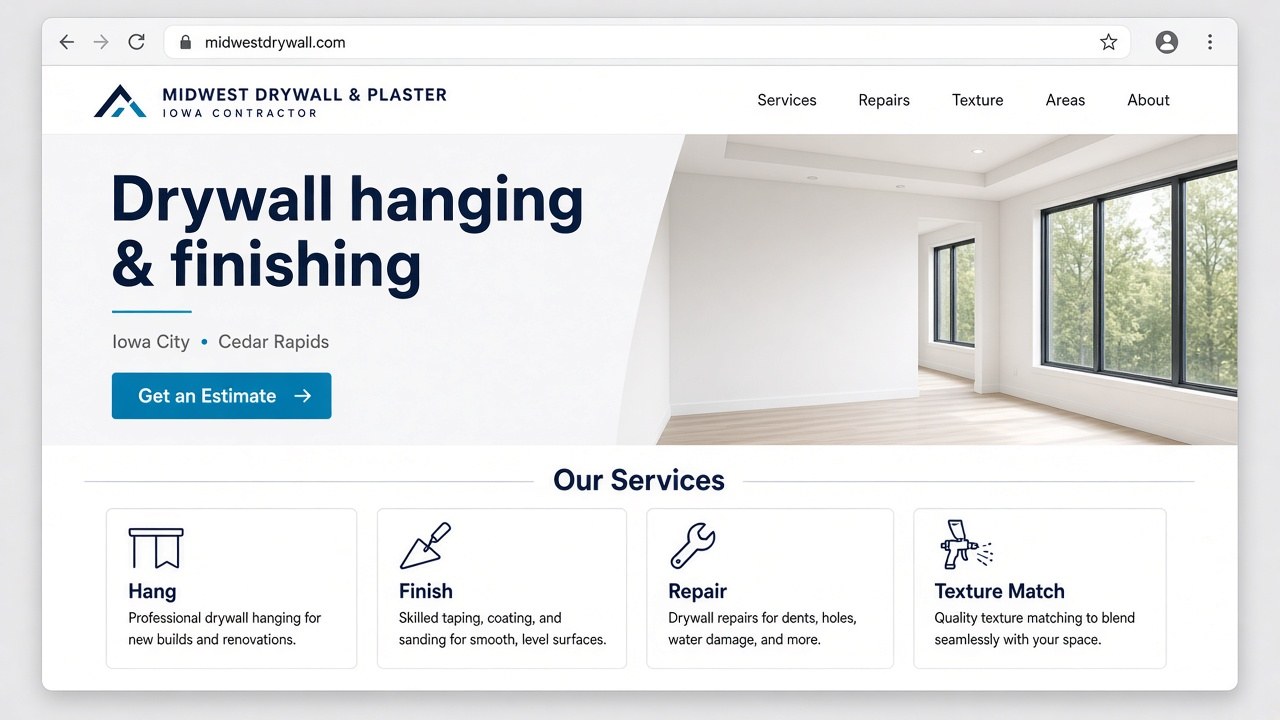
A drywall and plaster contractor website should answer what a homeowner or remodeler asks before they book: whether you hang, finish, or repair, how you match texture, how you handle dust, which towns you serve, how estimates work, and how to call or request a quote. Put those facts in plain text on pages you own. That is the marketing. Design is the layout that makes those facts easy to find on a phone and easy for search and AI to cite.
Many drywall crews lean on a Facebook page, a Google Business listing, or word of mouth alone. Those help, but they change rules, hide posts, and often skip texture notes, dust-control steps, and hanging vs finishing scope. The company that posts clear services, real before-and-after photos, and an estimate-or-call path on a site it owns gets callers who already know what they need.
Who is reading the site
Drywall and plaster traffic comes from a few groups.
Homeowners fixing a water stain, a cracked ceiling, or a punched wall. They search and ask AI things like drywall repair Iowa City, texture match Cedar Rapids, or plaster repair Coralville.
Remodelers and general contractors who need hanging and finishing on a schedule. They want scope, lead time, and whether you finish to paint-ready.
Insurance and restoration jobs after leaks or storms. They want documentation-friendly photos, clear process, and a reliable contact.
New-to-town households and DIY remodelers in Iowa City, Cedar Rapids, and the Quad Cities who compare a few drywall companies the same way they compare a painter: clear services, clear dust notes, real photos, and an easy way to request an estimate.
Iowa drywall and plaster contractors compete the way home-service trades do everywhere: clear services, clear process, real job photos, and an easy way to book.
What the homepage has to say in the first screen
In plain HTML text:
- Company name and the towns you serve
- What you are: drywall hanging, finishing, repair, and plaster — residential and light commercial if that is true
- Phone that reaches someone who schedules estimates
- One clear button: Get an Estimate / Request a Quote
- Lead-time note — how far ahead remodel windows book, and whether small repairs can come sooner
A homeowner comparing three drywall companies on a Sunday night wants to see services, texture help, and how to get an estimate fast.
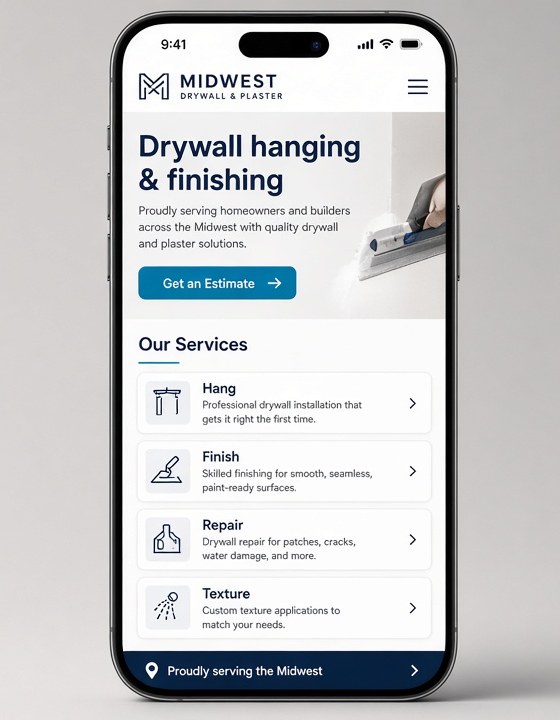
Publish services and scope as separate lists
People quote the checklist, not the slogan. Make yours easy to compare.
- Hanging vs finishing vs repair vs plaster — named as separate services, not buried in one paragraph
- New construction, remodel, and punch-list work if you do them
- Ceiling work, moisture-resistant board, sound board, and fire-rated assemblies if you offer them
- Texture matching: knockdown, orange peel, skip trowel, smooth, or skim coat — say which you actually do
- Patch sizes you take (small hole vs full sheet vs full room)
- Dust control: plastic containment, negative air, or HEPA sanding if that is your practice
- Paint-ready vs paint included — say where your scope ends
- What you do not do: full painting, framing, or water mitigation if that is your rule
Plain service lists build trust. They also give AI assistants a fair answer when someone asks who can match knockdown texture near them.
How you estimate and schedule
Estimating is where drywall sites lose trust. “Call for pricing” with no rules makes people wary. A plain estimating page does the opposite.
- Whether you price by sheet, by square foot, by room, or by time-and-materials — say which
- What changes the price: ceiling height, texture match difficulty, water damage, overnight dry time, or furniture moves
- Site visit vs photo estimate for small patches
- How far ahead remodel hanging books vs how soon a small repair can land
- Deposit, change-order, and material notes in plain language
- Whether you work for GCs on bid, or homeowners direct, or both
You do not need a public price for every room size. You do need rules a homeowner or GC can understand before they call.
Towns, access, and job-site rules
Service-area and job-site rules matter as much as the texture list.
- Towns and counties you serve, named in plain text — Iowa City, Coralville, North Liberty, Cedar Rapids, Davenport, and surrounding towns if that is your map
- Lead time for remodel packages vs small residential repairs
- Access notes: occupied homes, pets, parking, multi-story, and HOA rules
- Whether you work evenings or weekends for occupied homes, if that is true
- Whether you travel outside your core map, and any travel fee
Update the list when towns or lead times change. An outdated “same-week everywhere” claim wastes both sides’ time when the crew is already booked.
Insurance, licenses, and who shows up
Homeowners and GCs ask about paperwork before they ask about texture.
- Liability insurance and workers’ comp — facts that are true for your company
- Licenses or registrations that apply in the towns you serve
- Who hangs, who finishes, and who runs the estimate walk-through
- Warranty or touch-up notes you actually stand behind — without inventing a guarantee you do not offer
- How you document water or insurance jobs with photos and scope notes
Put estimate and call buttons on every page. Keep click-to-call in the header for people who want to talk scope or schedule through.
Proof that belongs on a URL you own
- Before-and-after photos of real repairs and finishes you ran — with permission and without inventing a house you did not serve
- Photos that show texture close-up and full-room finish, not just a stock handshake
- Reviews on a page you own, plus a link to Google Business
- Insurance and process facts that are true for your company
- GC or remodeler references if customers ask who you work with
A clean before-and-after of a patched ceiling in an Iowa City ranch helps more than a stock photo of a perfect white wall. A texture-match close-up works too, if that is what you have.
The estimate path is the conversion
A good estimate request asks for:
- Hanging, finishing, repair, plaster, or texture match
- Room type and rough size, or a short description of the damage
- Photos of the wall or ceiling if they have them
- Preferred timing (soon repair vs remodel window)
- Address or town
- Contact phone and email
- How they heard about you
Say how confirmations and site visits work. Put the estimate page on its own URL so Google Business posts, Facebook bios, and AI answers can link to it.
Content that feeds search and AI without theater
Useful posts for a drywall and plaster company read like notes from the job:
- How we match knockdown or orange peel on an older Iowa house
- Small hole vs full-sheet repair — when each makes sense
- Dust control on occupied homes
- Paint-ready vs paint included — what our scope covers
- Towns you added this year, with honest lead-time notes
Why the website matters more now
Websites and SEO are changing. They still matter, and for drywall and plaster contractors they matter more now. Bots now make a large share of web requests — Cloudflare’s Matthew Prince has said bots passed humans on Cloudflare’s network mid-2026 (about 57% bots / 43% humans). That is HTTP requests, not hours of human attention. People still hire drywall crews for real repairs and real remodels, and they still shortlist online first. More and more, ChatGPT, Gemini, Grok, and Google’s AI answers decide which companies a new customer hears about first. Those tools look for clear facts: hanging vs finishing, texture matching, dust control, towns served, estimate rules, and how to call.
Your website should be the source of record. Facebook, Google Business, and lead apps can point back to it. Keep the true services, process notes, job proof, and estimate path on a domain you own.
Design rules that fit a drywall and plaster company
- Fast on mobile, with large service cards and real text captions
- Estimate and call buttons one tap from any page
- Navigation: Services, Repairs, Texture, Process, Service area, About, Reviews, Get an Estimate
- No fake reviews, and no photos of other companies’ jobs
- You own the domain, hosting, and content
What Upley does for companies like this
Upley builds and hosts websites for Iowa and Midwest businesses. For a drywall and plaster contractor that means clear service and texture lists in plain text, process and service-area notes that stay current, an estimate path that works on a phone, hosting that stays up for daily crawls, and an easy way to post real before-and-after photos with captions.
Same Iowa web team that ran Big Ten Web Design, handling design, hosting, and SEO, plus the modern layer so search and AI can find the true file about your services, towns, and how to book a drywall estimate.
If your current site is mostly a logo and a link to Facebook, start with the homepage five facts, a service list, and an estimate button. Then add texture and dust-control pages.
Book 30 minutes
Thirty minutes. Iowa time. No deck.
Iowa City, Cedar Rapids, Quad Cities / Davenport