
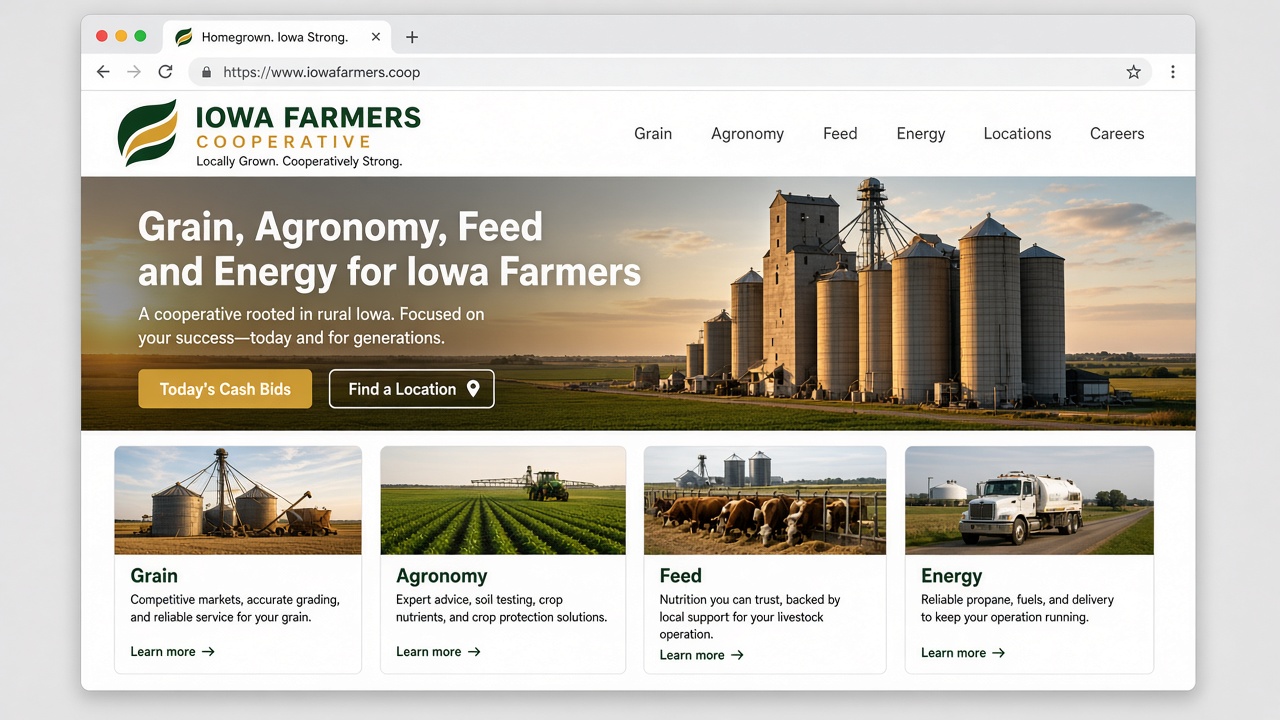
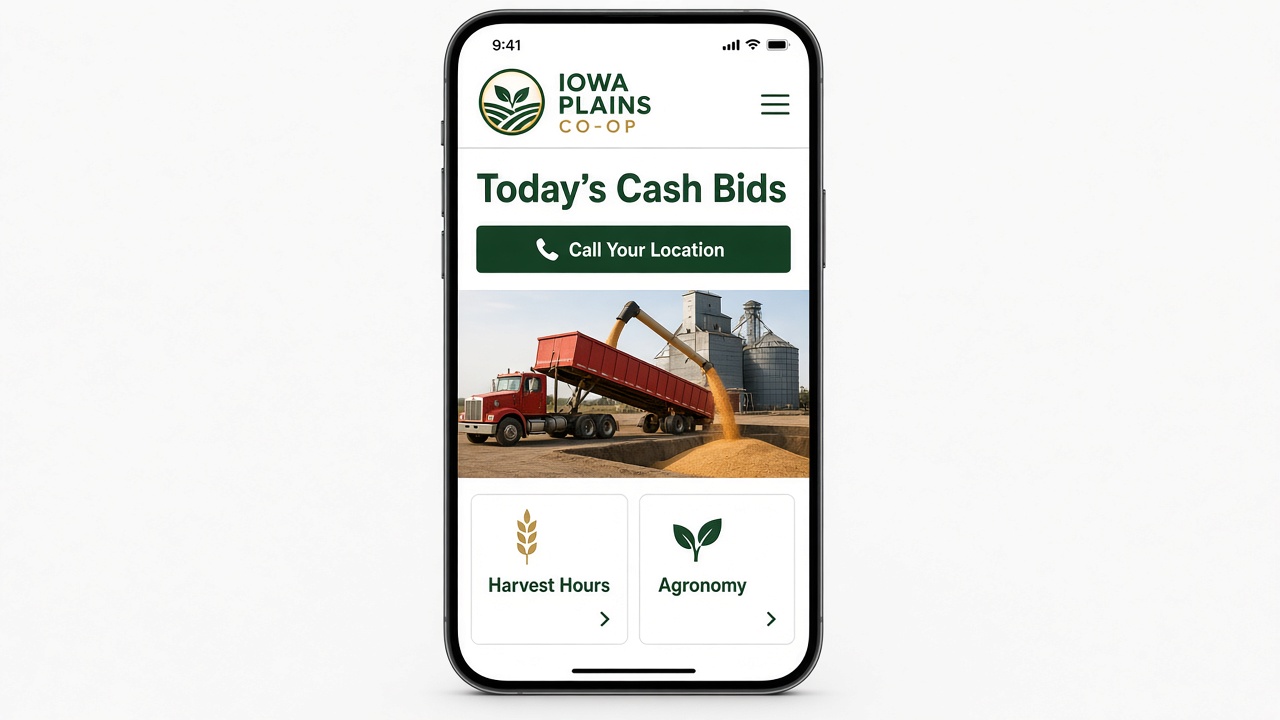
An ag co-op website has one job: help a member find today’s bids, know which elevator is open and until when, and reach the right person for grain, agronomy, feed, or fuel. Put your locations, hours, services, and the people who run each one in plain text on a site the co-op owns. That is the marketing. Design is making “Today’s Cash Bids” and “Call Your Location” easy to find from a phone in a combine cab.
Most co-ops are not trying to win strangers with a slick site. Members already know you. But the member base is changing. The son or daughter taking over the farm checks bids on a phone, not the radio. New landowners and renters move in. Young people look for jobs. Bankers, seed reps, and truckers need to know where to go. And AI assistants answer more of those questions every year. The co-op whose site states the plain facts gets named.
Who is reading the site
Ag co-op websites get more kinds of readers than most businesses.
Members and patrons. They want cash bids, harvest hours, the scale ticket or account login, the agronomist’s number, and the date of the annual meeting.
New and younger farmers. They want to know how membership works, what patronage means at your co-op, what services you offer, and who to talk to first.
Haulers and truckers. They want location addresses, dump hours, which sites take which grain, and any harvest rules or wait times.
Job seekers. Seasonal harvest help, applicator drivers, CDL drivers, agronomy interns, and office staff. They want openings, pay ranges if you share them, and how to apply.
Search engines and AI assistants. When someone asks ChatGPT, Gemini, Grok, or Google which elevator near Washington, Iowa is open late during harvest, or who does custom spraying near Kalona, those tools look for plain facts on pages they can read. A bids widget and a logo slider give them very little.
What the homepage has to say in the first screen
In plain HTML text, not baked into a graphic:
- What you are: a grain, agronomy, feed, and energy cooperative, or whichever of those you really do
- The towns where you have locations
- One clear button: Today’s Cash Bids, plus Find a Location
- Seasonal hours that change, like harvest hours, stated on the page itself
- A tap-to-call number, or a short list of numbers by department
Keep the elevator photo. Just put the words on top of it or beside it as real text.
Locations: one page each
This is the page set most co-ops skip, and the one that answers the most calls.
- One page per location with the street address, a map, and directions a trucker can follow
- Regular hours and harvest hours, plus who to call when hours change
- What that site does: grain receiving, which grains, fertilizer, chemical, feed, fuel, or a retail store
- The location manager’s name and direct number, with their okay
- Truck rules: scale entrance, dump pits, height or weight limits, and where to wait
A member at 6 a.m. should not have to call the main office to find out if the Riverside elevator is open.
Grain: bids, contracts, and the rules in words
- Cash bids by location, with a time stamp so people know how fresh they are
- What contract types you offer, in plain words, and who to call to set one up
- Drying, shrink, and storage charges stated plainly, or a clear note on where to get them
- Harvest updates: hours, lines, which sites are full, posted on your own site first and then shared to social
The bids feed is usually a widget from a data provider. That is fine. Put the words around it on your page so search and AI can still read what you do and where.
Agronomy, feed, and energy
- Agronomy: soil sampling, fertilizer, chemical, custom application, seed, and precision ag services, each with a short page
- The agronomists by name and territory, with each person’s okay, so a farmer knows who covers his ground
- Feed: what you mill or carry, bulk delivery area, and how to order
- Energy: propane, diesel, and gas delivery area, budget or contract programs, and the after-hours number
- Each service page ends with one button and one phone number
Membership, patronage, and governance
Co-ops are owned by their members, and that is worth explaining plainly.
- How to become a member, in a few steps, and what it costs if anything
- What patronage means at your co-op, in general words, and when it is usually paid
- The board of directors with names and districts, and the annual meeting date and place
- Annual report or summary, posted as a real page, with a PDF as a backup, not the only copy
- Member account login, clearly labeled, for people who need it
Careers and community
- Open jobs with real duties, locations, and how to apply, including seasonal harvest help
- What it is like to work at the co-op: a few photos of real crews, with their okay
- Scholarships, 4-H and FFA support, and community events, each with a short page and a date
Every one of those pages is a true record of your co-op that search and AI can read.
Content that feeds search and AI without theater
Good pages for an ag co-op read like answers the scale house and the agronomy office give every day:
- What to know before you haul to us during harvest
- How our drying and shrink charges work
- When to pull soil samples in our area and what we test for
- How to set up propane budget billing
- How patronage works here, in plain words
- What a custom application appointment looks like from call to invoice
Each one answers a real question. Add a photo from your own location or a member’s field. That is the kind of page that gets a co-op named when someone asks their phone where to haul grain or who sprays nearby.
Why the website matters more now
Websites and search are changing. They still matter, and for ag co-ops they matter more now. Bots now make a large share of web requests. Cloudflare’s Matthew Prince has said bots passed humans on Cloudflare’s network in mid-2026, about 57% bots and 43% humans. That counts HTTP requests, not hours of human attention. Farmers still need bids and hours today, and they still look first. More and more, ChatGPT, Gemini, Grok, and Google’s AI answers decide which co-op or elevator a farmer, a trucker, or a job seeker hears about. Those tools look for clear facts: locations, hours, services, and who to call.
Your website should be the source of record. Your Facebook page, text alerts, radio spots, Google Business listings, and app can all point back to it. Keep the true locations, hours, services, and policies on a domain the co-op owns.
Design rules that fit an ag co-op
- Real photos of your elevators, trucks, applicators, and people, compressed so pages load fast on a rural connection
- Large headings, Today’s Cash Bids and Find a Location near the top of every page, and tap-to-call numbers
- Navigation: Grain, Agronomy, Feed, Energy, Locations, Membership, Careers, Contact
- Hours, services, and policies in real text, not images or PDFs, so search and AI can read them
- Harvest hours and closures easy for your staff to update without calling a developer
- The co-op owns the domain, hosting, and content, not a vendor or a software program
What Upley does for ag co-ops
Upley builds and hosts websites for Iowa and Midwest businesses. For an ag co-op that means a clean first screen, a page for every location with real hours and truck rules, service pages for grain, agronomy, feed, and energy, a plain membership page, and a careers page that actually brings in applicants. We also make it easy to post a few photos from the elevator or a member’s field with a short caption to your website, social, and Google Business.
Same Iowa web team that ran Big Ten Web Design, handling design, hosting, and SEO, plus the modern layer so search and AI can find the true facts about your co-op.
If your current site is a bids widget and a contact form, start with the five first-screen facts and one page per location. Then add a harvest page and service pages one at a time, starting with agronomy.
Book 30 minutes
Thirty minutes. Iowa time. No deck.
Iowa City, Cedar Rapids, Quad Cities / Davenport