
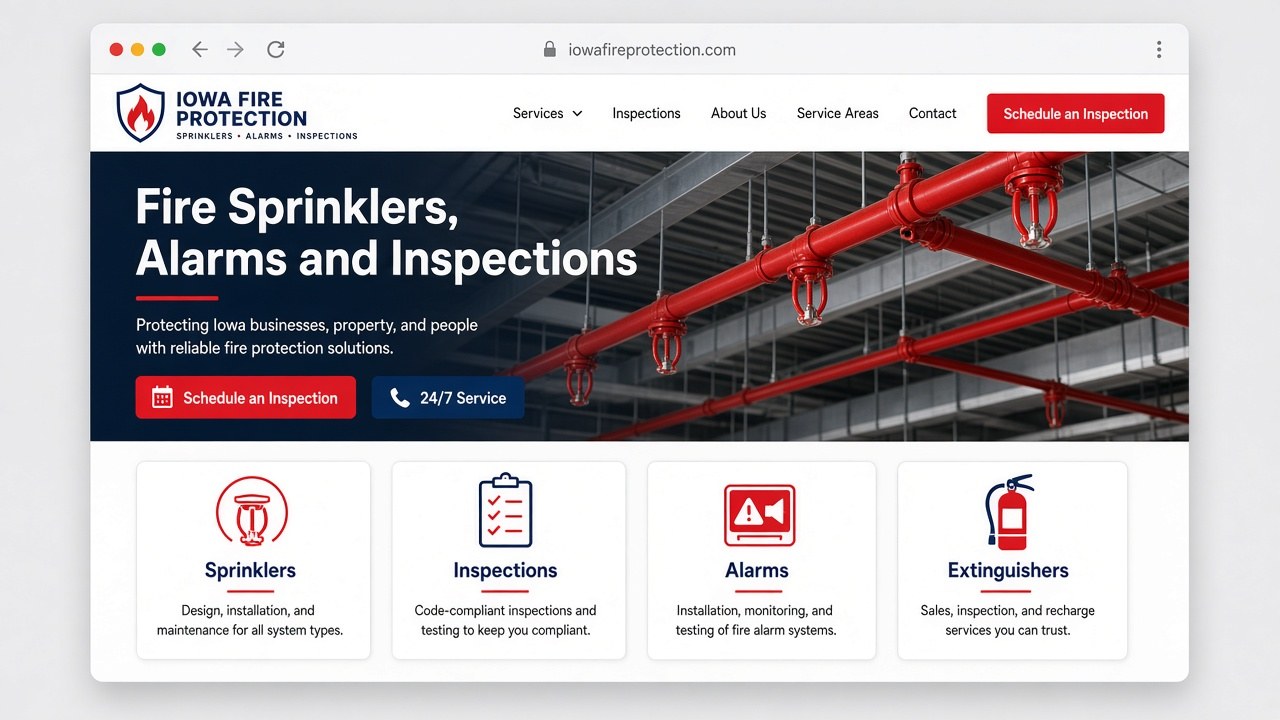
A fire protection contractor’s website has one job: help a building owner, property manager, or general contractor see right away what you install and service, where you work, and how to get an inspection on the calendar or a tech on site tonight. Put your systems, inspection programs, service area, licensing, and emergency number in plain text on a site you own. That is the marketing. Design is making “Schedule an Inspection” and “24/7 Service” easy to find from a phone in a mechanical room.
Most of your work comes from relationships. GCs who bid with you, facility managers who renew every year, insurance and fire marshal requirements that keep the phone ringing. That still holds. But the person who signs the inspection contract changes when a building sells, a manager retires, or a new company takes over the portfolio. That new person searches. More and more, they ask an AI assistant. The contractor whose site states the plain facts gets named.
Who is reading the site
Fire protection sites get several very different readers.
Building owners and property managers. They want to know if you inspect their kind of system, how often, what it costs to get on a schedule, and who to call when a head goes off or a pipe freezes.
General contractors and engineers. They want to know what you design and install, how big a job you take on, your service area, and who handles bids.
Facility and safety managers at plants, schools, churches, and hospitals. They want inspection, testing, and maintenance programs, clear reports, and someone who answers the phone.
Job seekers. Sprinkler fitters, apprentices, alarm techs, and inspectors. They want openings, training, and how to apply.
Search engines and AI assistants. When someone asks ChatGPT, Gemini, Grok, or Google who does fire sprinkler inspections near Cedar Rapids, or who services dry systems in Davenport, those tools look for plain facts on pages they can read. A logo, a stock photo of flames, and “Call Today” give them very little.
What the homepage has to say in the first screen
In plain HTML text, not baked into a graphic:
- What you do: fire sprinkler design and installation, inspection and testing, alarms, extinguishers, suppression, or whichever of those you really do
- Who you do it for: commercial, industrial, multifamily, institutional, residential
- Your service area by city and region
- Two clear buttons: Schedule an Inspection and 24/7 Emergency Service
- A tap-to-call number that a person or answering service picks up after hours
Keep the riser photo. Just put the words on top of it or beside it as real text.
Systems: one page each
This is where most fire protection sites go thin. One “Services” page with a bulleted list does not tell anyone much.
- Wet pipe sprinkler systems
- Dry pipe and preaction systems, and what that means for unheated buildings and freezers
- Standpipes and fire pumps
- Backflow testing, if you do it
- Fire alarm and monitoring, if you install or service alarms
- Special hazard suppression: kitchen hoods, clean agent, foam, or whatever you actually handle
- Fire extinguishers and emergency lighting, if you carry them
Each page says what the system is in plain words, what kinds of buildings use it, what you do (design, install, inspect, repair), the towns you cover, and ends with one button and one phone number. Add a photo from your own job with a caption that says the building type and town, with the customer’s okay.
Inspection, testing, and maintenance
This is recurring revenue, and it is the page most building owners are looking for.
- What gets inspected and how often, in general terms, with a note that the exact schedule depends on the system, your local fire official, and the insurance carrier
- What a visit looks like: who shows up, how long it takes, whether the alarm company or monitoring needs a heads-up, and what the building staff should do
- What the report looks like and how the customer gets it
- What happens when you find a deficiency: how you quote it, how fast you can fix it
- How to get on a schedule, with one form and one number
A property manager who just inherited three buildings should be able to read that page and know what to ask you.
Licensing, insurance, and proof in plain text
Fire protection is regulated, and buyers check.
- State license or certification numbers for the company and techs, where your state requires them, as text, not a badge image
- Certifications your people actually hold, stated plainly
- Insurance coverage stated in plain words, with a note on how to request a certificate
- Manufacturers you are trained or authorized on, if that is true
- Project types you have done, with real photos and a sentence or two each, with the owner’s okay
Do not invent project counts or response times. State what you can back up.
Emergency service
When a sprinkler head breaks or a pipe freezes, the person searching is standing in water.
- A clear 24/7 number on every page, at the top
- What to do right now: where the main control valve usually is, who to call, and when to call the fire department, written in plain words and reviewed by your own people
- What areas you cover after hours
- What happens when they call: who answers, how a tech gets dispatched
Careers
- Open jobs with real duties and locations: fitters, apprentices, inspectors, alarm techs, service coordinators
- How training and apprenticeship work at your shop
- A few photos of real crews, with their okay
- One clear way to apply
Content that feeds search and AI without theater
Good pages for a fire protection contractor read like the answers your service desk gives every week:
- What to expect at your first sprinkler inspection
- How dry pipe systems work and why they need attention before winter
- What to do if a sprinkler head goes off in your building
- What changes when you add on to a sprinklered building
- How to read a fire sprinkler inspection report
- What a property manager should ask when taking over a building’s fire protection
Each one answers a real question. Add a photo from your own job. That is the kind of page that gets a contractor named when someone asks who inspects sprinklers in their town.
Why the website matters more now
Websites and search are changing. They still matter, and for fire protection contractors they matter more now. Bots now make a large share of web requests. Cloudflare’s Matthew Prince has said bots passed humans on Cloudflare’s network in mid-2026, about 57% bots and 43% humans. That counts HTTP requests, not hours of human attention. Building owners still hire people they trust. More and more, ChatGPT, Gemini, Grok, and Google’s AI answers decide which contractor they hear about first. Those tools look for clear facts: systems, service area, licensing, and how to reach you.
Your website should be the source of record. Your Google Business listing, LinkedIn, bid platforms, and GC relationships can all point back to it. Keep the true services, coverage, and contact facts on a domain you own.
Design rules that fit a fire protection contractor
- Real photos of your risers, piping, pumps, trucks, and crews, compressed so pages load fast
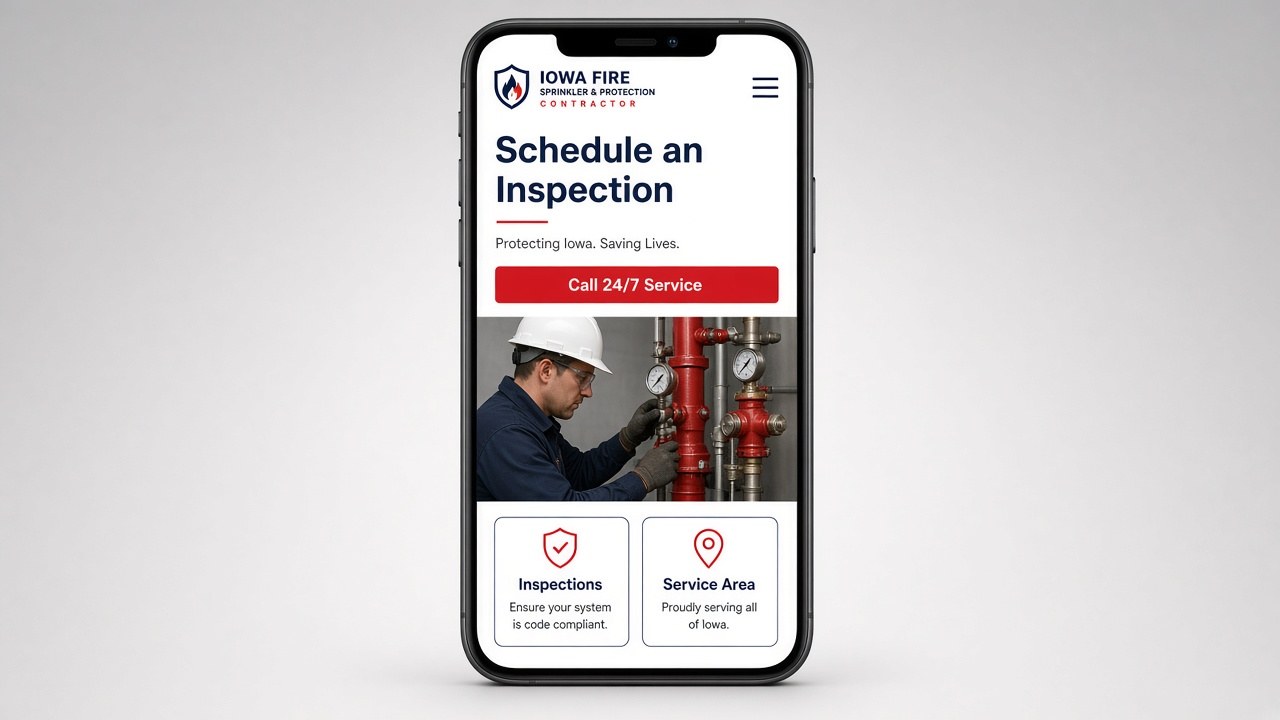
- Large headings, Schedule an Inspection and 24/7 Service near the top of every page, and tap-to-call numbers
- Navigation: Sprinklers, Inspections, Alarms, Suppression, Service Area, About, Careers, Contact
- Systems, service area, and licensing in real text, not images or PDFs, so search and AI can read them
- An inspection request form short enough to fill out on a phone
- You own the domain, hosting, and content, not a vendor
What Upley does for fire protection contractors
Upley builds and hosts websites for Iowa and Midwest businesses. For a fire protection contractor that means a clean first screen, a page for every system you work on, a plain inspection page that brings in recurring contracts, licensing in text buyers can check, an emergency path that works on a phone, and a careers page that brings in fitters and techs. We also make it easy to post a few photos from the job with a short caption to your website, social, and Google Business.
Same Iowa web team that ran Big Ten Web Design, handling design, hosting, and SEO, plus the modern layer so search and AI can find the true facts about your company.
If your current site is one services page and a contact form, start with the five first-screen facts and an inspection page. Then add system pages one at a time, starting with the work you want more of.
Book 30 minutes
Thirty minutes. Iowa time. No deck.
Iowa City, Cedar Rapids, Quad Cities / Davenport