
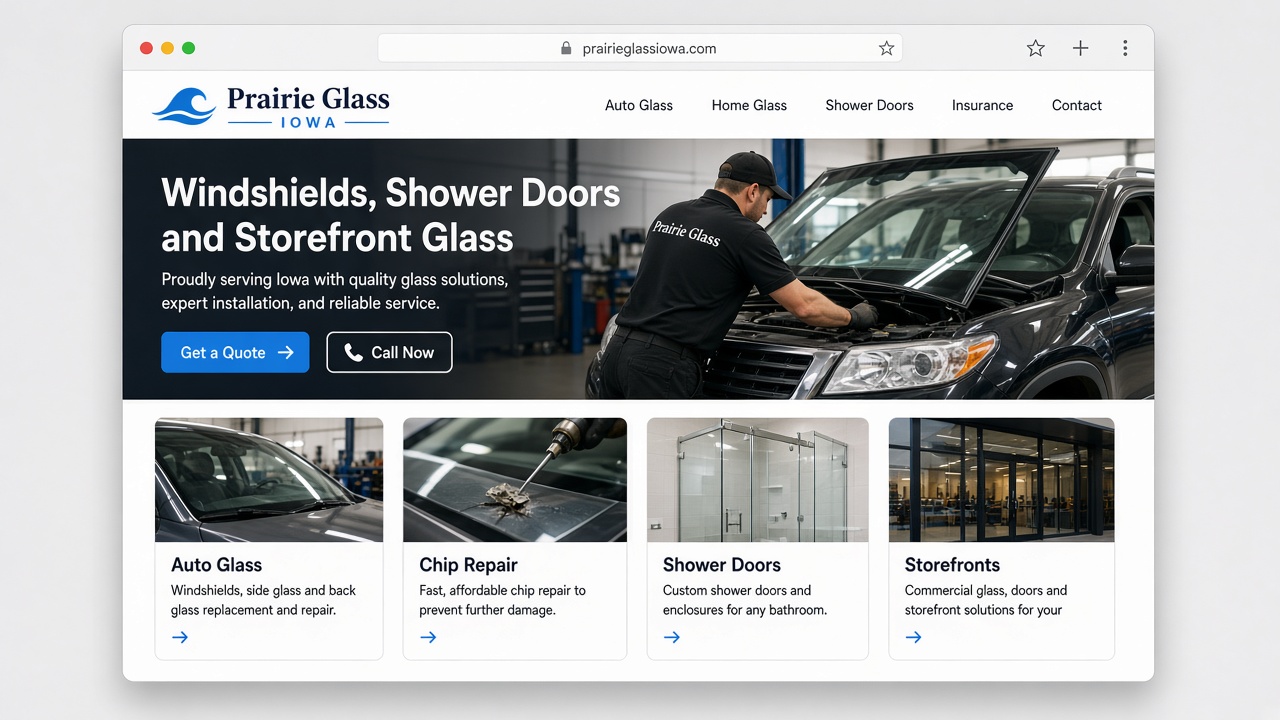
A glass shop’s website has one job: help someone with a cracked windshield, a foggy window, or a broken storefront see right away what you fix, where you go, and how to get a quote or an appointment. Put your services, service area, insurance steps, and phone number in plain text on a site you own. That is the marketing. Design is making “Get a Quote” and “Call Now” easy to hit from a phone in a parking lot.
Most glass shops run on word of mouth, body shop referrals, insurance networks, and contractors who call the same shop every time. That still works. But a lot of glass work starts with a rock on the interstate or a ball through a window. The person did not plan for it, does not have a shop in mind, and grabs a phone. More and more, they ask an AI assistant. The shop whose site lays out the plain facts gets named.
Who is reading the site
Glass shop sites get a few very different readers.
Drivers with a chip or crack. They want to know if you can fix it or if it needs replacing, if you come to them, how soon, and how insurance works.
Homeowners. Foggy double-pane windows, a broken pane, a new shower door, a mirror for the bathroom, a glass tabletop. They want to know if you do that kind of job and what the next step is.
Business owners and property managers. A broken storefront, a door that won’t close right, an emergency board-up after a break-in. They want a number that answers.
Contractors and builders. They want to know if you handle storefront, shower enclosures, and mirrors on new construction and remodels, and who handles bids.
Search engines and AI assistants. When someone asks ChatGPT, Gemini, Grok, or Google who does mobile windshield replacement in Iowa City, or who fixes foggy windows near Cedar Rapids, those tools look for plain facts on pages they can read. A logo, a stock photo of a windshield, and “Call Today” do not give them much.
What the homepage has to say in the first screen
In plain HTML text, not baked into a graphic:
- What you do: auto glass, flat glass, or both, in a few words
- Your main services: windshield replacement, chip repair, shower doors, storefronts, window glass, or whatever you really do
- Your service area by city, and whether you offer mobile service
- Two clear buttons: Get a Quote and Call Now
- Your hours, and whether you take walk-ins
Keep the photo of your tech setting a windshield. Just put the words on top of it or beside it as real text.
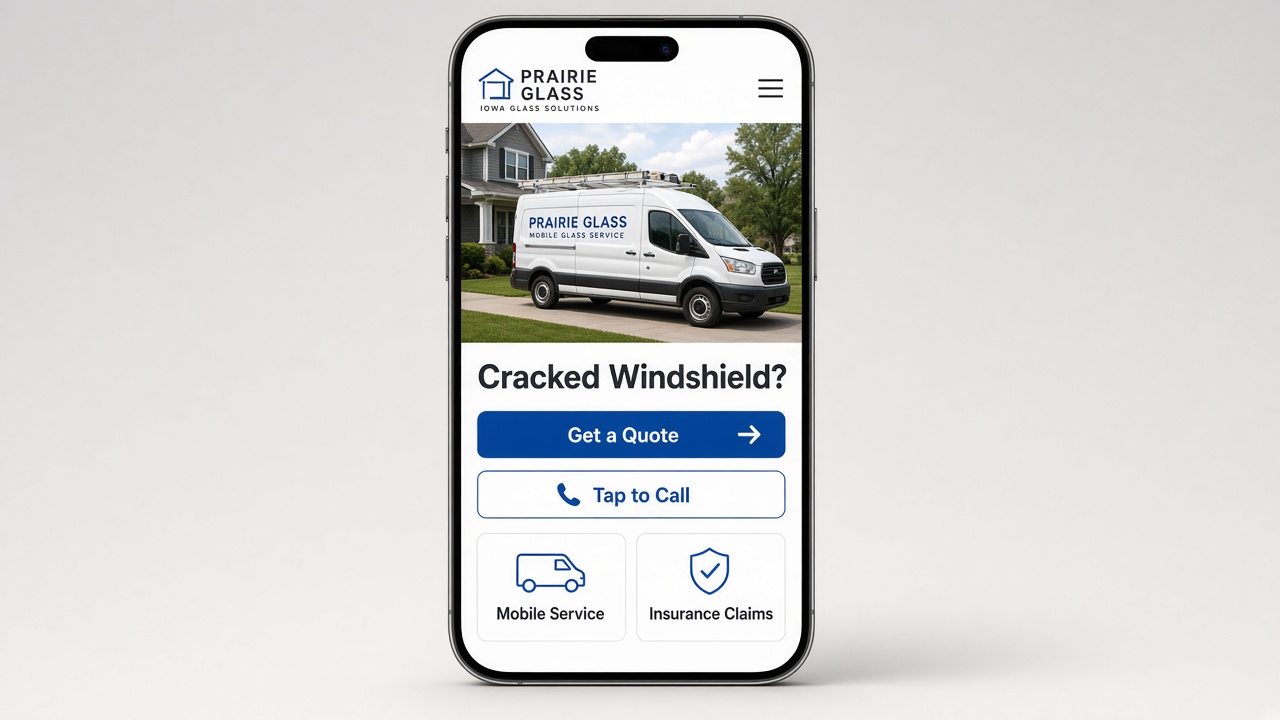
Auto glass: one page per service
This is where a lot of glass sites go thin. One “Auto Glass” page with a list does not answer much.
- Windshield replacement
- Chip and crack repair, with a plain note on when a repair works and when it needs a full replacement, as your techs would explain it
- Side and back glass
- Camera and sensor calibration, if you do it. Many newer vehicles have cameras mounted at the windshield, so say plainly whether you calibrate in house, send it out, or what the customer should expect
- Mobile service: what towns you drive to, what you need at the site, and what weather stops you
- Fleet and commercial vehicles, if you have accounts
Each page says what the job is in plain words, what kinds of vehicles you handle, how long it usually takes, the towns you cover, and ends with one button and one phone number. Add a photo from your own shop or a real driveway job, with the customer’s okay.
Insurance, in plain words
This is the question almost every auto glass customer has, and most shop sites skip it or bury it.
- Whether you work with insurance and bill the carrier directly, if you do
- What the customer should have ready: policy info, vehicle year, make, model, and VIN
- A plain note that coverage and deductibles depend on the customer’s own policy, so they should check with their agent
- Whether the customer gets to pick the shop, said the way your state and your experience back it up
- What happens if they pay out of pocket instead
Keep it short and true. A driver who has never filed a glass claim should read that page and know what to do next.
Flat glass: one page per job
Flat glass work is easy to miss on a site that leads with windshields. Give each kind of job its own page:
- Foggy or failed double-pane windows, and whether you replace just the glass unit or the whole window
- Broken window glass repair
- Shower doors and enclosures, with photos of your own installs
- Mirrors, wall mirrors, and gym mirrors
- Glass tabletops and shelves
- Storefront glass and commercial doors
- Emergency board-up, if you offer it, with the after-hours number at the top
Write each one the way you would explain it at the counter. What it is, what you need to measure or see, how long it takes, and how to get on the schedule.
Proof in plain text
People want to know they are calling a real shop.
- Your address, hours, and a photo of the building and the vans
- Years in business and who owns the shop, if you are comfortable sharing
- Certifications or training your techs actually hold, stated plainly as text
- Warranties stated in plain words: what is covered and for how long
- Real job photos with a short caption that names the job and the town, with the customer’s okay
Do not invent install counts or response times. State what you can back up.
Content that feeds search and AI without theater
Good pages for a glass shop read like the answers your counter gives every week:
- Can this windshield chip be repaired, or does it need replacing?
- Why does my car need a camera calibration after a new windshield?
- How long until I can drive after a windshield replacement?
- Why are my windows foggy between the panes, and do I need all new windows?
- What to know before ordering a frameless shower door
- What to do tonight if your storefront glass gets broken
Each one answers a real question. Add a photo from your own work. That is the kind of page that gets a shop named when someone asks who fixes windshields or foggy windows in their town.
Why the website matters more now
Websites and search are changing. They still matter, and for glass shops they matter more now. Bots now make a large share of web requests. Cloudflare’s Matthew Prince has said bots passed humans on Cloudflare’s network in mid-2026, about 57% bots and 43% humans. That counts HTTP requests, not hours of human attention. People still choose a shop they trust. More and more, ChatGPT, Gemini, Grok, and Google’s AI answers decide which shop they hear about first. Those tools look for clear facts: services, service area, mobile options, insurance steps, and how to reach you.
Your website should be the source of record. Your Google Business listing, Facebook page, insurance network listing, and body shop referrals can all point back to it. Keep the true services, coverage, and contact facts on a domain you own.
Design rules that fit a glass shop
- Real photos of your techs, vans, shop, and finished installs, compressed so pages load fast
- Large headings, Get a Quote and Call Now near the top of every page, and tap-to-call numbers
- Navigation: Auto Glass, Home and Business Glass, Shower Doors, Mobile Service, Insurance, Service Area, About, Contact
- Services, service area, and hours in real text, not images or PDFs, so search and AI can read them
- A quote form short enough to fill out on a phone, with a spot for vehicle info or a photo of the broken glass
- You own the domain, hosting, and content, not a vendor
What Upley does for glass shops
Upley builds and hosts websites for Iowa and Midwest businesses. For a glass shop that means a clean first screen, a page for every service you want more of, a plain insurance page, a quote form that works from a phone, and flat glass pages that get found on their own. We also make it easy to post a few photos from the job with a short caption to your website, social, and Google Business.
Same Iowa web team that ran Big Ten Web Design, handling design, hosting, and SEO, plus the modern layer so search and AI can find the true facts about your shop.
If your current site is one page with a phone number, start with the five first-screen facts and an insurance page. Then add service pages one at a time, starting with the work you want more of.
Book 30 minutes
Thirty minutes. Iowa time. No deck.
Iowa City, Cedar Rapids, Quad Cities / Davenport