
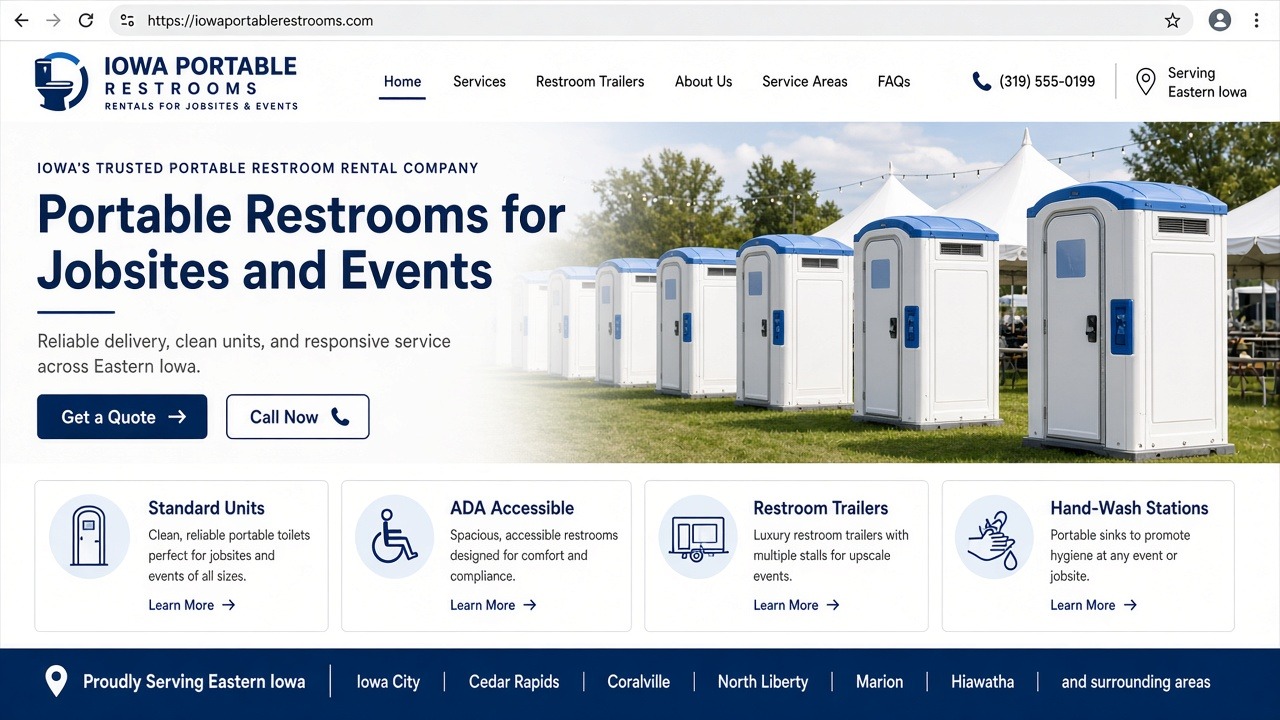
A portable toilet rental website should answer what a contractor, event planner, or homeowner asks before they book: which unit types you deliver, how often units get cleaned, whether the job is a one-day wedding or a multi-week jobsite, what the site must provide for the truck, which towns you serve, and how to get a quote or call. Put those facts in plain text on pages you own. That is the marketing. Design is the layout that makes those facts easy to find on a phone and easy for search and AI to cite.
Many portable restroom companies lean on a Facebook page, a Google Business listing, or a truck wrap alone. Those help, but they often skip unit type pages, pump schedules, and a clear event vs construction path. The company that posts clear unit lists, real delivery photos, and a quote-or-call path on a site it owns gets callers who already know what they need.
Who is reading the site
Portable toilet rental traffic comes from a few groups.
General contractors and site supers who need units for a jobsite by Monday, plus a pump schedule that matches the crew size.
Event planners, fair boards, and venue managers booking a wedding, festival, race, or outdoor concert. They want ADA units, restroom trailers, hand-wash stations, and a delivery window tied to setup day.
Municipalities and parks departments ordering for a season of games or a weekend event. They want quantity, duration, and who to call if something fails.
Homeowners renting for a backyard party, graduation, or construction project at the house. They want a simple path: size, price range rules, delivery day, and pickup.
Search engines and AI assistants. When someone asks ChatGPT, Gemini, Grok, or Google for portable toilets near Iowa City, or ADA restrooms for a Cedar Rapids festival, those tools look for plain facts on pages they can read. A logo and “Call Today” do not give them much.
What the homepage has to say in the first screen
In plain HTML text, not baked into a graphic:
- Company name and the towns you serve
- What you rent: standard units, ADA/accessible, restroom trailers, hand-wash stations — named in a few words
- Phone that reaches someone who books deliveries
- Two clear buttons: Get a Quote and Call Now
- A short note on lead time — same-day or weekend delivery when you offer it, or how far ahead to reserve
A planner comparing three companies on a Tuesday afternoon wants to see unit types, event vs jobsite paths, and how to book fast.
One page per unit type
This is where a lot of portable restroom sites go thin. One “Units” page with a photo grid does not answer much.
- Standard portable toilets — when they fit (small crews, short events), capacity notes in plain language
- ADA / accessible units — when they are required or wise, and that you can deliver them with standards
- Luxury / restroom trailers — for weddings and upscale events; what is inside, power or water needs if any
- Hand-wash stations and sanitizer stations — how many people they support and when you recommend pairing them with units
- Specialty options you actually carry: high-rise, urinal banks, solar lights, winter packages — only what you stock
Each page says what the unit is in plain words, when it fits, what the customer needs at the site, and ends with Get a Quote and Call Now. Add a photo from your own yard or a real delivery, with the customer’s okay.
Event vs construction: two clear paths
Event planners and contractors book differently. Give each path its own page or a clear split on the homepage.
Events (weddings, festivals, races, outdoor concerts)
- Quantity and guest-count guidance in plain language (not a fake formula you cannot back up)
- Delivery and pickup windows tied to setup and teardown
- ADA and trailer options called out
- Weekend and holiday delivery notes if that is part of how you work
- What the venue must provide: level ground, truck access, and who meets the driver
Construction / jobsites
- How many units for crew size, stated as advice you actually give on the phone
- Weekly or multi-week rental terms
- Pump and service frequency options
- Same-day or next-day add-ons when a crew grows mid-job — only if you typically offer that; say it as what to publish, not a claim about a company you do not run
- Access notes for muddy sites, gates, and after-hours drop
Split the quote form too: Event or Construction as the first choice. That alone cuts back-and-forth.
Service frequency / pump schedule page
Competitors almost always skip this. Contractors and fair boards ask it every week.
Publish a plain page that covers:
- How often units get cleaned and pumped on a multi-day event
- Typical jobsite service (for example weekly, twice weekly, or as needed) — stated as your real options
- What “service” includes: pump, restock supplies, wipe-down, or whatever you actually do
- How to request an extra service mid-rental
- Holiday and weekend service rules
- What happens if a unit is full before the next scheduled visit
Keep it short and true. A site super should read that page and know what they are buying.
Delivery, site requirements, and emergency add-ons
Logistics rules matter as much as the unit list.
- Towns and counties you serve, named in plain text — Iowa City, Coralville, North Liberty, Cedar Rapids, Davenport, and surrounding towns if that is your map
- Delivery windows and how far ahead to book for fair week or peak wedding season
- Site requirements: level ground, truck access width, soft ground limits, and where units can sit
- Same-day, next-day, and weekend delivery — only state what you typically offer; update when the truck is booked solid
- Emergency add-ons mid-event or mid-job: extra units, extra hand-wash, extra pump — how to request them and what response time you can honestly promise
- Whether you deliver outside your core map, and any travel fee
Update the list when towns or windows change. An outdated “same-day everywhere” claim wastes both sides’ time when the truck is already out.
Proof in plain text
People want to know they are calling a real yard.
- Your address, hours, and a photo of the yard and trucks
- Years in business and who owns the company, if you are comfortable sharing
- Insurance and licensing facts that are true for your company
- Real delivery photos with a short caption that names the town and the job type (event or construction), with the customer’s okay
- Reviews on a page you own, plus a link to Google Business
Do not invent unit counts or response times. State what you can back up.
The quote path is the conversion
A good quote request asks for:
- Event or construction / jobsite
- Preferred unit types and quantity (or guest count / crew size)
- Delivery address and preferred drop window
- How many days or weeks on site
- Whether ADA units or a restroom trailer are needed
- Pump / service frequency preference
- Contact phone and email
- How they heard about you
Say how confirmations and delivery windows work. Put the quote page on its own URL so Google Business posts, Facebook bios, and AI answers can link to it. Keep Call Now in the header for people who need restrooms this weekend.
Content that feeds search and AI without theater
Useful posts for a portable toilet rental company read like notes from the dispatcher:
- Standard vs ADA vs restroom trailer — which fits a wedding, a race, or a jobsite
- How often portable toilets should be serviced on a multi-day event
- What the site must provide before our truck arrives
- Same-day and weekend delivery — how our booking windows work
- Towns you added this year, with honest access notes
Each one answers a real question. Add a photo from your own delivery. That is the kind of page that gets a company named when someone asks who rents portable restrooms near them.
Why the website matters more now
Websites and SEO are changing. They still matter, and for portable toilet rental companies they matter more now. Bots now make a large share of web requests. Cloudflare’s Matthew Prince has said bots passed humans on Cloudflare’s network in mid-2026, about 57% bots and 43% humans. That counts HTTP requests, not hours of human attention. People still book units for real jobsites and real events. More and more, ChatGPT, Gemini, Grok, and Google’s AI answers decide which companies a new customer hears about first. Those tools look for clear facts: unit types, pump schedules, event vs construction paths, towns served, and how to get a quote.
Your website should be the source of record. Facebook, Google Business, and lead apps can point back to it. Keep the true unit list, service rules, job proof, and quote path on a domain you own.
Design rules that fit a portable toilet rental company
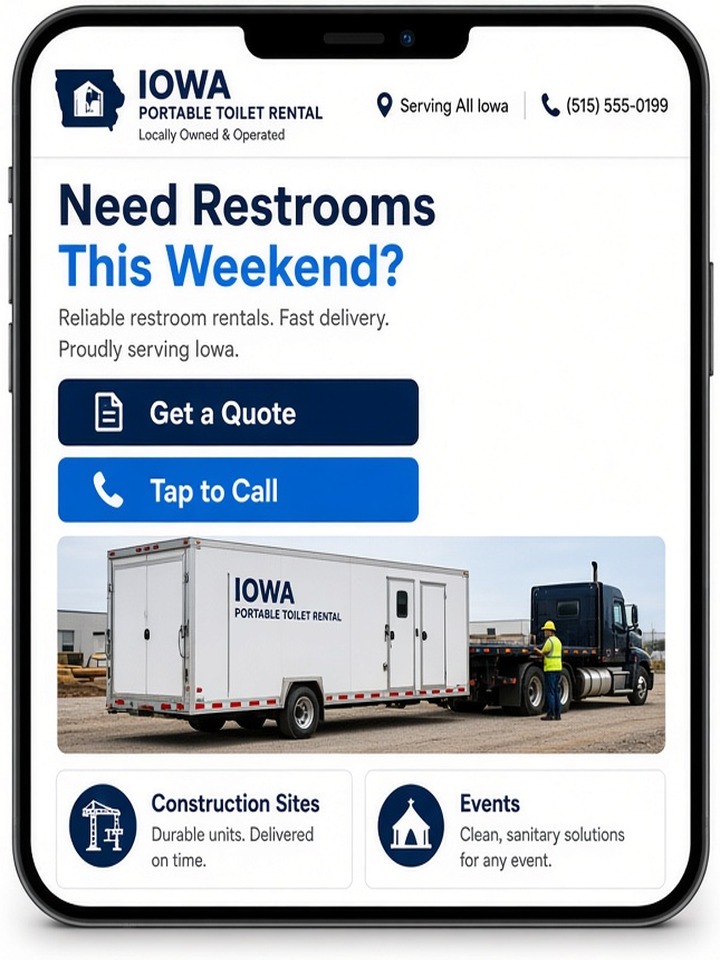
- Fast on mobile, with large unit cards and real text captions
- Get a Quote and Call Now one tap from any page
- Navigation: Units, Events, Construction, Service Schedule, Delivery, Service Area, About, Reviews, Get a Quote
- Services, towns, and hours in real text, not images or PDFs
- No fake reviews, and no photos of other companies’ trucks
- You own the domain, hosting, and content
What Upley does for companies like this
Upley builds and hosts websites for Iowa and Midwest businesses. For a portable toilet rental company that means clear unit type pages in plain text, a pump and service schedule page, separate event and construction paths, delivery and service-area notes that stay current, a quote path that works on a phone, hosting that stays up for daily crawls, and an easy way to post real delivery photos with captions.
Same Iowa web team that ran Big Ten Web Design, handling design, hosting, and SEO, plus the modern layer so search and AI can find the true file about your units, towns, and how to book.
If your current site is mostly a logo and a link to Facebook, start with the homepage five facts, unit type cards, and a quote button. Then add the service schedule page and the event vs construction split.
Book 30 minutes
Thirty minutes. Iowa time. No deck.
Iowa City, Cedar Rapids, Quad Cities / Davenport