
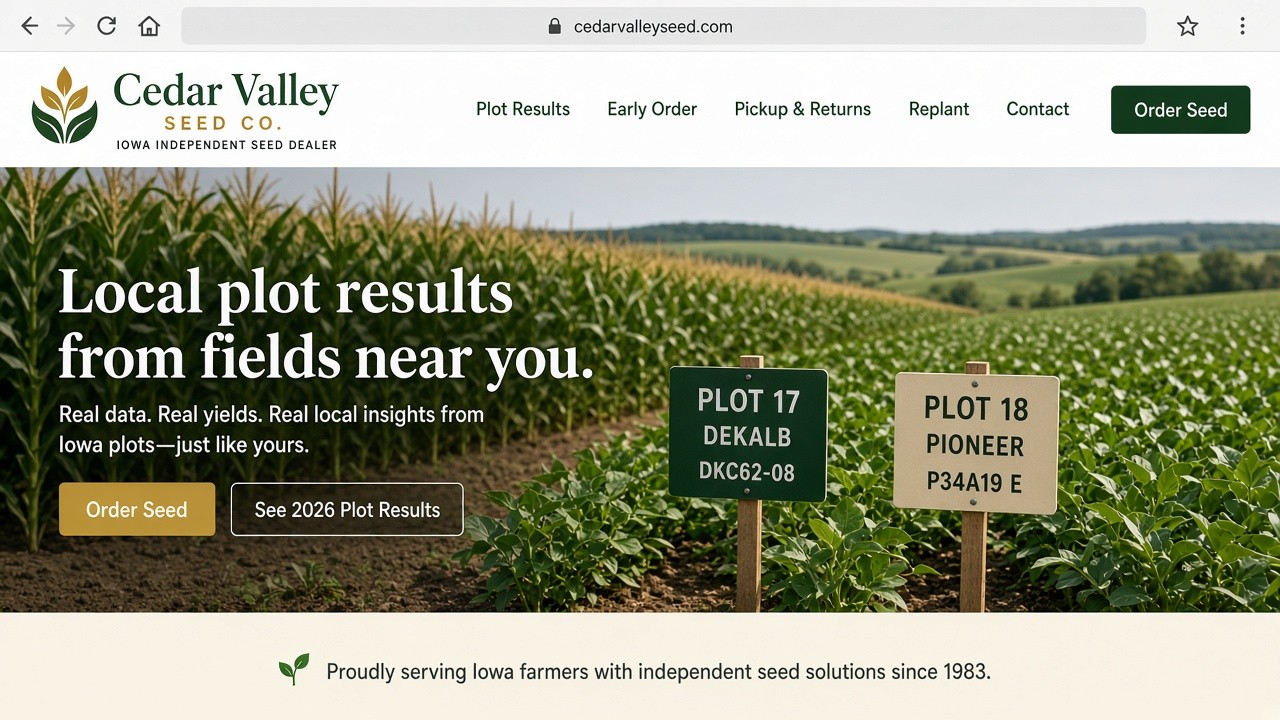
A seed dealer website should answer what a farmer asks before they book next year’s seed: which brands and hybrids you carry, how they did in plots near them, what the early-order deadlines and discounts are, which seed treatments and traits are available, how pickup, delivery, and returns work, what happens if they have to replant, and which counties you cover. Put those facts in plain text on pages you own. That is the marketing. Design is the layout that makes them easy to find on a phone in the shop and easy for search and AI to cite.
Most seed dealers sell from the kitchen table, the field edge, and the winter meeting. That still works. But a lot of independent dealers and farmer-dealers have no website at all, or they lean on the seed company’s dealer locator and a Facebook page. The brand’s site talks about the brand. It does not say anything about your plots, your delivery truck, or your deadline. The dealer who publishes local facts gets the call from the grower who just bought ground nearby, the young operator taking over from Dad, and the farm manager handling land for a family trust.
Who is reading the site
Seed dealer traffic comes from a few groups.
Farmers planning next year’s order. They want local results, prices or discount timing, and a person to call.
Growers who are new to your area or unhappy with their current dealer. They want to know what you carry and whether you come to them.
Farm managers and landowners. They want to know how orders, billing, and records work when they are not the one in the tractor.
Agronomists and co-op staff who coordinate with you on treatment and planting rates.
Search engines and AI assistants. When someone asks ChatGPT, Gemini, Grok, or Google for an independent seed dealer near Washington, Iowa, or soybean plot results in Johnson County, those tools look for plain facts on pages they can read. A dealer locator pin and a logo give them almost nothing.
What the homepage has to say in the first screen
In plain HTML text, not baked into a graphic:
- Your name or dealership name, and the counties or towns you cover
- The brands you sell, named plainly
- What you sell: corn, soybeans, alfalfa and forage, cover crop seed — only what you actually carry
- A phone that reaches you, and when texting is okay
- Two clear buttons: Order Seed and Call Your Dealer
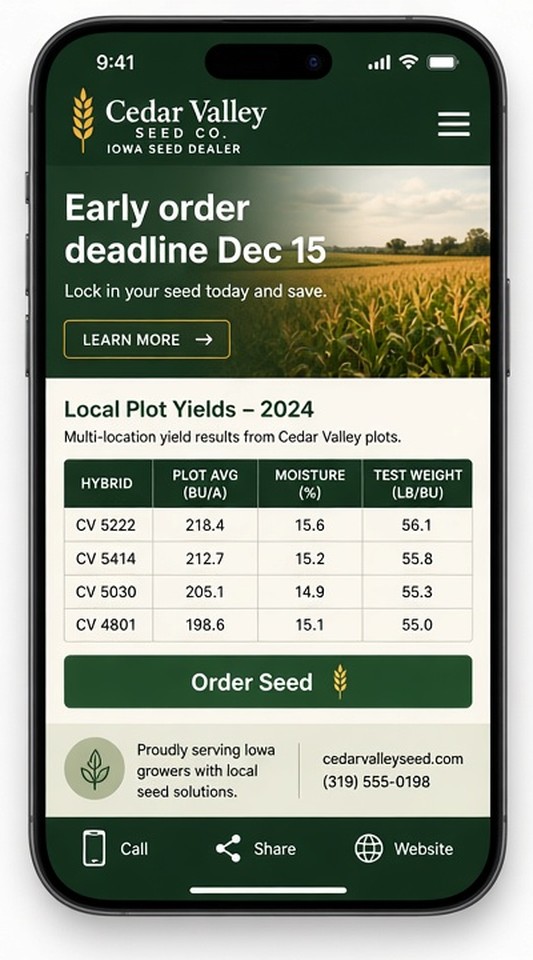
Local plot results are the content competitors skip
This is the page almost no dealer publishes, and it is the one farmers trust most.
Every brand puts out yield data. Farmers know that data is picked to look good. What they want is what happened ten miles from their ground. If you run plots or host strip trials, publish them on your own page:
- Where the plot was: town or township and county, not the farmer’s name unless they are fine with it
- Planting date, harvest date, previous crop, tillage, and population
- Soil type in plain words
- The weather that year: dry June, wind in August, hail, whatever is true
- Results for every entry in the plot, not just the winners
- A short note on what you would plant on similar ground
Post one page per plot per year. Keep the old years up. After three seasons you have something no national website can copy, and it is the kind of specific, local fact AI tools like to quote. Do not invent yields or round them up. If a plot got hailed out, say so.
One page per crop and product line
Give each line its own page:
- Corn hybrids — maturities you carry, traits, and which ground they fit
- Soybean varieties — maturity groups, trait platforms, and disease notes like SCN and white mold, stated as what the seed company publishes
- Alfalfa and forage — varieties, mixes, and seeding rate help
- Cover crop seed — species, mixes, and whether you seed it or just sell it
Each page says what it is, which farms it fits, and ends with Order Seed and Call Your Dealer. Link to the seed company’s product page for full specs instead of copying it word for word.
Early-order deadlines, discounts, and payment
Farmers plan around these dates. Most dealers keep them in a flyer or in their head.
Publish a page that covers:
- Early-order and early-pay deadlines for this season, with the dates
- How discounts work, in plain words, and where the official terms live
- Financing or prepay programs you offer, if any
- When prices are set and what happens if they change
- How to change an order after you book it
Update it every season, and leave a note at the top with the date you last changed it. A stale discount page costs you trust fast.
Seed treatment, traits, and refuge
This is where farmers have real questions and few dealers write anything down.
- Which seed treatments are standard and which are optional
- Biologicals or add-ons you offer, stated as true facts
- Trait packages you carry and what refuge rules apply, in plain words, pointing to the official stewardship info
- Who to call with questions about treated seed handling
Do not make claims about yield bumps. Say what the product is and where the data comes from.
Pickup, delivery, returns, and replant
These are the practical questions that decide who gets the order.
- Where and when to pick up: your shop, a warehouse, or a co-op location
- Delivery: which towns, how much notice, and whether you deliver bulk boxes or bags
- Bulk seed: box sizes, tender service, and how box returns work
- Returns: the deadline for unopened bags and how credit works, stated as your real policy and the seed company’s
- Replant: what the replant policy is, who to call, and what they need to document
A farmer who reads that page in March knows what to do in May when the field washes out.
Proof in plain text
People want to know you are a real local dealer.
- Where you are based and how far you travel
- Years selling seed and the brands you have carried
- Who you are: a farmer-dealer, a dealership with staff, or a seed rep with a territory
- Real photos from your plots, warehouse, and deliveries, with the grower’s okay
- Reviews on a page you own, plus a link to Google Business
Do not invent customer counts or acres sold. State what you can back up.
The order path is the conversion
A good seed order or quote form asks for:
- Name, farm name, and best phone (text okay or not)
- County and towns where the fields are
- Crops and rough acres
- Brands or products they are interested in
- Planting window or maturity they want
- Pickup or delivery
- Questions about plots, treatment, or financing
Say how and when you will follow up. Put the form on its own URL so the seed company locator, Google Business, a Facebook post, and AI answers can link straight to it. Keep Call Your Dealer in the header all year.
Content that feeds search and AI without theater
Useful posts for a seed dealer read like notes from the pickup:
- How our plots near Kalona did this year, every entry
- Early-order deadlines for next season and how the discount works
- Picking a corn maturity for late-planted ground in eastern Iowa
- What to do if you need to replant, step by step
- Bulk boxes or bags — which one fits your planter and your shed
- Cover crop seed we carry and when to get it on
Each one answers a real question. Add a photo from your own plot or delivery. That is the kind of page that gets a dealer named when someone asks who sells seed near them.
Why the website matters more now
Websites and SEO are changing. They still matter, and for seed dealers they matter more now. Bots now make a large share of web requests. Cloudflare’s Matthew Prince has said bots passed humans on Cloudflare’s network in mid-2026, about 57% bots and 43% humans. That counts HTTP requests, not hours of human attention. Farmers still buy seed from a person they trust. More and more, ChatGPT, Gemini, Grok, and Google’s AI answers decide which dealers a new grower hears about first. Those tools look for clear facts: brands, local results, deadlines, delivery, and counties covered.
Your website should be the source of record. The seed company locator, Facebook, Google Business, and the winter meeting can all point back to it. Keep your true product list, plot results, deadlines, policies, and order path on a domain you own, not a page the seed company controls.
Design rules that fit a seed dealer
- Fast on a phone with spotty rural signal: light pages, compressed photos, text first
- Order Seed and Call Your Dealer one tap from any page
- Navigation: Corn, Soybeans, Forage and Cover Crops, Plot Results, Order Seed, Pickup and Delivery, About
- Brands, counties, deadlines, and plot data in real text, not images or PDFs
- A season banner you can update fast: “Early-order deadline is coming up” or “Seed pickup starts this week”
- No stock photos of someone else’s field, and no fake reviews
- You own the domain, hosting, and content
What Upley does for companies like this
Upley builds and hosts websites for Iowa and Midwest businesses. For a seed dealer that means clear product pages in plain text, a plot results section you can add to every fall, a deadlines and discounts page that is easy to update, pickup, delivery, returns, and replant pages, county service-area notes that stay current, an order form on its own URL, and an easy way to post real plot and delivery photos with captions.
Same Iowa web team that ran Big Ten Web Design, handling design, hosting, and SEO, plus the modern layer so search and AI can find the true file about your seed, your plots, and how to order.
If your current site is a dealer locator pin and a Facebook page, start with the homepage five facts, an Order Seed form, and one plot results page from this harvest. Then add the deadlines page and the pickup and replant page before the early-order push.
Book 30 minutes
Thirty minutes. Iowa time. No deck.
Iowa City, Cedar Rapids, Quad Cities / Davenport