
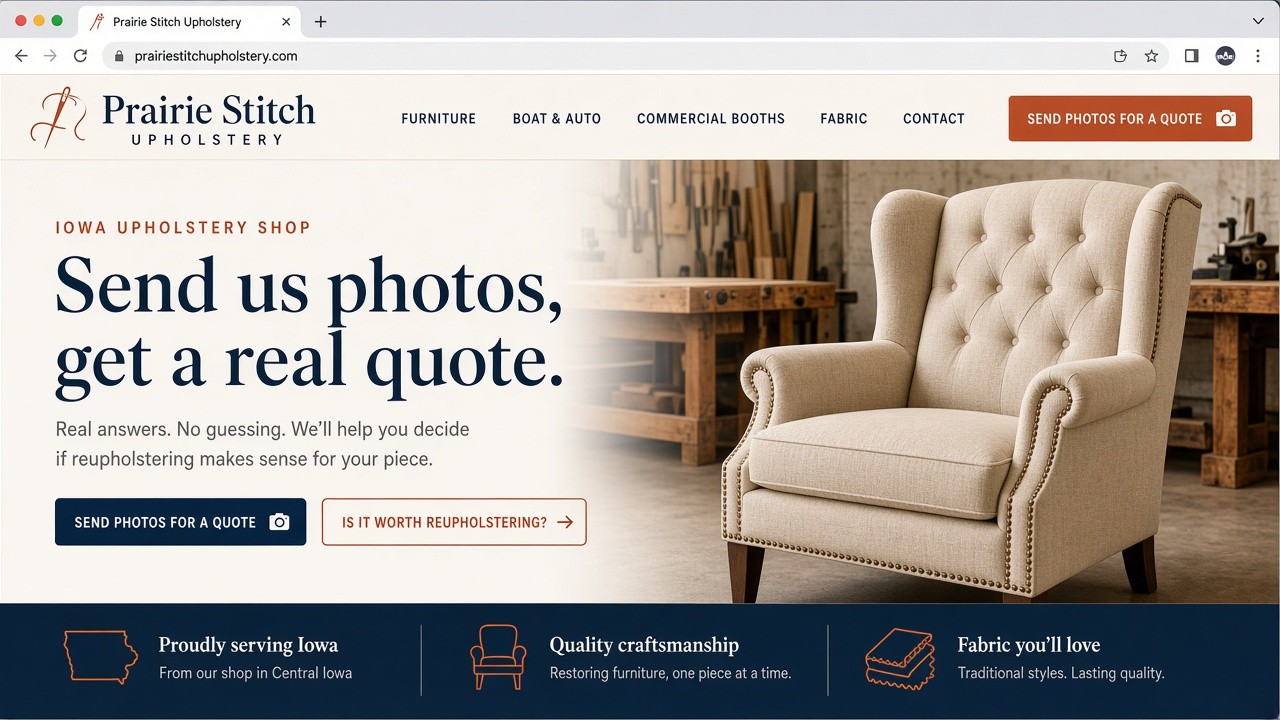
An upholstery shop website should answer what people ask before they haul a chair to your door: what you work on, how to get a quote from photos, what drives the price, how much fabric a piece takes, whether they can bring their own fabric, whether the frame and foam are worth saving, how long it takes, and how pickup and delivery work. Put those answers in plain text on pages you own. That is the marketing. Design is the layout that makes them easy to read on a phone and easy for search and AI to cite.
Most upholstery shops run on word of mouth, a Facebook page, and a phone that rings while your hands are full of staples. That still works for the people who already know you. But the person with Grandma’s wingback, the boat owner with cracked seats, and the restaurant owner with torn booths usually start by asking a phone or an AI assistant. If your site is one page with a logo and a phone number, you are not part of that answer.
Who is reading the site
Upholstery traffic comes from a few groups.
Homeowners with a piece they care about. Often it is a family chair, an antique, or a good sofa with a tired cover. They want to know if it is worth it and roughly what it costs.
Boat, RV, car, truck, and tractor owners. They want marine vinyl, seat repair, and a timeline that fits the season.
Restaurants, bars, churches, clinics, and offices. They want booths, pews, waiting room chairs, and work done when they are closed.
Designers and furniture stores. They want to know if you take trade work and how you handle their fabric.
Search engines and AI assistants. When someone asks ChatGPT, Gemini, Grok, or Google who reupholsters dining chairs near Cedar Rapids, or whether it is worth reupholstering a recliner, those tools look for plain facts on pages they can read. A photo gallery with no words gives them almost nothing.
What the homepage has to say in the first screen
In plain HTML text, not baked into a graphic:
- Your shop name, the town you are in, and the area you serve
- What you work on: furniture, antiques, cushions, boat and auto seats, commercial booths — only what you actually do
- How to get a quote, including send photos
- A phone that reaches the shop, your hours, and whether texting is okay
- Two clear buttons: Send Photos for a Quote and Call the Shop
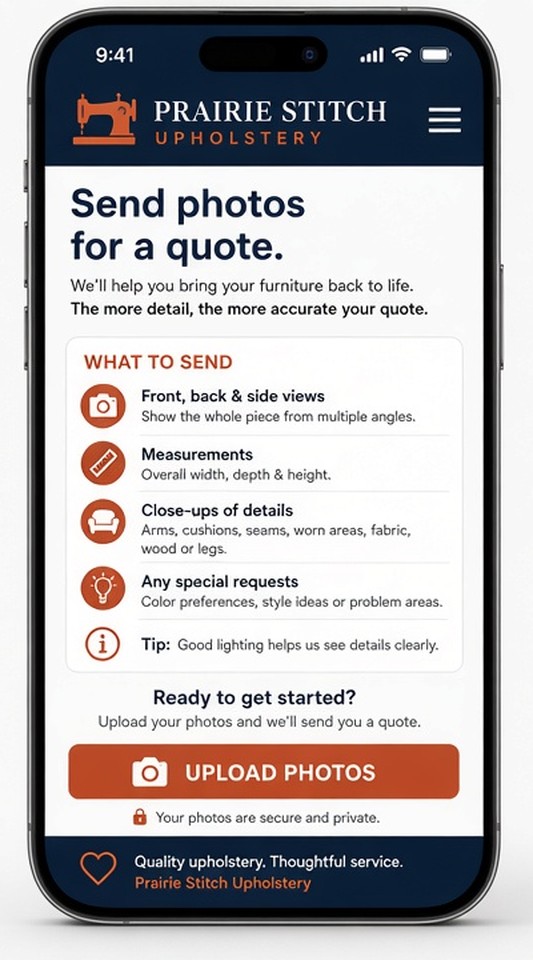
The send-photos quote page is the page competitors skip
Most shops say “call for a quote.” Then they spend the call asking for the same five things every time. Write those things down and let people send them.
A good quote page tells the customer exactly what to send:
- A straight-on photo of the whole piece, plus the back and sides
- Close-ups of worn spots, torn seams, and sagging cushions
- A photo under the seat or cushion if they can get one
- Rough measurements: width, depth, and height
- Whether they have fabric picked, want to see samples, or want to bring their own
- Their town and whether they need pickup
Then say what happens next: who looks at the photos, how fast you reply, and that a photo quote is a range until you see the piece in person. That one page saves you phone time and gives AI tools a clear, quotable answer to “how do I get an upholstery quote.”
Explain what drives the price
People are afraid to call because they think the answer will be a shock. You do not have to post a price list. Explain the parts of the price in plain words:
- Labor, based on the piece: a dining seat, a wingback, a sofa, a sectional, a booth run
- Fabric, and roughly how many yards common pieces take
- Foam, batting, springs, and webbing if they need replacing
- Frame repair, regluing, or refinishing the wood
- Extras like welting, tufting, skirts, and pattern matching
- Pickup and delivery
If you are comfortable with it, post honest starting ranges by piece type and date the page. If you are not, say so and explain why the photo quote is the fastest way to a real number. Either way, do not post a price you will not honor.
Is it worth reupholstering? Answer it
This is the question almost every customer has and almost no shop answers in writing.
Write a page that walks through it honestly:
- Solid hardwood frames and good springs are usually worth saving
- Particleboard or stapled-together frames often are not
- Family pieces and antiques may be worth it for reasons that are not about money
- When a new cover is enough and when the foam and springs need to go too
- When you will tell someone to buy new instead
The shop that will say “this one is not worth it” earns trust, and that page is exactly the kind of plain, useful answer AI assistants pull from.
Fabric, customer’s own material, and samples
Fabric questions slow down every job. Put the answers on a page:
- Which fabric lines you carry or order from, and whether samples can go home
- Whether you accept customer’s own material, and any rules on yardage, quality, or extra charges
- How much extra to buy for pattern matching
- Performance fabrics, leather, and marine vinyl, described as what they are and where they fit
- How long fabric orders usually take to arrive
Foam, frames, and cushion work
A lot of customers do not need a full reupholstery job. Give that work its own page:
- Cushion foam replacement and new cushion covers
- Seat cushions for kitchen chairs, benches, and window seats
- Frame repair and spring retying
- Outdoor cushions, if you do them
Small jobs are how a lot of people meet you. Make them easy to find.
Boat, auto, RV, and farm seats
If you do this work, it deserves its own pages, written for those buyers:
- Boat seats, bolsters, and marine vinyl
- Car and truck seats, headliners, and classic car interiors
- RV dinettes and couches
- Tractor and combine seats
Say what you do, what you do not, and the season. Spring is boat season. A page that says “Book boat seats before April” in plain text does more than any ad.
Commercial booths, pews, and seating
Restaurants and churches need a different page:
- Booth and banquette recovering, on site or in the shop
- After-hours and weekend work so they do not close
- Commercial-grade vinyl and cleanable fabrics
- Waiting room chairs, pews, and stools
- How you quote a whole room
Turnaround, pickup, and delivery
Write down the logistics people worry about:
- Typical turnaround by job type, and when the shop is backed up
- Drop-off hours and where to park
- Pickup and delivery, which towns, and the charge
- Deposits and when the balance is due
- What happens if fabric is backordered
Update the turnaround note when your backlog changes. A date at the top of the page tells people it is current.
Proof in plain text
People want to see that you do good work and that you are real.
- Before-and-after photos from your own shop, with a short caption: what the piece was, what you did, and the fabric
- Years in business and where you learned the trade
- Who does the work
- Reviews on a page you own, plus a link to Google Business
Do not invent job counts or post someone else’s photos. State what you can back up.
Content that feeds search and AI without theater
Useful posts for an upholstery shop read like notes from the bench:
- We recovered a 1960s rocker from Marion: what we kept and what we replaced
- How much fabric does a wingback chair take?
- New foam or new chair? How to tell before you spend money
- Boat seats: when to recover and when to replace
- What happens to your sofa the week it is in our shop
- Bringing your own fabric: what works and what to avoid
Each one answers a real question with your own photo. Snap a picture before you tear a piece down and again when it goes out the door. That is a post. That is the kind of page that gets a shop named when someone asks who reupholsters furniture near them.
Why the website matters more now
Websites and SEO are changing. They still matter, and for upholstery shops they matter more now. Bots now make a large share of web requests. Cloudflare’s Matthew Prince has said bots passed humans on Cloudflare’s network in mid-2026, about 57% bots and 43% humans. That counts HTTP requests, not hours of human attention. People still pick an upholsterer they trust. More and more, ChatGPT, Gemini, Grok, and Google’s AI answers decide which shops a customer hears about first. Those tools look for clear facts: what you work on, how quotes work, what drives cost, and where you are.
Your website should be the source of record. Facebook, Google Business, and word of mouth can all point back to it. Keep your true services, quote path, fabric rules, turnaround, and before-and-after work on a domain you own.
Design rules that fit an upholstery shop
- Fast on a phone: light pages, compressed photos, text first
- Send Photos for a Quote and Call the Shop one tap from any page
- Navigation: Furniture, Cushions and Foam, Auto and Boat, Commercial, Fabric, Our Work, Get a Quote
- Services, towns, turnaround, and fabric rules in real text, not images
- Before-and-after photos with captions, not a slideshow with no words
- No stock photos of someone else’s work, and no fake reviews
- You own the domain, hosting, and content
What Upley does for companies like this
Upley builds and hosts websites for Iowa and Midwest businesses. For an upholstery shop that means clear service pages in plain text, a send-photos quote form on its own URL, a pricing and fabric page you can keep current, separate pages for furniture, cushions, marine and auto, and commercial work, a turnaround note that is easy to update, and an easy way to post before-and-after photos with captions from your phone.
Same Iowa web team that ran Big Ten Web Design, handling design, hosting, and SEO, plus the modern layer so search and AI can find the true file about your shop, your work, and how to get a quote.
If your current site is one page and a Facebook link, start with the homepage five facts, a send-photos quote page, and three before-and-after posts from jobs you finished this month. Then add the “is it worth it” page and the fabric page.
Book 30 minutes
Thirty minutes. Iowa time. No deck.
Iowa City, Cedar Rapids, Quad Cities / Davenport