
A car dealer website should answer what a buyer asks before they drive over: is the truck still here, what’s the real price after fees, what will you give me for my trade, can I get financed, and what did you fix on this used car. Put those answers in plain text on pages you own. That is the marketing. Design is the layout that makes it easy to read on a phone in a parking lot, and easy for search and AI to cite.
Most dealer sites are a big rotating banner, an inventory feed with “Call for price,” and a pop-up chat box before the page finishes loading. The buyer still doesn’t know what the truck costs out the door.
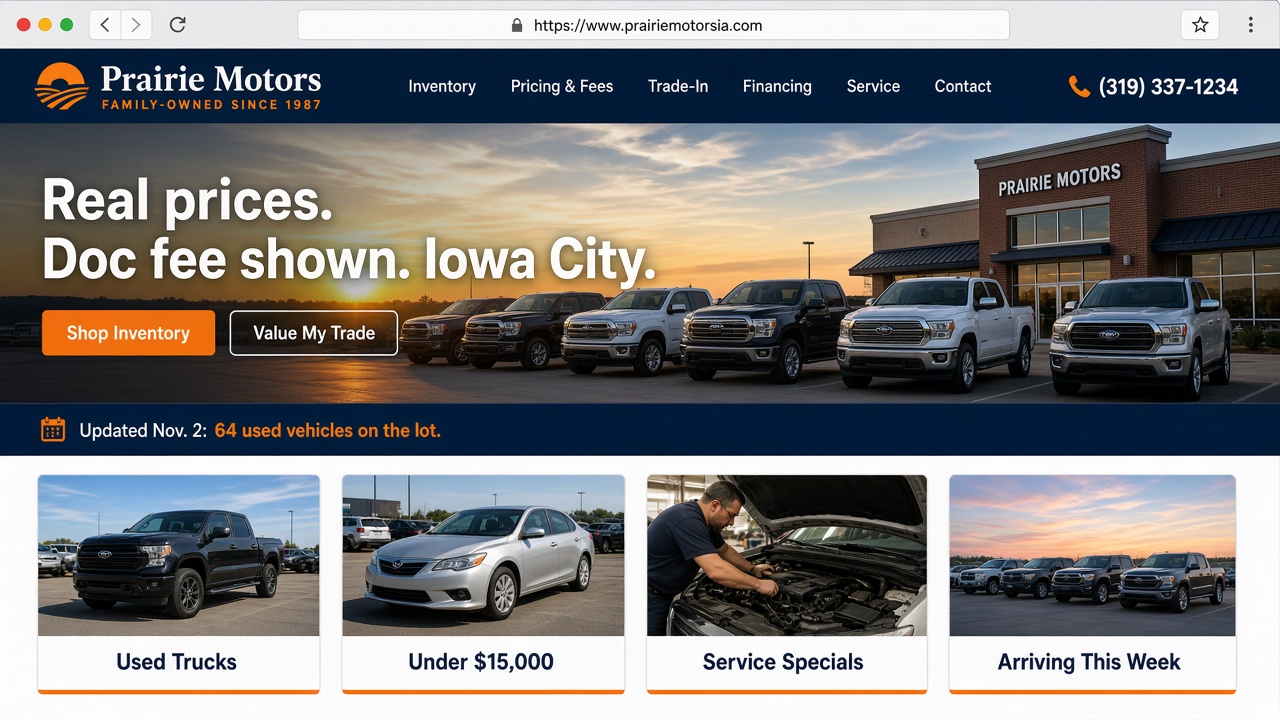
A dated inventory note
Inventory feeds go stale. A buyer who drives an hour for a truck that sold Tuesday doesn’t come back. Fix that on the site:
- One line at the top of the homepage with a date: “Updated Monday, Nov. 2: 64 used vehicles on the lot. Six trucks under $25,000. Three arriving this week.”
- Mark sold vehicles sold, and take them down within a day
- An Arriving This Week list for trade-ins still in the shop, with a way to get first call
- When you’re light on something, like third-row SUVs, say so and offer to find one
That line is what an AI assistant needs when someone asks “used trucks for sale near Cedar Rapids.”
An honest trade-in page
The trade is where buyers trust dealers least. Give them a page that explains how it works:
- How you figure a trade value: condition, miles, the auction market, what you’d have to fix
- Why an online estimate and the number on the lot can differ, said plainly
- What helps a trade: service records, both keys, a clean title
- Payoffs: how you handle a trade that still has a loan on it, and what upside-down means
- Whether you’ll buy a car outright even if they don’t buy one from you
No “we pay top dollar.” Just the process.
Financing, in plain English
People are nervous about credit. Answer them before they ask:
- Who you work with: banks, credit unions, captive lenders
- What happens to their credit when they apply, and when you pull it
- First-time buyers, thin credit, rebuilding credit: what’s realistic
- Down payment and term: what a longer loan really costs, with a simple example
- What you won’t do, if that’s true for you: no pressure on extended warranties, no surprise add-ons
Don’t post rates you can’t back up. Post the process.
The reconditioning checklist for every used car
This is the page almost no dealer has, and it’s the one that sells used cars. For every used vehicle, show what you checked and what you did:
- Your inspection list: brakes, tires with tread depth, fluids, battery, belts, lights, codes
- What you replaced, by part, with the date: “New front pads and rotors, two new tires, oil change, 10/28/2026”
- What you didn’t fix and why, so nothing is a surprise
- The vehicle history report link
- Whether it’s sold with a warranty or as-is, with a link to the buyer’s guide
A buyer who sees “two new tires and front brakes” in text trusts you more than one who sees “certified” in a starburst.
Service and parts, with prices
The service lane keeps a dealership going between car sales. Treat it like its own small business on the site:
- Prices for common work: oil change by type, tire rotation, alignment, battery, brakes
- Makes you service, including ones you don’t sell
- Wait time today, with a date, and whether you have loaners or a shuttle
- Winter prep: block heaters, batteries, tires, wipers, and when to come in before the first cold snap
- Online booking that goes to a real calendar, plus a phone number that a person answers
Who is reading the site
A dad shopping for a first car for his daughter, under $12,000, safe, and close to home.
A farmer who needs a three-quarter-ton truck with a hitch before harvest and wants to know if you’ll take his old one.
A nurse working nights who’s comparing prices on her phone at 2 a.m. and will only call if the price is posted.
Search engines and AI assistants. When someone asks “used car dealer in Iowa City with no hidden fees” or “where can I get a used truck with new tires near Davenport,” those tools look for plain facts on pages they can read. A banner and “Call for price” give them nothing.
What the homepage has to say in the first screen
In plain HTML text, not baked into a graphic:
- Your dealership name, your town, and what you sell: new, used, trucks, which makes
- Inventory count and price range, with the date
- What the posted price includes, including the doc fee
- Trade-ins, financing, and service in one line
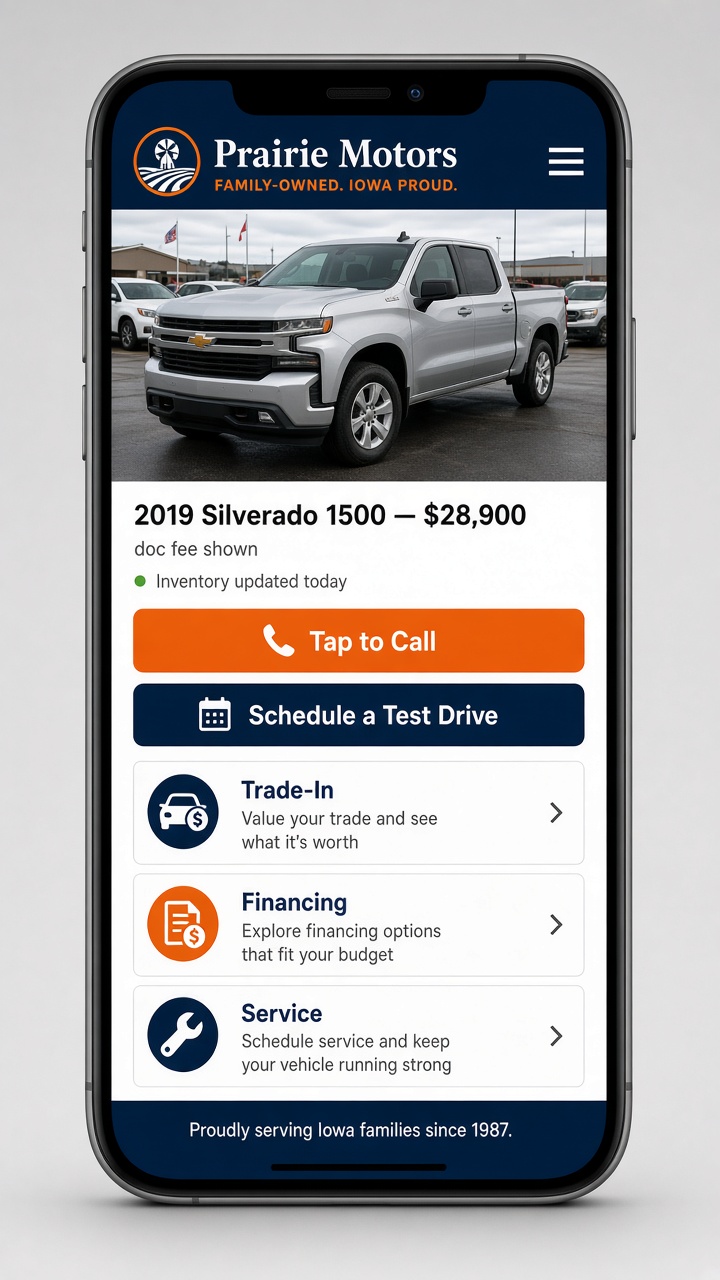
- Two clear buttons: Call, and Schedule a Test Drive
Proof in plain text
- Who owns it and who you’ll talk to, with real photos of the sales and service staff
- How long you’ve been in town, and how many cars you sold or serviced last year, if you track it
- Real reviews from buyers on a page you own, plus links to Google Business
- Your plain answer to the complaints every lot gets, like a trade value someone didn’t like, and what you do about it
Don’t invent awards or “number one” claims. State what you can back up.
Content that feeds search and AI without theater
Useful posts for a car dealer read like answers from the sales desk and the service lane:
- What the doc fee is and why we charge what we charge
- How we figure your trade value
- What we check on every used car before it goes on the lot
- Best used SUVs for Iowa winters under $20,000, from what’s on our lot
- How to buy a first car for a teenager
- When to put winter tires on, and what they cost here
Each one answers a real question with your own photo. Snap the trade-in getting new tires in the shop, or the truck that just came off the lift. That’s a post. That’s how a local dealer gets named when someone asks an AI assistant where to buy.
Why the website matters more now
Websites and SEO are changing. They still matter, and for a dealer they matter more now. Bots now make a large share of web requests. Cloudflare’s Matthew Prince has said bots passed humans on Cloudflare’s network in mid-2026, about 57% bots and 43% humans. That counts HTTP requests, not hours of human attention. Buyers still test drive and still sign. More and more, ChatGPT, Gemini, Grok, and Google’s AI answers decide which lots a buyer hears about first. Those tools look for clear facts: prices, fees, inventory, and what was fixed.
Your website should be the source of record. Listing sites, Facebook Marketplace, Google Business, and the manufacturer’s site can all point back to it. Keep your true prices, fees, and inventory on a domain you own, so you’re not paying a listing site for every lead.
Design rules that fit a car dealer
- Fast on a phone: most buyers shop on a phone, often from another dealer’s lot
- Call, text, and Schedule a Test Drive one tap from any page
- No pop-up chat covering the price before the page loads
- Navigation: Inventory, Pricing and Fees, Trade-In, Financing, Service, About, Contact
- Prices, fees, and reconditioning notes in real text, not images or PDFs
- Your own photos of your own cars on your own lot, not stock showrooms
- You own the domain, hosting, and content, not just a feed from an inventory vendor
What Upley does for car dealers
Upley builds and hosts websites for Iowa and Midwest businesses. For an independent or family car dealer that means plain-text pages for pricing and fees, a dated inventory note, an honest trade-in page, a financing page that answers the nervous questions, a reconditioning checklist on every used car, service prices, and an easy way to post a photo and a few words when a good trade comes in.
Same Iowa web team that ran Big Ten Web Design, handling design, hosting, and SEO, plus the modern layer so search and AI can find the true file about your lot, your prices, and what you fixed.
If your current site is a banner and “Call for price,” start with the homepage five facts and a pricing and fees page. Then add the trade-in page and the reconditioning checklist.
Book 30 minutes
Thirty minutes. Iowa time. No deck.
Iowa City, Cedar Rapids, Quad Cities / Davenport