
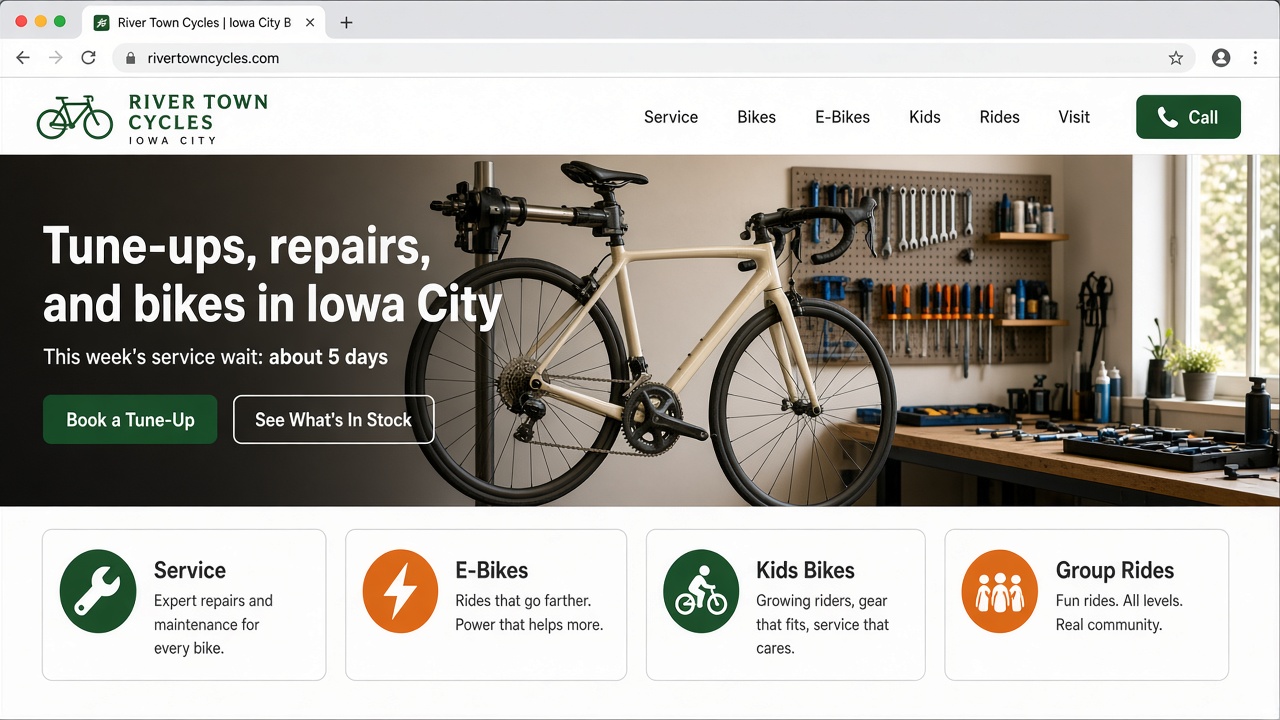
A bike shop website should answer what a commuter with a flat and a parent buying a first real bike both want to know: what a tune-up costs, how long you’ll have the bike, whether you have the right size on the floor, and whether they can ride it before they buy. Put those answers in plain text on pages you own. That is the marketing. Design is the layout that makes it easy to read on a phone and easy for search and AI to cite.
Most local bike shop sites are a brand logo wall, a link to a manufacturer’s catalog that shows bikes the shop doesn’t have, and a phone number. The person with a bike in the back of the car still has to call to find out if you can fit them in before the weekend ride.
A tune-up and repair price list
Service is the steady money in a bike shop, and it’s the part most sites hide. Post it:
- Your tune-up levels by name, what each one includes, and the price
- Common repairs with a starting price: flat fix, tube and tire, brake bleed, cable and housing, wheel true, chain and cassette
- Labor rate for anything not on the list
- Whether parts are extra, and roughly what common parts cost
- E-bike service: what you’ll work on, which motor systems, and whether there’s an extra charge
- Bikes bought somewhere else, including online and big-box: do you work on them, and is the price the same
A price list on the page tells someone you won’t surprise them at pickup. Use your own numbers and put the year on it.
A dated service wait time
In April every shop in Iowa is backed up, and nobody says so online. Put one line at the top of the service page and update it every week:
“Updated Monday, April 13: tune-ups are running about 8 days. Flats and small fixes are usually same day if you drop off before noon.”
That line saves you a dozen phone calls a day in spring, and it’s the plain fact an AI assistant can repeat when someone asks “which bike shop near me can fix my bike this week.”
What’s actually on the floor
A link to a manufacturer’s full catalog is not your inventory. A page you own that says what you really have works better:
- Bikes in stock by type and size, updated weekly, even if it’s a simple list
- What you can order, and how long special orders take right now
- Kids bikes by wheel size and the age range they usually fit
- Used and consignment bikes, with photos and prices
- Whether a customer can test ride, and what they need to bring
“We have 14 kids bikes on the floor right now, 16 to 24 inch” is the line that gets a parent in the car on Saturday.
E-bikes, honestly
E-bikes are the question everyone is asking, and most local shops answer it with a brand banner. Write the page:
- The classes of e-bikes in plain words, and where each one can ride in your area, including local trails that allow or ban them
- Real price ranges for what you carry
- Range, charging, and battery life in plain numbers, and what a replacement battery costs
- Whether you service e-bikes bought online, and what you can’t fix
- Test rides and demo days
When someone asks ChatGPT, Gemini, or Grok “is an e-bike worth it” or “can I ride an e-bike on the trail near me,” the answer gets built from pages like this. If yours is clear and local, your shop gets named.
Fitting, trade-ins, and storage
- Bike fitting: what it is, how long it takes, the price, and who should get one
- Trade-in or used-bike buying: how you price it and what condition you accept
- Winter tune-up specials and off-season storage, with dates and prices
- Rentals, if you do them, with daily rates and what’s included
Local rides and trails
This is the content a chain store or online seller can’t write. You know the roads.
- Shop group rides: day, time, pace, distance, and whether it’s no-drop
- Your favorite local trails and routes, with honest notes on surface and difficulty
- Trail conditions after rain, when you know them
- Local events and races you support, with dates
A page called “Five rides from our front door” is local, original, and exactly what an AI assistant needs when a visitor asks where to ride in your town.
Who is reading the site
A college student whose bike got a flat on the way to class, looking for the nearest shop that’s open.
A dad trying to figure out what size bike a 7-year-old needs before he drives across town.
A retired couple looking at e-bikes for the trail, wondering what they cost and whether they’re hard to ride.
Search engines and AI assistants. When someone asks “bike tune-up price near me” or “bike shop in Iowa City that works on e-bikes,” those tools look for plain facts on pages they can read. A logo wall gives them nothing.
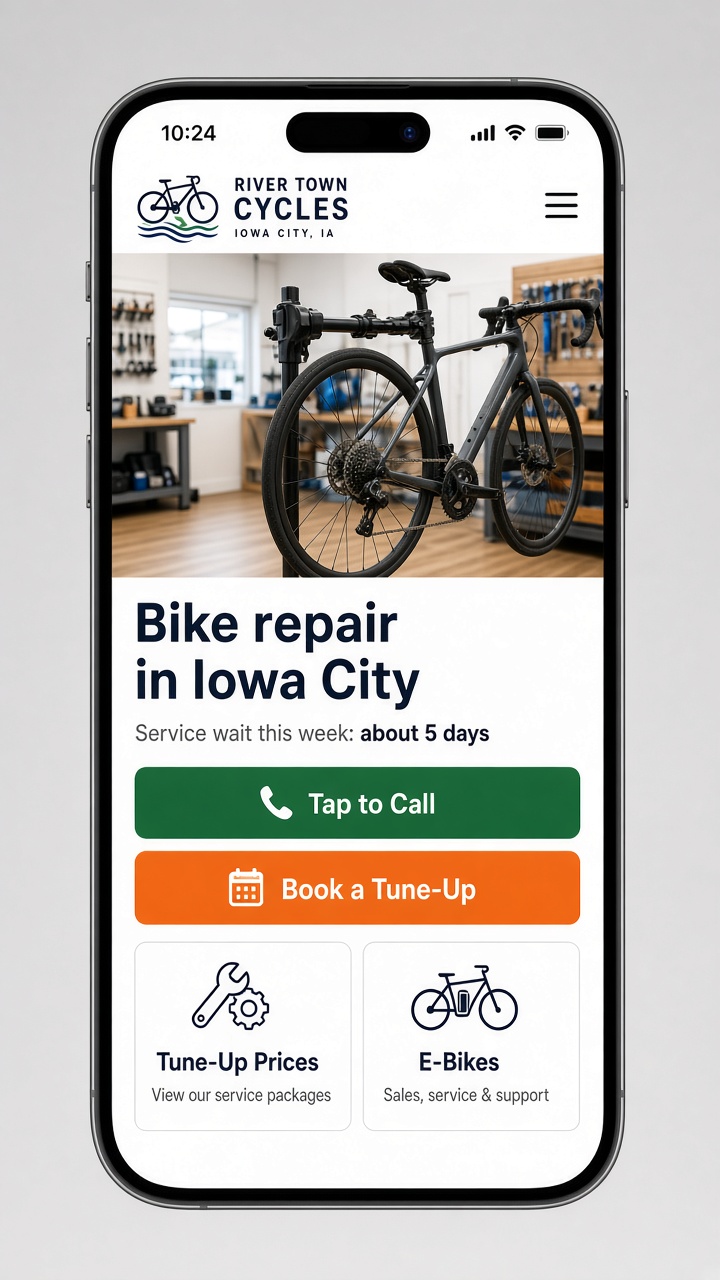
What the homepage has to say in the first screen
In plain HTML text, not baked into a graphic:
- Your shop name, your town, and how long you’ve been there
- Service, with this week’s wait time and a link to prices
- What you sell: road, mountain, gravel, kids, e-bikes
- Hours, including Saturday and Sunday, with seasonal changes
- Two clear buttons: Call, and Book a Tune-Up
Proof in plain text
- Who owns the shop and who’s at the repair stand, with real photos
- Any mechanic training or certifications you actually hold
- Real reviews on a page you own, plus a link to Google Business
- Photos of your own repairs, builds, and group rides
Don’t invent awards or certifications. State what you can back up.
Content that feeds search and AI without theater
Useful posts for a bike shop read like answers from the person at the counter:
- How often does a bike need a tune-up in Iowa?
- What size bike does my kid need?
- Is it worth fixing a big-box store bike?
- How to store your bike for winter, and how to wake it up in spring
- E-bike rules on our local trails
- What a bike fit fixes, and what it doesn’t
Each one answers a real question with your own photo. Take a picture of a wheel being trued, a kid’s first bike at pickup, or the Tuesday night group ride. That’s a post. That’s how a local bike shop gets named when someone asks an AI assistant where to go.
Why the website matters more now
Websites and SEO are changing. They still matter, and for a local bike shop they matter more now. Bots now make a large share of web requests. Cloudflare’s Matthew Prince has said bots passed humans on Cloudflare’s network in mid-2026, about 57% bots and 43% humans. That counts HTTP requests, not hours of human attention. People still walk in, test ride, and drop off bikes. More and more, ChatGPT, Gemini, Grok, and Google’s AI answers decide which shops a rider hears about first. Those tools look for clear facts: what it costs, how long it takes, and what you have.
Your website should be the source of record. Instagram, Facebook, Strava clubs, Google Business, and brand catalogs can all point back to it. Keep your true prices, wait time, stock, and rides on a domain you own.
Design rules that fit a bike shop
- Fast on a phone: light pages, compressed photos, text first
- Call and Book a Tune-Up one tap from any page
- Navigation: Service, Bikes, E-Bikes, Kids, Fitting, Rides, About, Visit
- Prices, wait times, and hours in real text, not images
- Your own photos of your own shop, not brand stock shots
- You own the domain, hosting, and content
What Upley does for bike shops
Upley builds and hosts websites for Iowa and Midwest businesses. For a bike shop that means plain-text pages for tune-up prices, a weekly service wait time, what’s on the floor, an honest e-bike page, fitting and trade-ins, local rides, and an easy way to post photos from the repair stand with a few words.
Same Iowa web team that ran Big Ten Web Design, handling design, hosting, and SEO, plus the modern layer so search and AI can find the true file about your shop, what it costs, and how long it takes.
If your current site is a logo wall and a phone number, start with the homepage five facts, a service price list, and a dated wait time. Then add the e-bike page and local rides.
Book 30 minutes
Thirty minutes. Iowa time. No deck.
Iowa City, Cedar Rapids, Quad Cities / Davenport