
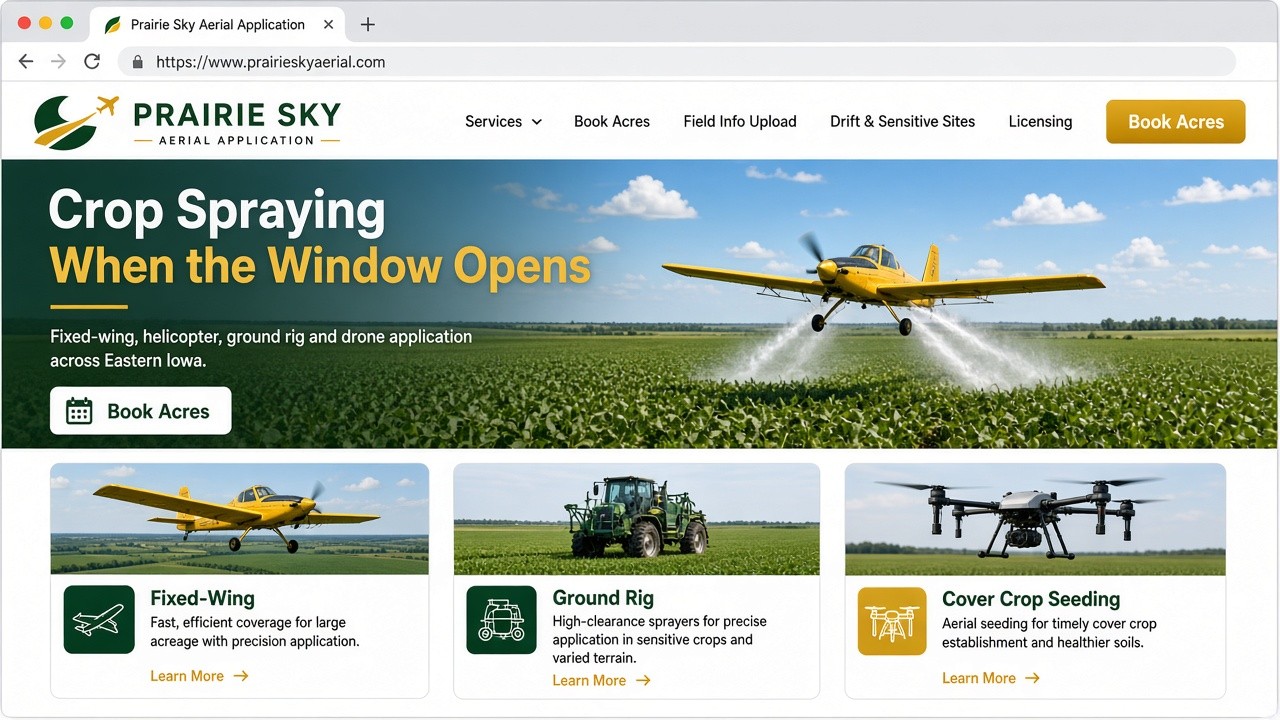
A crop spraying or aerial application website should answer what a farmer, agronomist, or co-op asks before they book acres: what you apply and how (fixed-wing, helicopter, ground rig, drone), which jobs you take (fungicide, insecticide, cover crop seeding), how to get in the queue when the window opens, what field info you need, how you handle drift and sensitive neighbors, and which counties you cover. Put those facts in plain text on pages you own. That is the marketing. Design is the layout that makes them easy to find on a phone in a pickup and easy for search and AI to cite.
Most applicators run on phone calls, word of mouth, and a co-op relationship. That works until a grower new to the area, a landlord’s farm manager, or a younger operator goes looking. Many applicator sites are a logo, a plane photo, and a phone number. The operator who explains how booking works, what a field needs, and how drift is handled gets calls from people who already trust the process.
Who is reading the site
Crop spraying traffic comes from a few groups.
Farmers and operators who need fungicide on corn at tassel or insecticide on beans when aphids hit threshold. They want to know if you cover their county and how fast you can get there.
Agronomists, seed reps, and co-op staff who write the recommendation and line up the applicator. They want product handling rules, how to send a work order, and who to call.
Farm managers and landowners managing ground for someone else. They want licensing, insurance, and how records come back after the job.
Neighbors, beekeepers, organic growers, and specialty crop farms. They want to know how to tell you where sensitive sites are, and who answers if they have a concern.
Search engines and AI assistants. When someone asks ChatGPT, Gemini, Grok, or Google for aerial fungicide application near Cedar Rapids, or cover crop seeding by plane in eastern Iowa, those tools look for plain facts on pages they can read. A plane photo with no text gives them almost nothing.
What the homepage has to say in the first screen
In plain HTML text, not baked into a graphic:
- Company name and the counties or towns you cover
- How you apply: fixed-wing, helicopter, ground rig, drone — only what you run
- What you apply: fungicide, insecticide, cover crop seed, and anything else you actually do
- A phone that reaches dispatch during the season
- Two clear buttons: Book Acres and Call Dispatch
A grower scrolling at 6 a.m. during a disease outbreak wants to know three things fast: do you cover me, can you get here, and how do I get on the list.
One page per application method
This is where applicator sites go thin. Give each method its own page.
- Fixed-wing aerial — when it fits (big acres, tall crops, wet fields), typical field size you take, and what the airstrip or ferry distance means for timing
- Helicopter, if you run one — small or odd-shaped fields, obstacles, and why some jobs need it
- Ground rig — when ground beats air, boom widths, and crop height limits in plain words
- Drone spot spraying — what fits (waterways, small fields, spot treatment), acre limits, and the FAA and state rules you operate under, stated as what is true for your company
- Cover crop seeding — aerial seeding into standing corn or beans, timing windows, and which seed mixes you handle
Each page says what the method is, when it fits, what you need from the farmer, and ends with Book Acres and Call Dispatch. Add a photo from your own job with the grower’s okay.
The booking and queue page
Competitors almost never publish this, and it is the question every grower asks in July.
Publish a plain page that covers:
- How to get on the list: call, text, online form, or through your agronomist or co-op
- What “booked” means: when an order is confirmed, and how you tell the grower
- How the queue works when the window opens: first come, by route, by crop stage, or by agreement — whatever is true for you
- Weather rules: wind, rain, and temperature limits that stop work, stated as your real practice
- How growers find out when their field is done
- Who supplies the product: you, the co-op, or the grower — and how pickup or delivery works
Keep it short and honest. A farmer who reads that page understands why the plane was over the neighbor’s field first, and that saves a lot of phone calls.
Field info and maps
A good work order saves an hour of back-and-forth. Tell people exactly what to send.
- Field location: section, township, and county, a map pin, or a shapefile
- Field boundaries and acres
- Crop and growth stage
- Product and rate, or the agronomist’s recommendation
- Hazards: power lines, towers, wind turbines, houses, livestock, open water
- Sensitive neighbors nearby: bees, organic fields, vineyards, specialty crops
Accept the file types you can actually use, and say so. If you take shapefiles or maps from common farm software, name which ones.
Drift, sensitive sites, and neighbors
This page builds trust with people who never hire you, and they are the ones who call the state or post on Facebook.
- How you plan around sensitive sites and how a neighbor can tell you about one
- Whether you check the state’s sensitive crop and apiary registry, if your state has one — in Iowa that is the FieldWatch program used by many applicators, so name it only if you use it
- Buffer and wind practices you actually follow
- A contact for concerns that reaches a real person
- What happens after a complaint, in plain words
Do not promise zero drift. State what you do.
Licensing, insurance, and records
Farm managers and landowners want this in writing.
- Commercial applicator licensing facts that are true for your company and pilots
- Aircraft and operator certifications you hold
- Insurance coverage, stated as true facts
- What application records the grower gets back: date, product, rate, acres, weather conditions — and how you send them
- How long you keep records
Proof in plain text
People want to know they are booking a real operation.
- Your base or airstrip location and service radius
- Years in business and who flies or runs the rigs
- Aircraft and equipment you run, named plainly
- Real job photos with a short caption naming the county, crop, and application type, with the grower’s okay
- Reviews on a page you own, plus a link to Google Business
Do not invent acre counts or response times. State what you can back up.
The book-acres path is the conversion
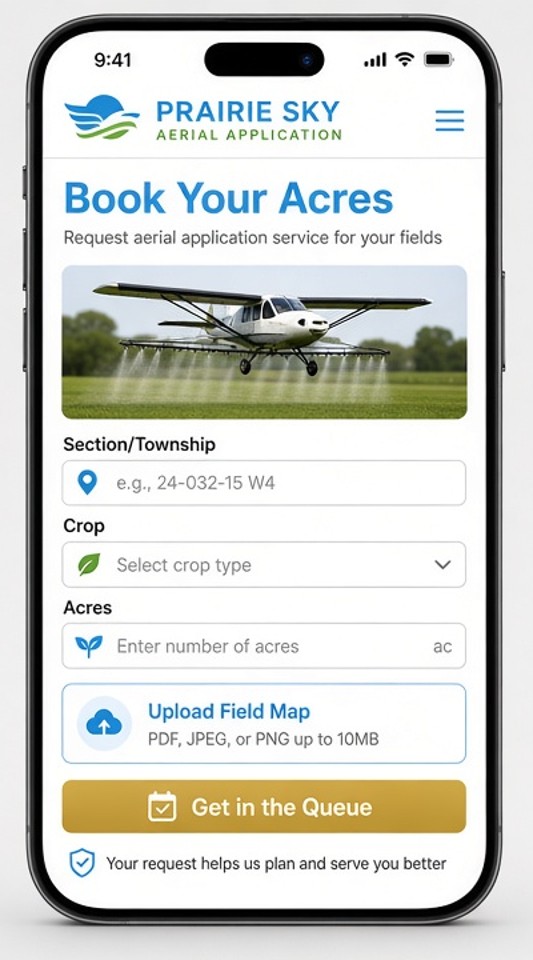
A good book-acres form asks for:
- Name, farm name, and best phone (text okay or not)
- County, township, and field location or map upload
- Acres and crop
- Application type: fungicide, insecticide, cover crop seeding, other
- Product supplied by: you, co-op, or grower
- Preferred method: aerial, ground, drone, or “your call”
- Timing: as soon as possible, a target date, or at a crop stage
- Hazards and sensitive neighbors
- Agronomist or co-op contact, if any
Say how and when you confirm. Put the form on its own URL so the co-op, a seed rep, Google Business, and AI answers can link straight to it. Keep Call Dispatch in the header during the season.
Content that feeds search and AI without theater
Useful posts for an applicator read like notes from dispatch:
- Aerial vs ground fungicide on corn — when each one makes sense
- How our queue works when tar spot or white mold shows up
- What we need from you before we can spray your field
- How we handle drift around bees, organic fields, and houses
- Flying on cover crop seed — timing in standing corn and beans
- The counties we added this year and where we base the plane
Each one answers a real question. Add a photo from your own job. That is the kind of page that gets an applicator named when someone asks who sprays fungicide by plane near them.
Why the website matters more now
Websites and SEO are changing. They still matter, and for crop spraying companies they matter more now. Bots now make a large share of web requests. Cloudflare’s Matthew Prince has said bots passed humans on Cloudflare’s network in mid-2026, about 57% bots and 43% humans. That counts HTTP requests, not hours of human attention. Farmers still book acres with a person. More and more, ChatGPT, Gemini, Grok, and Google’s AI answers decide which applicators a new grower hears about first. Those tools look for clear facts: methods, jobs, counties covered, booking rules, and drift practices.
Your website should be the source of record. The co-op, Facebook, Google Business, and word of mouth can all point back to it. Keep the true method list, booking rules, field requirements, drift practices, and book-acres path on a domain you own.
Design rules that fit an applicator
- Fast on a phone with spotty rural signal: light pages, compressed photos, text first
- Book Acres and Call Dispatch one tap from any page
- Navigation: Services, Aerial, Ground Rig, Drone, Cover Crops, Book Acres, Drift and Safety, Service Area, About
- Counties, methods, and season hours in real text, not images or PDFs
- A season banner you can update fast: “Booking fungicide now” or “Cover crop seeding orders open”
- No stock photos of someone else’s plane, and no fake reviews
- You own the domain, hosting, and content
What Upley does for companies like this
Upley builds and hosts websites for Iowa and Midwest businesses. For a crop spraying or aerial application company that means clear method and service pages in plain text, a booking and queue page, a field info and map upload form, a drift and sensitive-sites page neighbors can read, county service-area notes that stay current, hosting that holds up during the season rush, and an easy way to post real job photos with captions.
Same Iowa web team that ran Big Ten Web Design, handling design, hosting, and SEO, plus the modern layer so search and AI can find the true file about your methods, counties, and how to book acres.
If your current site is mostly a plane photo and a phone number, start with the homepage five facts, a Book Acres form, and the booking and queue page. Then add the method pages and the drift page before next season.
Book 30 minutes
Thirty minutes. Iowa time. No deck.
Iowa City, Cedar Rapids, Quad Cities / Davenport