
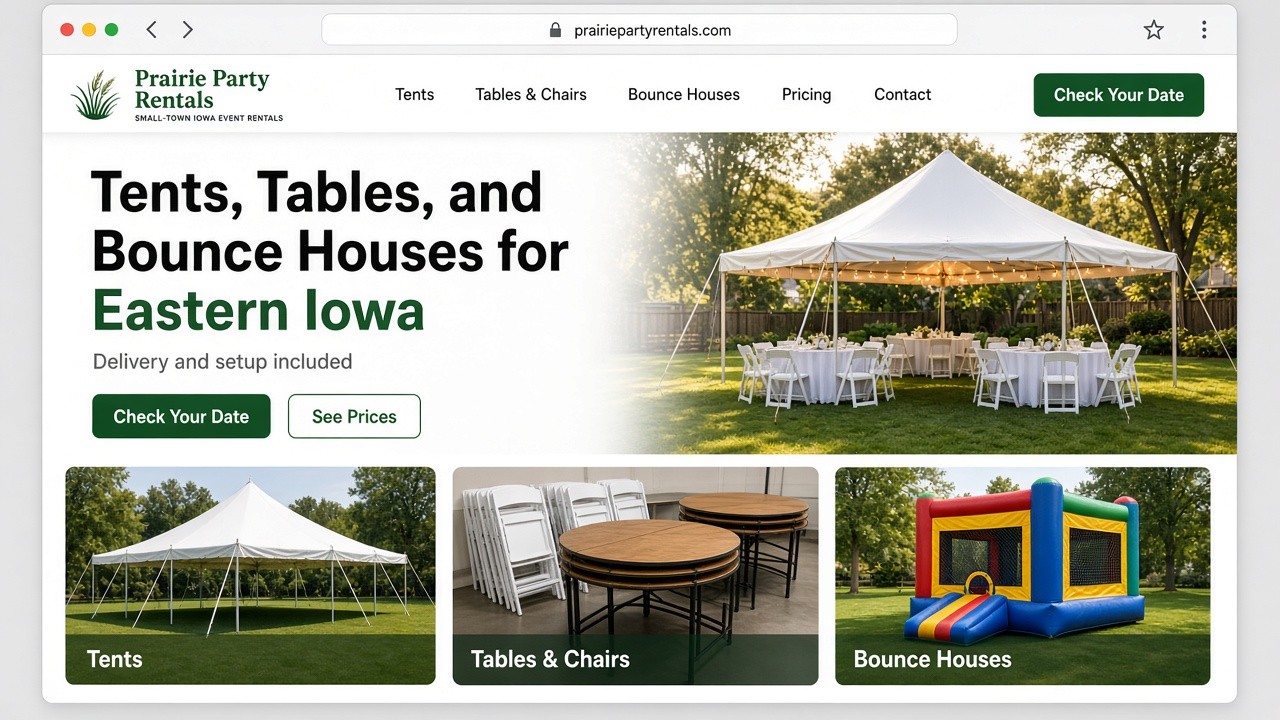
A party rental website has one job: help someone pick the right tent, tables, chairs, or bounce house for a real date and a real yard, then reserve it without three rounds of phone tag. Put the inventory, the prices or price ranges, the delivery area, the setup rules, and the deposit terms in plain text on a site you own. That is the marketing. Design is making all of it easy to sort through on a phone at 10 at night, and easy for search and AI to repeat correctly.
Most rental customers are planning something once. A graduation party in May. A wedding reception on the farm. A church picnic, a company cookout, a fifth birthday. They do not know what size tent fits 80 people or whether a bounce house can go on gravel. The company whose website answers those questions first usually gets the booking.
Who is reading the site
Party rental websites get a handful of readers.
Parents planning a birthday or a graduation party. They want a bounce house or a tent, a price, and to know if the date is open. They are comparing two or three companies on a phone.
Couples and families planning a wedding or reunion. Bigger order, more questions. Tent sizes, flooring, lighting, linens, tables, chairs, and whether you will come out to look at the site first.
Event planners, churches, schools, and businesses. Repeat customers who want a clear order process, invoices, and a contact who answers.
Towns and nonprofits. Festivals, fun runs, and fundraisers that need permits, insurance certificates, and setup on public ground.
Search engines and AI assistants. When someone asks ChatGPT, Gemini, Grok, or Google who rents a 20 by 40 tent near Marion, or who has a water slide in the Quad Cities, those tools look for plain facts on pages they can read.
What the homepage has to say in the first screen
In plain HTML text, not baked into an image:
- What you rent, in a few words: tents, tables and chairs, bounce houses, or whatever your core lines are
- The towns and counties you deliver to
- That delivery and setup are included, or what they cost
- One clear button: Check Your Date
- Phone and email that reach a real person, with your office hours and best times to call on a busy weekend
A parent with a date in mind needs to know if you cover their town and if that Saturday is open. Everything else can be one tap away.
Put the inventory on real pages
This is where most rental sites fall short. One gallery of photos and a “call for pricing” line makes the customer do all the work.
- A page for each category: tents, tables and chairs, inflatables, concessions, staging and flooring, lighting, linens, generators
- A short entry for each item with its size, what it holds, and a real photo of your actual unit
- How many people each tent size seats with round tables, with long tables, and standing
- Prices or honest price ranges, plus what changes the price
- Packages that match real events: backyard grad party for 60, farm wedding for 150, kids birthday
You do not have to publish every price if you truly cannot. But a range and a few example packages answer most questions before the phone rings.
Delivery, setup, and the yard
Rental customers worry about the logistics more than the gear. Spell them out.
- Your delivery area by town and county, with any mileage or delivery fee written plainly
- When you deliver and pick up, and whether that changes on holiday weekends
- What setup includes, and what the customer is responsible for
- Surface rules: grass, gravel, concrete, asphalt, and when you need to stake or use weights
- How much flat space each tent or inflatable needs, plus clearance from trees, power lines, and buildings
- Utility locates before staking, and who calls for them
- Power needs for inflatables and lighting, and whether you rent generators
Write it the way your crew lead would explain it on the phone. Short sentences. Real numbers only where they are true for your gear.
Weather, safety, and the rules
These pages save the most phone calls and the most bad days.
- Your weather policy: wind limits for inflatables and tents, what happens if it rains, and who makes the call
- Cancellation and rescheduling terms, written in plain words
- Deposit amount, when the balance is due, and what forms of payment you take
- Damage and cleaning policy, including what counts as normal wear
- Inflatable safety rules for kids, posted where parents will read them
- Insurance certificates and permit help for towns, schools, and businesses, if you offer it
A plain weather page posted ahead of time is easier for everyone than a rushed call on a windy Saturday morning.
Make booking easy
The best rental sites let people get from browsing to reserved without a phone call, but keep the phone call easy too.
- A date-availability check, even a simple form, on every item and package page
- An online reservation or quote request that asks for the date, address, surface, headcount, and items
- A confirmation email that repeats the order, the delivery window, and the rules
- A clear note about how far ahead people should book in busy months like May, June, and wedding season
If you take reservations through a rental software system, connect it to your own site and keep the inventory pages on your domain. The booking tool can change. Your pages should stay.
Proof that belongs on a URL you own
- Photos from real events you set up, with permission: the tent on a farm, the bounce house at a grad party, the tables in a church hall
- A short note with each photo: what was rented, the town, and the headcount
- Reviews from real customers, quoted only with permission, and a link to your Google Business listing
- Your address and phone written the same way everywhere
A photo of your 30 by 60 tent set up for a reception outside Solon says more than any stock image of a ballroom.
Content that feeds search and AI without theater
Useful pages for a rental company read like answers your office gives every week:
- What size tent do you need for 50, 100, or 150 guests
- Can a bounce house go on gravel or concrete
- How far ahead to book for graduation season
- What happens with a tent rental if it rains or the wind picks up
- What a backyard grad party rental package includes
- What to have ready before the delivery crew shows up
Each one answers a question someone is already asking. That is what gets a rental company named when a parent asks a phone assistant who rents tents near them.
Why the website matters more now
Websites and search are changing. They still matter, and for rental companies they matter more now. Bots now make a large share of web requests. Cloudflare’s Matthew Prince has said bots passed humans on Cloudflare’s network in mid-2026, about 57% bots and 43% humans. That counts HTTP requests, not hours of human attention. People still book rentals, and they still look first. More and more, ChatGPT, Gemini, Grok, and Google’s AI answers decide which companies a customer hears about. Those tools look for clear facts: what you rent, where you deliver, what it costs, and how to book.
Your website should be the source of record. Facebook, Google Business, your booking software, and any directory listings can all point back to it. Keep the true inventory, prices, delivery area, and rules on a domain the company owns.
Design rules that fit a rental company
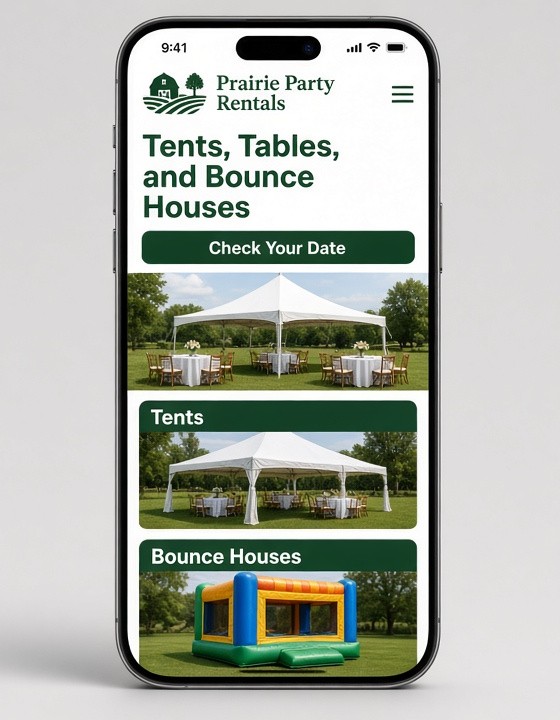
- Fast on mobile, with large headings and a Check Your Date button near the top of every page
- Navigation: Tents, Tables and Chairs, Inflatables, Packages, Delivery Area, Policies, Contact
- Real photos of your own gear and your own setups, not stock
- Inventory and prices easy for the office to update without calling a developer
- The company owns the domain, hosting, and content, not the booking software vendor or a former employee
What Upley does for event and party rental companies
Upley builds and hosts websites for Iowa and Midwest service businesses. For a rental company that means a clear first screen, inventory pages with sizes and price ranges, package pages for real events, delivery and weather policies in plain words, a date-check and quote path that works on a phone, and hosting that stays up for daily crawls. We also make it easy to post photos from a setup with a short caption to the website, social, and Google Business.
Same Iowa web team that ran Big Ten Web Design, handling design, hosting, and SEO, plus the modern layer so search and AI can find the true facts about your business.
If your current site is a photo gallery and a phone number, start with the five first-screen facts, a delivery area page, and one page per rental category. Then add packages and the weather policy before graduation season.
Book 30 minutes
Thirty minutes. Iowa time. No deck.
Iowa City, Cedar Rapids, Quad Cities / Davenport