
A hearing aid center website should answer what a person asks after years of saying “what?” at the dinner table: what a hearing test costs, what hearing aids cost, whether insurance or the VA helps, whether the cheap ones at the pharmacy would work, who does the test, and what happens if the aids end up in a drawer. Put those answers in plain text on pages you own. That is the marketing. Design is the layout that makes it easy to read at a large type size, and easy for search and AI to cite.
Most hearing sites say “better hearing, better living,” show a stock couple laughing on a beach, and hide every price behind a free consultation. People put off hearing help for years. A site that answers the money question honestly is the one they finally call.
Post your prices by technology level
This is the page almost nobody in the industry writes, and it is the one people search for most. Hearing aids are a big purchase and people are scared of a sales pitch. Take the fear out:
- Price ranges per pair for each technology level: basic, standard, advanced, premium
- What changes between levels in plain words: how well they handle restaurants and crowds, streaming from a phone, rechargeable or batteries
- Who usually does fine with the basic level, and who really needs more
- Financing, payment plans, and whether you take HSA or FSA cards
- A date on the page: “Prices updated October 2026”
A line like “Most of our patients choose standard-level rechargeable aids, $X to $Y a pair, including two years of follow-up visits” is a sentence a person can plan around. “Call for pricing” sends them to the big-box store that posts a number. Use your real numbers.
Bundled or unbundled: say what the price includes
Families get burned here. One clinic’s price includes the test, the fitting, years of adjustments, cleanings, and a loss-and-damage warranty. Another sells the device and charges for every visit after. Both can be fair. The family just cannot compare them.
Spell it out:
- What is included: hearing test, fitting, follow-up adjustments, cleanings, warranty, loss and damage coverage, batteries or charger
- For how long
- What a visit costs after that, or if you offer an unbundled price with pay-per-visit care
- Your trial period, how returns work, and any fee you keep if they come back
This is the page AI tools quote when someone asks “what should a hearing aid price include.” It is also the page that keeps a person from walking out to “think about it.”
Be honest about over-the-counter hearing aids
Since 2022, adults with perceived mild to moderate hearing loss can buy hearing aids over the counter without a prescription or exam. Every person over 55 has seen them at the pharmacy. Most clinic sites pretend they do not exist. That is a mistake.
Write the honest page:
- Who OTC aids can work well for, and who should get tested first
- Warning signs that need a real exam: hearing loss in one ear, sudden loss, ringing in one ear, dizziness, ear pain or drainage
- What a professional fitting adds: a test, aids programmed to the person’s own hearing, follow-ups
- Whether you will test someone who bought OTC aids, help set them up, and what that costs
A clinic that says “these might be enough for you, and here is when they are not” earns trust that no coupon buys. A person who starts with OTC aids and later needs more remembers who told them the truth.
What a hearing test costs and what happens
Fear of the unknown keeps people from booking. Walk them through it:
- What the test costs, and when insurance or Medicare pays for it
- How long it takes, and that it does not hurt
- What you check: the ear canal, tones, words in quiet and in noise
- That a family member is welcome to come, and why that helps
- That they leave with their results in plain words and no pressure to buy that day
Insurance, Medicare, and VA in plain English
Write a benefits page a person can follow without calling:
- Original Medicare: Part B may cover a diagnostic hearing exam when a doctor orders it. Original Medicare does not pay for hearing aids. Say that plainly.
- Medicare Advantage plans: many include some hearing benefit. Say which plans you work with and how to check.
- Private insurance and employer plans: which ones you bill, and what a benefit usually looks like
- Iowa Medicaid: whether you accept it and for what
- VA: whether you see veterans through VA community care, or how to get aids through the VA if you do not
- Hearing aid benefit companies: if you take them, list them
Keep it dated and true. Do not promise coverage you cannot back up. “Call us with your card and we will check before your visit” is a fine last line, not a whole page.
Walk-in repairs, cleanings, and batteries
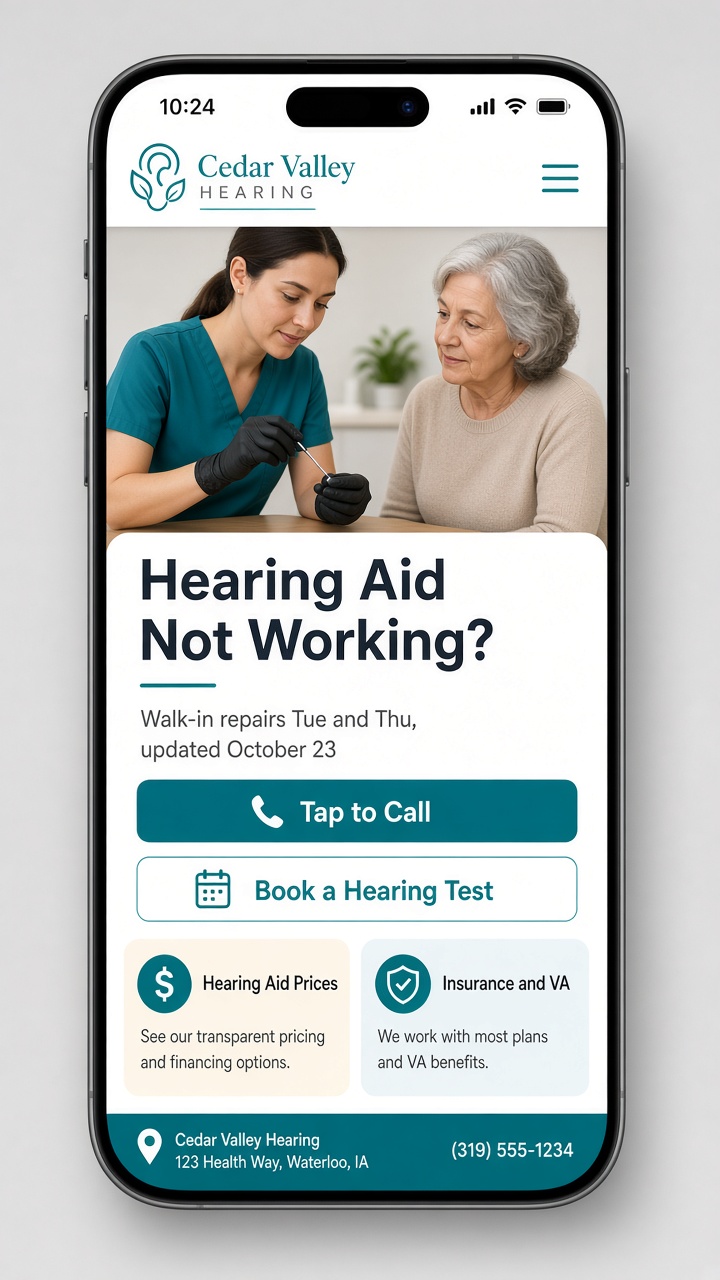
A hearing aid that quits on a Sunday is an emergency to the person wearing it. This is your most-visited page, and most clinics bury it.
- Walk-in hours for cleaning, tube and dome changes, and quick fixes
- Whether you work on aids bought somewhere else, and what that costs
- Batteries and supplies you sell, and whether they can buy without an appointment
- What to try at home first: change the battery, check the charger, clean the wax guard, check that it is not muted
- How repairs that go out to the maker work, and how long they take, and whether you lend a loaner
Put a date on the hours: “Updated October 23: walk-ins Tuesday and Thursday, 9 to 4.” That is a reason to keep the page fresh, and a reason for search and AI to trust it.
Who does the testing
People want to know who they are trusting with their ears. Say it on a page:
- Names and photos of the audiologists and hearing instrument specialists
- The difference between the two, in plain words, and that both are licensed by the state
- How long each has been in practice and in town
- Whether you are independent or owned by a hearing aid maker or chain, and which brands you fit
Being independent and fitting several brands is a real selling point. Say it if it is true. If you are part of a larger group, say that too. Honest beats vague.
Tinnitus, kids, and the other things you do
Many clinics do more than hearing aids and never say so. Give each its own short page if you offer it:
- Tinnitus evaluation and what can help
- Custom earplugs for hunters, musicians, and people who run loud equipment on the farm or in the shop
- Hearing tests for kids, and what age you see
- Earwax removal
- Cochlear implant referrals and follow-up
- Hearing help at assisted living and nursing homes, with the towns you visit
Each of those is a question someone is typing into ChatGPT or Google right now. “Custom earplugs for hunting in Iowa City” is a page your competitors do not have.
Who is reading the site
The person with hearing loss. Often in their 60s or 70s, often reading at a large font size, often skeptical after years of putting it off.
Their spouse or adult child. Often the one who books the appointment.
Doctors and clinic nurses referring patients for a hearing test.
Veterans and people with hearing loss from work, farming, or hunting.
Search engines and AI assistants. When someone asks ChatGPT, Gemini, Grok, or Google “how much are hearing aids in Cedar Rapids” or “does Medicare pay for a hearing test,” those tools look for plain facts on pages they can read. A stock photo and “call for a free consultation” give them nothing.
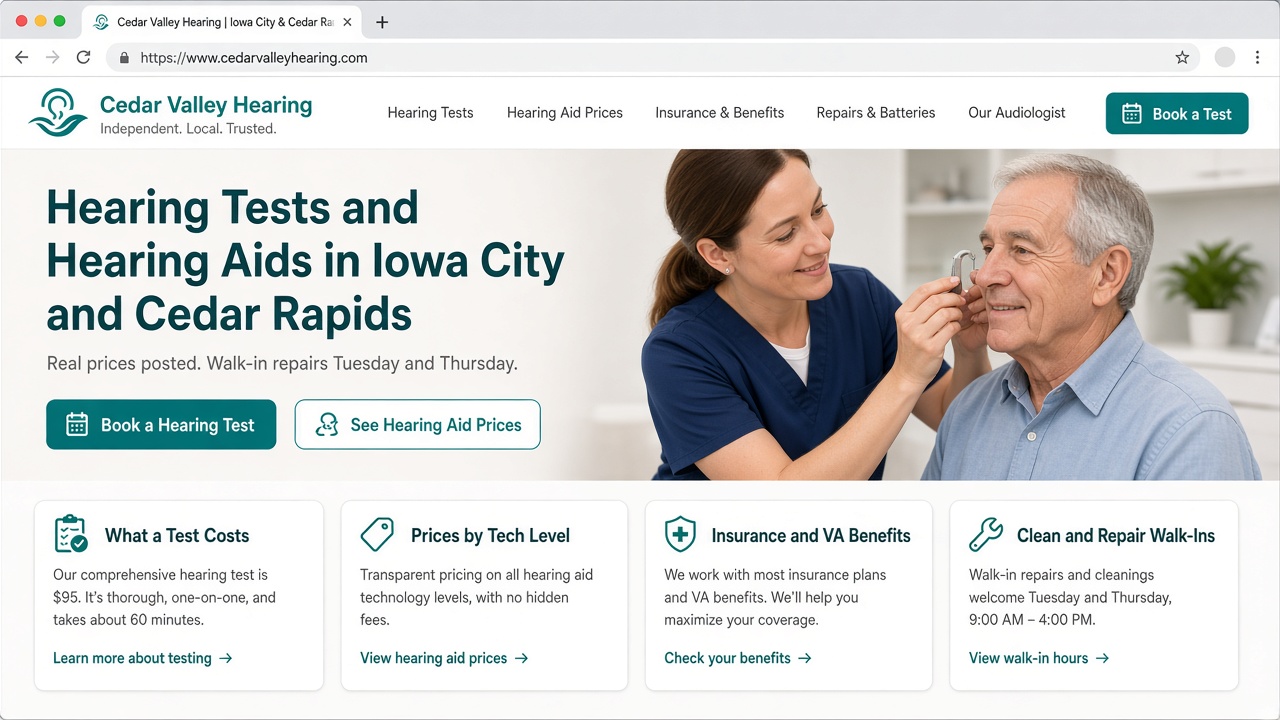
What the homepage has to say in the first screen
In plain HTML text, not baked into a graphic:
- Your name, your town, and that you do hearing tests and hearing aids
- What a test costs, or a link straight to the prices page
- Walk-in repair hours
- Who pays: insurance, Medicare Advantage, VA, HSA
- Two clear buttons: Call, and Book a Hearing Test
Proof in plain text
- Who owns the clinic, with names and how long they have been in town
- Real reviews on a page you own, plus a link to Google Business
- Short notes from patients, with permission, about what changed: “I can hear my granddaughter at church again”
- Doctors and clinics that refer to you, if they say you can name them
Do not invent star ratings, awards, or before-and-after claims. State what you can back up.
Content that feeds search and AI without theater
Useful posts for a hearing aid center read like answers from the audiologist at the first visit:
- What hearing aids cost in Iowa, and what changes the price
- OTC hearing aids or a fitting: how to tell which you need
- Does Medicare pay for hearing aids
- My hearing aid stopped working: five things to check before you call
- Protecting your hearing during deer season and in the shop
- How to help a parent who will not admit they cannot hear
Each one answers a real question with your own photo. Snap a picture of the wax guard you just changed, the new charger case, or the custom earplugs going out to a farmer, with permission and no faces unless they say yes. That is a post. That is the kind of page that gets a clinic named when a person finally asks where to start.
Why the website matters more now
Websites and SEO are changing. They still matter, and for hearing care they matter more now. Bots now make a large share of web requests. Cloudflare’s Matthew Prince has said bots passed humans on Cloudflare’s network in mid-2026, about 57% bots and 43% humans. That counts HTTP requests, not hours of human attention. People still book the test, sit in the booth, and wear the aids home. More and more, ChatGPT, Gemini, Grok, and Google’s AI answers decide which clinics a person hears about first. Those tools look for clear facts: what it costs, what is included, who pays, and who does the test.
Your website should be the source of record. Hearing aid makers’ clinic finders, insurance directories, Google Business, and Facebook can all point back to it. Keep your true prices, benefits, hours, and people on a domain you own, not on a lead-gen site that sells your patient’s phone number to the chain down the road.
Design rules that fit hearing care
- Large readable type, high contrast, and a text-size button that works
- Fast on a phone: light pages, compressed photos, text first
- Call and Book a Hearing Test one tap from any page, plus a text or email option for people who struggle on the phone
- Navigation: Hearing Tests, Hearing Aid Prices, Insurance and Benefits, Repairs and Batteries, Our Team, Book a Test
- Captions on every video
- Prices, benefits, and hours in real text, not images or PDFs
- Your own photos, not stock couples on a beach
- A repair-hours note you can update from a phone in two minutes
- You own the domain, hosting, and content
What Upley does for clinics like this
Upley builds and hosts websites for Iowa and Midwest businesses. For a hearing aid center that means plain-text pages for prices by technology level, what the price includes, an honest OTC page, insurance and VA benefits, walk-in repairs, and the people who do the testing, plus an easy way to post photos from the clinic with a few words.
Same Iowa web team that ran Big Ten Web Design, handling design, hosting, and SEO, plus the modern layer so search and AI can find the true file about your clinic, what it costs, and who you help.
If your current site is a beach photo and “call for a free consultation,” start with the homepage five facts, a prices page, and a walk-in repair page. Then add the benefits page and the honest OTC page.
Book 30 minutes
Thirty minutes. Iowa time. No deck.
Iowa City, Cedar Rapids, Quad Cities / Davenport