
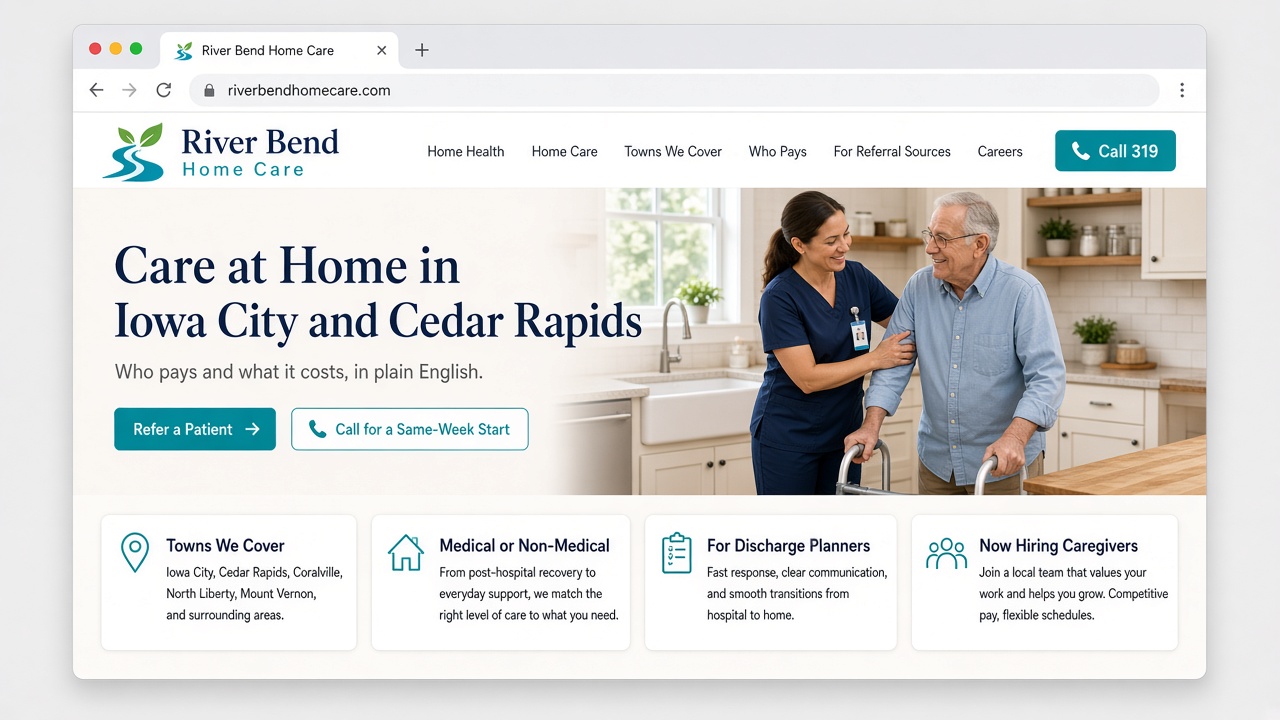
A home health or home care website should answer what a family asks the day Dad comes home from the hospital: which kind of care you give, whether you cover his town, how soon you can start, who pays for it, what an hour costs if insurance does not, and who will actually walk into his kitchen. Put those answers in plain text on pages you own. Give discharge planners their own page with a phone number that gets answered. That is the marketing. Design is the layout that makes it easy to read on a phone in a hospital hallway, and easy for search and AI to cite.
Most agency sites say “compassionate, personalized care in the comfort of home” and stop there. The family calls three agencies and picks the one that could start Thursday and explain the bill. Clear wins this business.
Medical or non-medical: say which one you are
This is the confusion that costs agencies the most calls. Families do not know there are two kinds of care at home, and the words overlap.
- Home health is skilled care ordered by a doctor: nursing, physical therapy, occupational therapy, speech therapy, wound care, injections, and teaching after surgery. It is usually short term and often paid by Medicare.
- Home care (private duty, non-medical, personal care) is help with daily life: bathing, dressing, meals, medication reminders, rides, light housekeeping, and someone there overnight. It is usually paid privately, by long-term care insurance, by the VA, or through a Medicaid waiver.
If you do one, say so on the first screen. If you do both, give each its own page and say how they work together. A family that knows which door to knock on calls you. A family that cannot tell calls the agency that explained it.
Who is reading the site
Adult children. Often out of town, often in a hurry, usually reading on a phone after a fall or a hospital stay.
The patient or client. They want to know who is coming, how often, and whether they get a say.
Discharge planners, case managers, clinic nurses, and social workers. They want to know what you take, which towns you cover, how to send a referral, and how fast you start.
Job seekers. Most agencies are short on caregivers and aides. Your site is also your hiring office.
Search engines and AI assistants. When someone asks ChatGPT, Gemini, Grok, or Google “home care that takes the VA in Coralville” or “does Medicare pay for home health after knee surgery,” those tools look for plain facts on pages they can read. A slideshow and a contact form give them nothing.
What the homepage has to say in the first screen
In plain HTML text, not baked into a graphic:
- Your name, your home office town, and whether you do home health, home care, or both
- The counties and towns you cover, or a link straight to that page
- How soon you can usually start, and an honest note when you are full
- Who pays: Medicare, Medicaid, VA, long-term care insurance, private pay
- Two clear buttons: Call, and Refer a Patient
A towns-we-cover page with real names
“Serving Eastern Iowa” tells nobody anything. List the counties and the towns: Iowa City, Coralville, North Liberty, Tiffin, Solon, Hills, Lone Tree, Cedar Rapids, Marion, Hiawatha. Say where you can start fast and where a start takes longer because of drive time. Say if you have a mileage charge for far-out clients.
This is the page AI tools match when a family asks about a specific town. It is also the page competitors never write, because they are afraid of leaving a town off. Leave it off on purpose and say “call us for towns not listed.” That is honest, and honest gets the call.
A page just for discharge planners and referral sources
Hospitals and clinics send a lot of home health business. Make their job easy:
- One referral phone line that a person answers, and the hours it is staffed
- Fax number and secure e-fax or portal, if you take referrals that way
- What you need with a referral: orders, face-to-face note, insurance, contact for family
- How fast you usually do the first visit after a referral
- Services you take and the ones you do not, like IV therapy or wound vacs
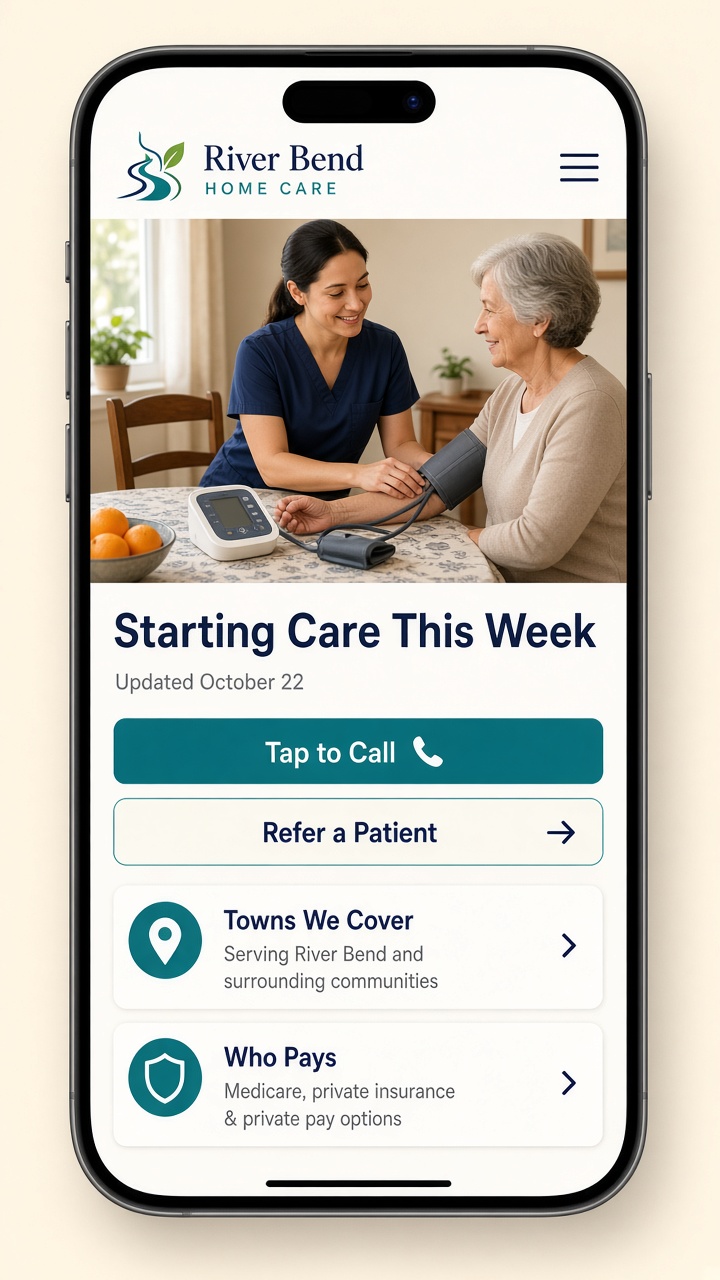
- A dated note on capacity: “Updated October 22: taking new referrals in Johnson and Linn counties”
That dated note matters. A planner with a patient going home tomorrow will call the agency that says it has room this week.
Who pays, in plain English
Write a payment page a family can follow without calling:
- Medicare home health: the person has to be under a doctor’s care, need skilled care part time, and be homebound. Explain what “homebound” means in plain words. Say Medicare does not pay for round-the-clock care or for help that is only bathing and housekeeping.
- Medicaid and waiver programs: whether you accept them, for which services, and whether there is a wait
- VA: whether you are a provider for VA community care or help with Aid and Attendance paperwork
- Long-term care insurance: what paperwork you handle and how claims work
- Private pay: your hourly rate range, your minimum shift (many agencies require two to four hours), overnight and weekend rates, and holiday rates
A line like “Private pay home care runs $X to $Y an hour with a three-hour minimum” is a sentence a family can plan around. “Call for a free consultation” is not. Use your real numbers and put a date on the page.
Who walks into the house
Every family is uneasy about a stranger in Mom’s home. Answer it before they ask:
- How you screen caregivers: background checks, references, driving records, drug tests if you do them
- Whether caregivers are employees or contractors, and whether you are bonded and insured
- Training: CNA, HHA, dementia care, transfers, and how often you train
- How you match caregivers to clients, and what happens if it is not a good fit
- Who the supervising nurse is, and how often they check in
- What happens when a caregiver calls in sick
What the first week looks like
Fear of the unknown keeps families from calling. Walk them through it:
- The first phone call: what we ask
- The assessment visit: who comes, how long it takes, what they look at
- The care plan: written down, shared with the family, and changed when needs change
- The first shift: introductions, the house tour, the notebook or app where visits get logged
- How the family gets updates
Proof in plain text
- Who owns and runs the agency, with names and how long they have been in town
- If you are Medicare certified, link to your listing on Medicare’s Care Compare site and let families read it there
- Real reviews on a page you own, plus a link to Google Business
- Notes from families and referral partners, with permission
Do not invent star ratings, awards, or testimonials. State what you can back up.
The hiring page is half your marketing
Agencies turn away clients because they cannot staff them. Give caregivers a real page:
- Pay range per hour, mileage pay, and shift differentials
- Shifts you need right now, by town: “Overnights in North Liberty, weekend mornings in Marion”
- What training you pay for, and whether you help people get their CNA
- How fast you hire, and what the steps are
- A short form that works on a phone, with no account to create
Date this page too. “Updated October 22” tells a job seeker the post is real. That page fills shifts, and filled shifts are what let you say yes to the next family.
Content that feeds search and AI without theater
Useful posts for a home care or home health agency read like answers from the nurse on the first visit:
- Home health or home care: which one does Dad need after the hospital
- Does Medicare pay for help at home, and what does homebound mean
- What an hour of home care costs in Johnson County, and what drives the price
- How to make a house safer after a fall: rugs, grab bars, lighting, stairs
- Signs a parent who lives alone needs some help at home
- What to have ready when the home health nurse comes the first time
Each one answers a real question with your own photo. Snap a picture of the grab bar your aide pointed out or the training day at the office, with permission and no client faces unless they say yes. That is a post. That is the kind of page that gets an agency named when a family asks where to start.
Why the website matters more now
Websites and SEO are changing. They still matter, and for home care they matter more now. Bots now make a large share of web requests. Cloudflare’s Matthew Prince has said bots passed humans on Cloudflare’s network in mid-2026, about 57% bots and 43% humans. That counts HTTP requests, not hours of human attention. Families still call, meet the nurse, and sign the care plan. More and more, ChatGPT, Gemini, Grok, and Google’s AI answers decide which agencies a family hears about first. Those tools look for clear facts: which care, which towns, who pays, and how fast.
Your website should be the source of record. Referral directories, Google Business, Facebook, and the hospital’s agency list can all point back to it. Keep your true services, towns, rates, and policies on a domain you own, not on a lead-gen site that sells your family’s phone number to five other agencies.
Design rules that fit home care
- Large readable type and high contrast
- Fast on a phone: light pages, compressed photos, text first
- Call and Refer a Patient one tap from any page
- Navigation: Home Health, Home Care, Towns We Cover, Who Pays, For Referral Sources, Careers
- Rates, towns, and policies in real text, not images or PDFs
- Your own photos with permission, not stock models in scrubs
- A capacity note and hiring page you can update from a phone in two minutes
- You own the domain, hosting, and content
What Upley does for agencies like this
Upley builds and hosts websites for Iowa and Midwest businesses. For a home health or home care agency that means plain-text pages for which care you give, the towns you cover, who pays and what it costs, how caregivers are screened, a referral page planners can use, and a hiring page that fills shifts, plus an easy way to post photos from the field with a few words.
Same Iowa web team that ran Big Ten Web Design, handling design, hosting, and SEO, plus the modern layer so search and AI can find the true file about your agency, where you go, and who you can care for.
If your current site is a slideshow and “compassionate care in the comfort of home,” start with the homepage five facts, a towns-we-cover page, and a who-pays page. Then add the referral page and a dated hiring page.
Book 30 minutes
Thirty minutes. Iowa time. No deck.
Iowa City, Cedar Rapids, Quad Cities / Davenport