
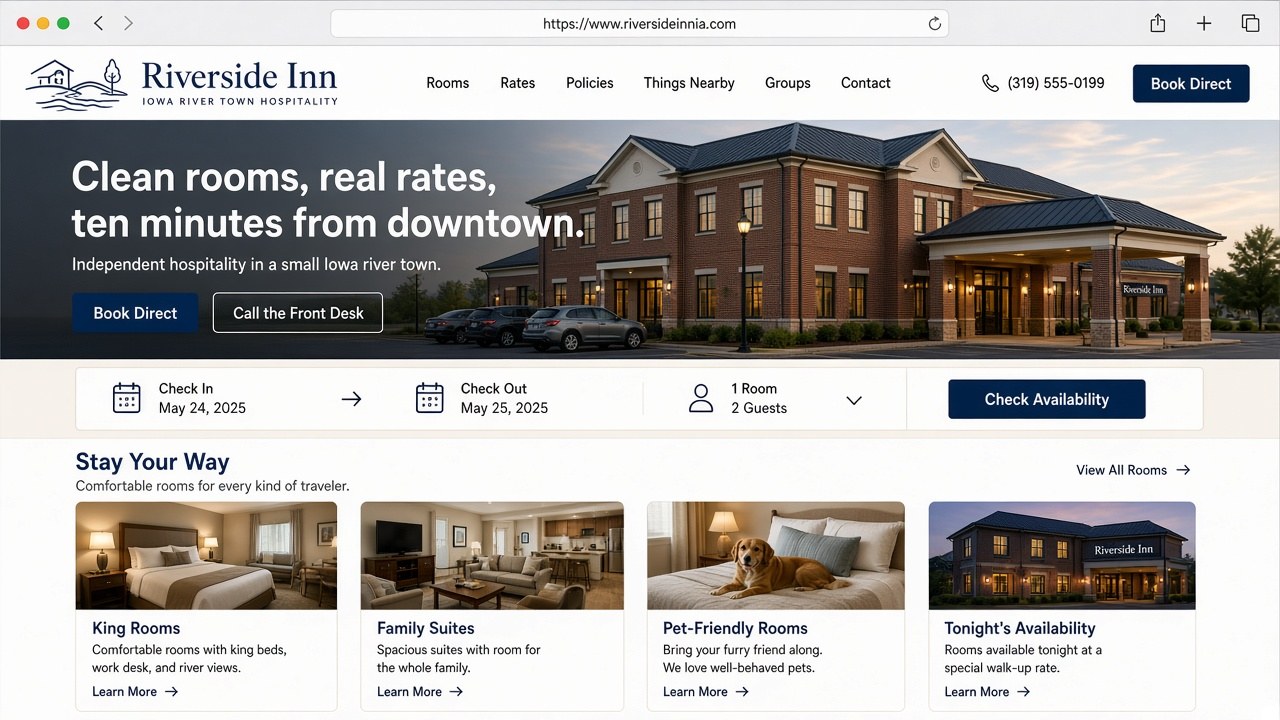
An independent hotel or motel website should answer what a traveler asks before they book: is there a room tonight, what does it really cost, can I bring the dog, where do I park the truck and trailer, and what’s close by. Put those answers in plain text on pages you own. That is the marketing. Design is the layout that makes it easy to read on a phone at a gas station off the interstate, and easy for search and AI to cite.
Most independent hotel sites are a slideshow of the pool, the word “comfort,” and a booking button that sends people to a third-party site that takes a cut of every night. The traveler still doesn’t know if the pool is open in November.
Why book-direct starts with your own site
Online travel sites charge a commission on every booking. Many independent owners pay it on most of their rooms because their own site gives the guest no reason to book there. Fix that on the site:
- A plain Book Direct page that says what the guest gets by booking with you: the best rate, a late checkout when you can, a free cancellation window, a real person on the phone
- The front desk phone number on every page, tap to call
- Your booking engine on your own domain, not a link that leaves the site
- The same rates and room names you use everywhere else, so nothing looks off
Don’t badmouth the travel sites. Just give people a clear reason to call you or book on your page.
Rates, posted by season
Travelers compare prices in seconds. A site with no numbers sends them to a site that has them. Post them:
- Starting rates by room type: king, two queens, suite, kitchenette
- How rates change: weekdays vs weekends, summer vs winter, football Saturdays, graduation weekends, big events in town
- Taxes and fees, said plainly, so the total isn’t a surprise at checkout
- Weekly and monthly rates for work crews, travel nurses, and people between houses
- What’s included: breakfast, parking, Wi-Fi, a fridge and microwave
Put the year on the page. A price with a date reads as honest.
A dated availability note
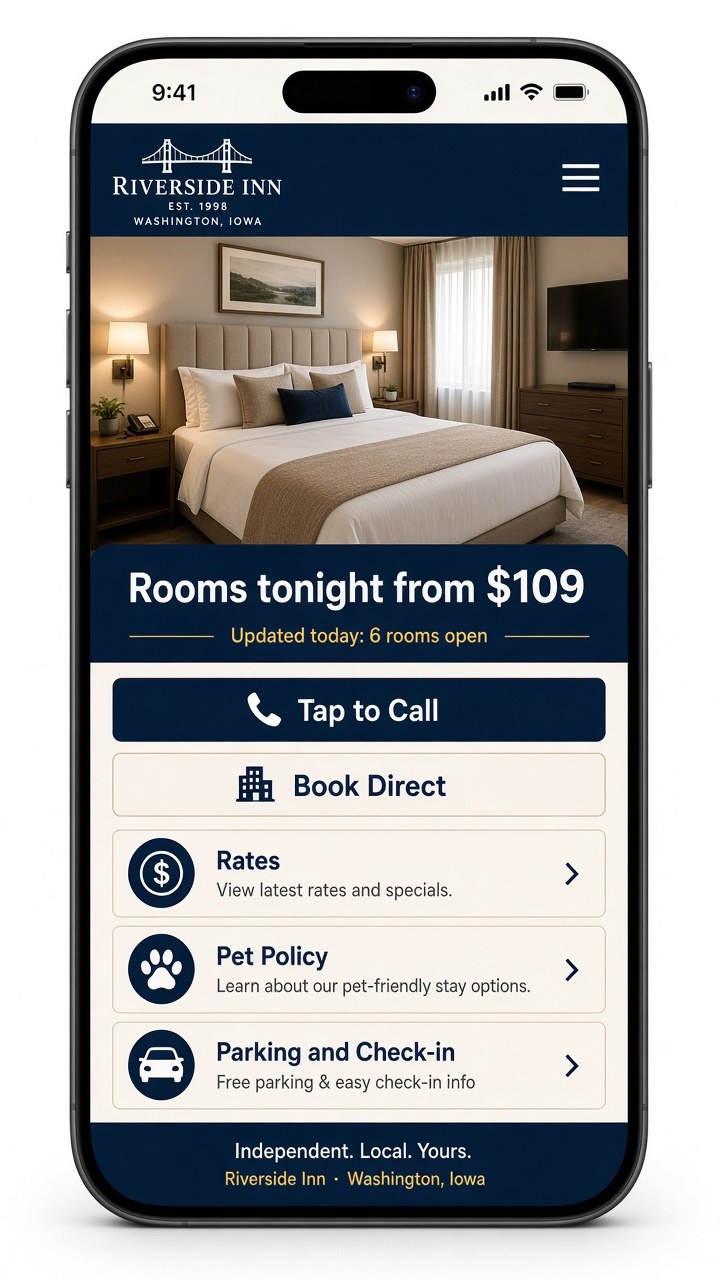
The highest-intent traveler is the one looking for a room tonight. Answer them at the top of the homepage:
- One line with the date: “Updated Saturday, Nov. 1: rooms open tonight and Sunday. Friday the 7th is close to full for the game.”
- Big weekends you already know will sell out, listed ahead of time
- When you’re sold out, say so and say when the next night opens up
That one line is what an AI assistant needs when someone asks “hotel with rooms tonight near Iowa City.”
Policies, in plain English
Guests don’t call to ask about the view. They call about the rules. Put the rules on one page:
- Check-in and check-out times, early check-in and late checkout, and what they cost
- Late arrivals: how to check in after the desk closes
- Pets: which rooms, how many, size limits, the fee, and where to walk them
- Parking: truck and trailer parking, boat parking, plug-ins for engine heaters in winter, overnight security
- Smoking, ID and age to rent a room, deposits and holds on the card
- Cancellation, in one or two sentences
This is the page most competitors skip. It’s also the page that saves your front desk the most phone time.
Room photos that match the room
Show every room type as it really is. Take the photos yourself on a bright morning:
- Each room type, with the bed size and how many it sleeps
- The bathroom, the desk, the fridge, the view out the window
- Accessible rooms, with the features listed in text: roll-in shower, grab bars, door widths
- The breakfast area, the pool and its season hours, the fitness room
A guest who sees the real room and gets the real room leaves a better review. Fancy staged photos that don’t match lead to the one-star kind.
What’s nearby, with real names
This page brings in travelers who don’t know your town yet. Make it specific:
- Distance and drive time to the hospital, the university, the stadium, the fairgrounds, the interstate exit
- Restaurants within walking distance, by name, and which ones are open late
- Places to see: trails, the river, the downtown, local wineries, seasonal events
- Where to get gas, groceries, and a pharmacy
- Driving notes for winter: which roads get plowed first, where trucks can turn around
“Seven minutes to the hospital, three blocks to two late-night restaurants” is a line a traveler trusts and a machine can repeat.
Groups, teams, and work crews
A lot of independent hotel income comes from groups. Give them a page:
- Sports teams and tournaments: room blocks, bus parking, early breakfast
- Wedding blocks: how to set one up, the cutoff date, shuttle info
- Work crews and contractors: weekly rates, truck parking, laundry
- Hospital families: discounted rates if you offer them, and how to ask
- A simple form or phone number that goes to the person who handles groups
Who is reading the site
A mom booking rooms for her son’s travel baseball tournament two months out.
A lineman on a storm crew who needs four rooms tonight and parking for bucket trucks.
A couple driving across Iowa with a dog, looking for a pet-friendly room off I-80.
Search engines and AI assistants. When someone asks “pet-friendly hotel in Cedar Rapids” or “hotel near the hospital in Iowa City with weekly rates,” those tools look for plain facts on pages they can read. A slideshow and the word “comfort” give them nothing.
What the homepage has to say in the first screen
In plain HTML text, not baked into a graphic:
- Your hotel name, your town, and what’s close by
- Rooms and starting rates
- Availability tonight, with the date
- Pets, parking, and breakfast in one line
- Two clear buttons: Call the Front Desk, and Book Direct
Proof in plain text
- Who owns it and who runs the desk, with real photos
- How long you’ve been open, and what you’ve updated recently, with dates: new beds, new carpet, new HVAC
- Real reviews from guests on a page you own, plus links to Google Business
- Your plain answer to common complaints, like road noise or train noise, and what you’ve done about it
Don’t invent awards or ratings. State what you can back up.
Content that feeds search and AI without theater
Useful posts for a hotel or motel read like answers from the front desk:
- Where to stay for a game weekend, and when to book
- Where to eat near the hotel after 9 p.m.
- What to know about winter driving on our stretch of the interstate
- How to set up a room block for a wedding or tournament
- What to do in town on a rainy Saturday
- Our pet policy, and the best places nearby to walk a dog
Each one answers a real question with your own photo. Snap the new beds going in, or the breakfast room before the doors open on a tournament morning. That’s a post. That’s how a local hotel gets named when someone asks an AI assistant where to stay.
Why the website matters more now
Websites and SEO are changing. They still matter, and for an independent hotel they matter more now. Bots now make a large share of web requests. Cloudflare’s Matthew Prince has said bots passed humans on Cloudflare’s network in mid-2026, about 57% bots and 43% humans. That counts HTTP requests, not hours of human attention. Travelers still book and still pay. More and more, ChatGPT, Gemini, Grok, and Google’s AI answers decide which hotels a traveler hears about first. Those tools look for clear facts: rates, rooms, policies, and what’s nearby.
Your website should be the source of record. Travel sites, Google Business, Facebook, and the visitors bureau can all point back to it. Keep your true rates, policies, and availability on a domain you own, and fewer of your nights go to commission.
Design rules that fit a hotel or motel
- Fast on a phone: most travelers book on a phone, often on the road
- Call and Book Direct one tap from any page
- Navigation: Rooms, Rates, Policies, Things Nearby, Groups, Contact
- Rates, policies, and room details in real text, not images or PDFs
- Your own photos of your own rooms, not stock lobbies
- You own the domain, hosting, and content
What Upley does for hotels and motels
Upley builds and hosts websites for Iowa and Midwest businesses. For an independent hotel or motel that means plain-text pages for rates by season, a dated availability note, a policies page that answers the front desk calls, honest room photos, a what’s-nearby page with real names, a groups page, a book-direct page, and an easy way to post a photo and a few words after a busy weekend.
Same Iowa web team that ran Big Ten Web Design, handling design, hosting, and SEO, plus the modern layer so search and AI can find the true file about your hotel, your rooms, and when you have space.
If your current site is a slideshow and an outside booking link, start with the homepage five facts and a policies page. Then add the rates page and the what’s-nearby page.
Book 30 minutes
Thirty minutes. Iowa time. No deck.
Iowa City, Cedar Rapids, Quad Cities / Davenport