
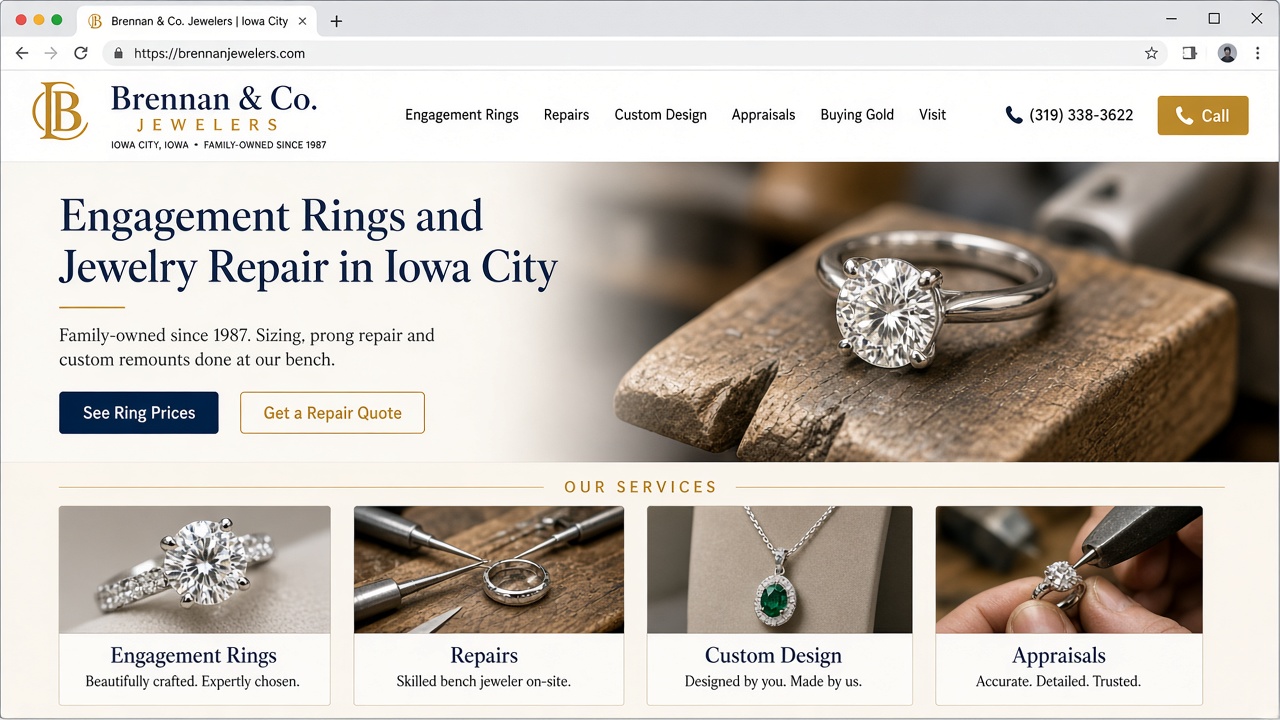
A jewelry store website should answer what a nervous first-time ring buyer and a grandmother with a broken chain both want to know before they walk in: what things really cost, whether you fix it in the store, how long it takes, and whether they can trust you. Put those answers in plain text on pages you own. That is the marketing. Design is the layout that makes it easy to read on a phone and easy for search and AI to cite.
Most local jeweler sites are a slideshow of brand logos, a “shop online” catalog the store never updates, and a contact form. The person who wants a ring resized by Saturday still has to call. The guy shopping for an engagement ring reads a chain store’s buying guide instead, and buys there.
Engagement rings, with price ranges
Ring buyers are scared of two things: overpaying and looking clueless at the counter. Help with both:
- Price ranges for what most of your customers spend, with a date: “Most engagement rings we sold in 2026 were between $X and $Y”
- What drives price in plain words: carat, cut, color, clarity, and metal
- Setting prices separate from stone prices
- A “first time buying a ring? Start here” page: what to bring, how to find a ring size secretly, how long a custom ring takes
- Whether you hold a ring, take a deposit, or do layaway
A real range on the page tells a buyer you are not going to embarrass them. Use your own numbers.
Natural and lab-grown diamonds, honestly
This is the question every ring buyer is asking right now, and most local jewelers dodge it online. Write the page:
- What a lab-grown diamond is, and that it is a real diamond, not a fake
- The price difference you see in your own case, in dollars
- Resale and trade-in: what you will and will not take back, and why
- Which one you carry, and how you label and certify each
- Moissanite and other stones, for people on a tighter budget
When someone asks ChatGPT, Gemini, or Grok “should I buy a lab-grown diamond,” the answer gets built from pages like this. If yours is clear and local, your store gets named.
Repairs get their own pages, with prices and turnaround
Repairs are the steady work that brings people back for 30 years, and they are usually one line on a jeweler’s site. Spell them out:
- Ring sizing up and down, chain soldering, prong retipping, stone setting, clasp replacement
- A starting price for each, or a range
- Turnaround: “Most sizing is done in 3 to 5 business days. Rush same-week for an extra fee”
- What you do in the store versus what you send out
- Watch batteries and bands, and whether you do it while they wait
- A “send us a photo for a quote” form
A page that says “Broken chain? Most solder repairs are $X and back in a week” is the one a person finds at 10 p.m. holding a snapped necklace.
Custom design and remounts
Remounting grandma’s diamond into a new ring is one of the most personal jobs a jeweler does, and almost nobody explains how it works online.
- The steps: sketch or CAD drawing, wax or 3D print, casting, setting, polish
- How many weeks each step takes, start to finish
- What a custom piece usually costs compared to a stock ring
- Using your own gold and stones, and how you handle the old metal
- Real photos of past custom work, with the customer’s permission
“Bring us your family stones: here is how a remount works and what it costs” is a page your competitors have not written.
Appraisals, insurance, and cleaning
- Who does appraisals, their training, and the fee
- Insurance appraisal versus estate or resale value, in plain words
- How often to update an appraisal, and why
- Free cleaning and inspection, and how often to come in
- Warranty or care plan details, written out, not “ask in store”
Buying gold and estate jewelry
If you buy gold, silver, or estate pieces, say how you price it, whether you test in front of the customer, and what ID they need. Plain honesty here sets you apart from a pawn shop or a mail-in gold company.
Who is reading the site
A 26-year-old guy on his phone in a parking lot, trying to figure out a budget before he talks to anyone.
A woman with her late mother’s ring, wondering if it can be resized without ruining it.
Someone who needs a watch battery and wants to know if they can wait for it.
Search engines and AI assistants. When someone asks “jeweler near me that does ring sizing” or “how much does a remount cost in Cedar Rapids,” those tools look for plain facts on pages they can read. A slideshow of brand logos gives them nothing.
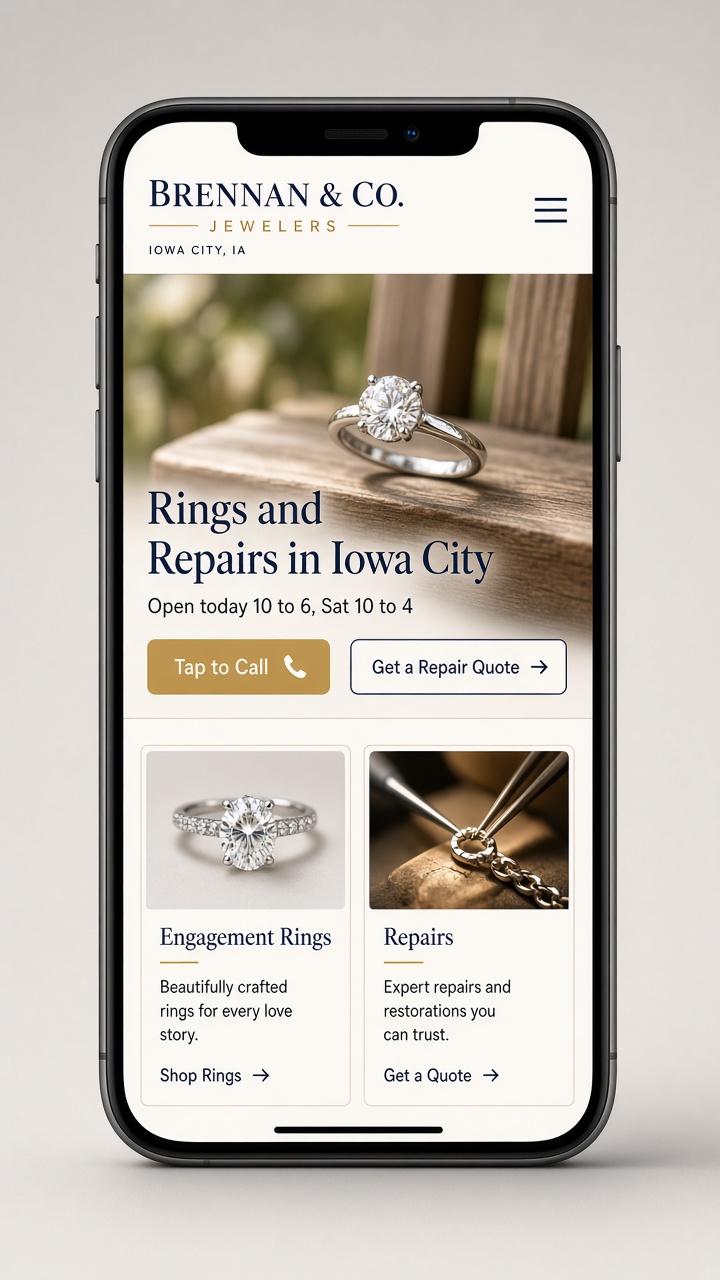
What the homepage has to say in the first screen
In plain HTML text, not baked into a graphic:
- Your store name, your town, and how long you have been there
- What you do in the store: repairs, custom work, appraisals
- Engagement rings, with a link to price ranges
- Hours, including Saturday
- Two clear buttons: Call, and Get a Repair Quote
Proof in plain text
- Who owns the store and who is at the bench, with real photos
- Any training or credentials you actually hold
- Real reviews on a page you own, plus a link to Google Business
- Before and after photos of your own repairs and remounts
Do not invent awards or certifications. State what you can back up.
Content that feeds search and AI without theater
Useful posts for a jeweler read like answers from the person at the counter:
- How to find her ring size without her knowing
- Can a ring be sized up two sizes? What we can and cannot do
- Lab-grown or natural: what the price difference looks like in our case this month
- Why your prongs need checking every year
- What happens to the old gold when we remount your stone
- How to clean jewelry at home without wrecking it
Each one answers a real question with your own photo. Take a picture of a retipped prong, a finished remount, or a resize on the bench. That is a post. That is how a local jeweler gets named when someone asks an AI assistant where to go.
Why the website matters more now
Websites and SEO are changing. They still matter, and for a local jeweler they matter more now. Bots now make a large share of web requests. Cloudflare’s Matthew Prince has said bots passed humans on Cloudflare’s network in mid-2026, about 57% bots and 43% humans. That counts HTTP requests, not hours of human attention. People still walk in, try on rings, and drop off repairs. More and more, ChatGPT, Gemini, Grok, and Google’s AI answers decide which stores a buyer hears about first. Those tools look for clear facts: what it costs, what you fix, and how long it takes.
Your website should be the source of record. Instagram, Facebook, Google Business, and vendor catalogs can all point back to it. Keep your true prices, repair list, and custom process on a domain you own.
Design rules that fit a jewelry store
- Fast on a phone: light pages, compressed photos, text first
- Call and Get a Repair Quote one tap from any page
- Navigation: Engagement Rings, Repairs, Custom Design, Appraisals, Buying Gold, About, Visit
- Prices, repair times, and hours in real text, not images
- Your own photos of your own work, not vendor stock shots
- You own the domain, hosting, and content
What Upley does for jewelers
Upley builds and hosts websites for Iowa and Midwest businesses. For a jeweler that means plain-text pages for engagement rings with price ranges, an honest lab-grown page, repairs with prices and turnaround, custom design and remounts, appraisals, and an easy way to post photos from the bench with a few words.
Same Iowa web team that ran Big Ten Web Design, handling design, hosting, and SEO, plus the modern layer so search and AI can find the true file about your store, what it costs, and what you do in house.
If your current site is a brand slideshow and a contact form, start with the homepage five facts, a repairs page, and a first-time ring buyer page. Then add custom design and the lab-grown page.
Book 30 minutes
Thirty minutes. Iowa time. No deck.
Iowa City, Cedar Rapids, Quad Cities / Davenport