
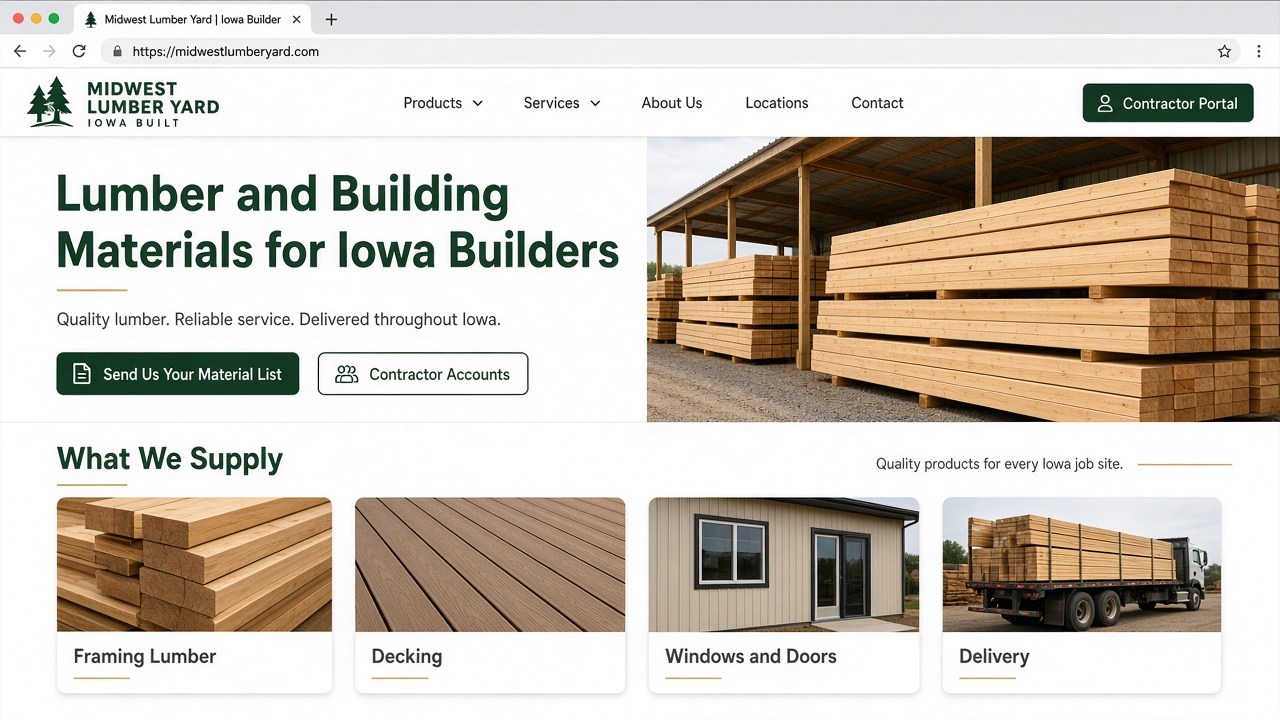
A lumber yard website has one job: help a builder or a homeowner know you have the material, how to get a price on their list, when you can deliver it, and when the yard is open. Put what you stock, how quotes work, your delivery area and truck rules, contractor accounts, and your hours in plain text on a site you own. That is the marketing. Design is making “Send us your material list” and the yard phone number easy to find from a phone on a job site.
Most lumber yards run on relationships. The builder who has bought from you for twenty years does not need a website to find you. But his kid taking over the crew does, and so does the couple building a pole shed, the new remodeler in town, and the deck guy who just moved here. They search, or they ask their phone. The yard whose site answers their questions plainly gets the first call.
Who is reading the site
Lumber yard websites get a few kinds of readers.
Builders and remodelers who already buy from you. They want yard hours, Saturday hours, the counter number, the delivery cutoff, and who their salesperson is.
New contractors. They want to know what you stock, whether you do takeoffs from plans, how contractor accounts and terms work, and whether you deliver to job sites with a boom or a piggyback forklift.
Homeowners and DIY folks. They want to know if you sell to the public, whether you will cut to length, if you carry treated lumber and composite decking, and if a regular person can get a quote without feeling dumb.
Farmers and ag buyers. Post-frame packages, steel, trusses, and barn hardware. They want to know if you put together packages and how far you deliver.
Search engines and AI assistants. When someone asks ChatGPT, Gemini, Grok, or Google where to buy a pole barn package near Iowa City, or who delivers treated lumber to a farm outside Tipton, those tools look for plain facts on pages they can read. A homepage with a slideshow and “stop in and see us” gives them very little.
What the homepage has to say in the first screen
In plain HTML text, not baked into a graphic:
- What you are: a full-line lumber yard, a building center, a post-frame supplier, or all of it
- Who you sell to: contractors, homeowners, farmers, or everyone
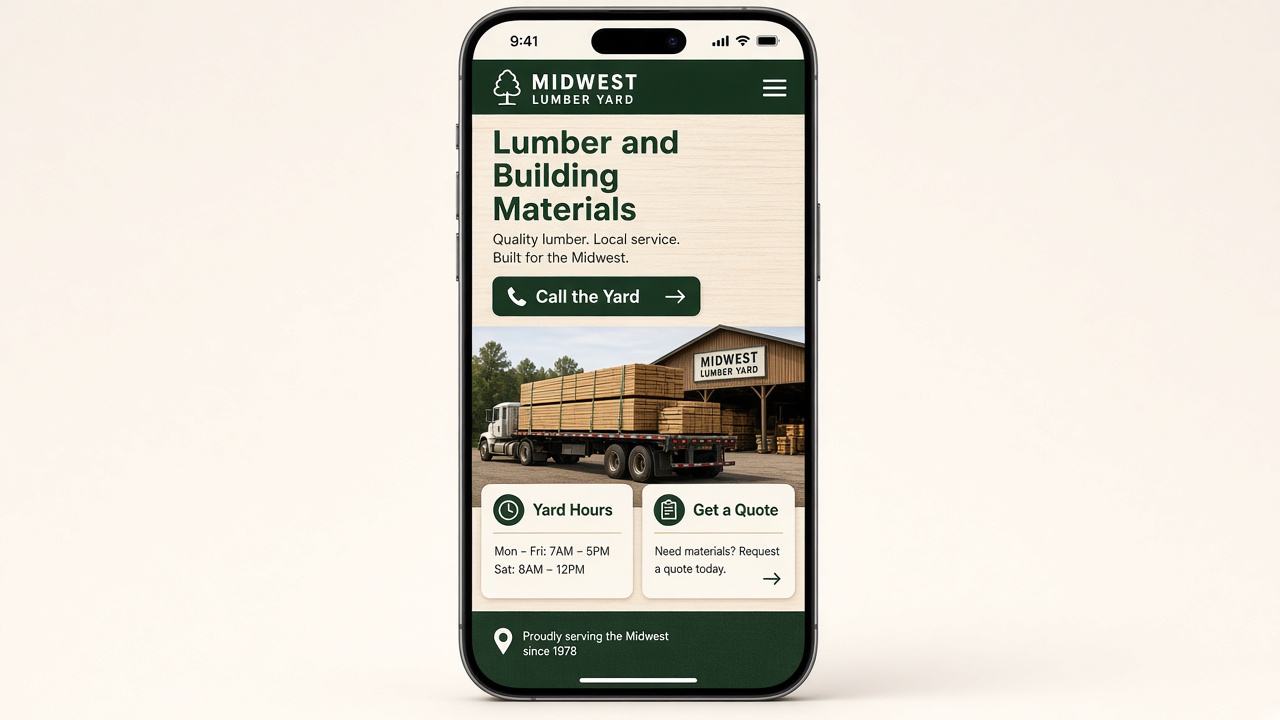
- Your yard address and today’s hours, including Saturday
- One clear button: Send Us Your Material List, plus a tap-to-call yard number
- Your delivery area by town and how soon you can usually deliver
Keep the photo of your yard, your sheds, or your trucks. Just put the words on top of it or beside it as real text.
Send us your list: the page that brings in work
This is the page most lumber yards skip, and the one that turns a visitor into a quote.
- A simple form where people can type a list or upload a photo of a handwritten list or a set of plans
- What happens next: who looks at it, how fast you usually get a quote back, and how they will hear from you
- Whether you do takeoffs from plans, for which kinds of jobs, and if there is a charge
- A note for homeowners: “You do not need to know every board. Tell us the project and the size and we will help.”
- A real person’s name and phone number for the quote desk
A contractor at 9 p.m. with a set of deck plans is not going to call. He will send a list to the yard that makes it easy.
What you stock, in words
Do not hide your lines in a logo row or a PDF flyer.
- A page for each category: framing lumber, treated lumber, engineered lumber and beams, sheet goods, decking and railing, siding and trim, roofing, windows and doors, insulation, hardware and fasteners, post-frame and steel
- Under each, the brands and grades you carry in plain text, and what you keep in stock versus order in
- Lengths and sizes you usually have on hand, in general words
- Special order lead times, said honestly: “most windows take two to four weeks” if that is true for you
- Services: cutting, millwork, door hanging, truss and package design, if you offer them
You do not need a full online store with live pricing. Lumber prices move too much for that to stay right. A clear “here is what we carry and here is who to ask for a price” page beats a stale price list every time.
Delivery, trucks, and the yard
- Delivery area by town, delivery days, and the order cutoff for next-day
- What trucks you run: flatbed, boom truck, piggyback forklift, roofing conveyor, and what each one can do
- Job-site rules: where you can set the load, who needs to be there, and what happens on a muddy site
- Will-call and pickup: where to pull in with a trailer, who loads, and whether the yard closes earlier than the counter
- Returns: how long, what condition, and any restocking charge, written plainly
A delivery page with real towns and real truck types answers ten phone calls a week before they happen.
Contractor accounts
- Who can open one: builders, remodelers, farmers, property managers, schools
- What you need from them: business info, tax-exempt certificate if it applies, references if you ask for them
- How terms and job accounts work, in general words, and how long approval usually takes
- A short online application or a printable form, plus the name of the person who handles it
- What they get: account pricing, job accounts, delivery scheduling, statements by email
Projects, packages, and the people at the counter
Lumber yards help build half the houses, decks, and sheds in their county. Almost none of it shows up online.
- Project pages: a deck, a garage package, a farm shop, a remodel, with a few photos and the main materials, shared with the owner’s okay
- Package pages: garage packages, pole barn packages, deck packages, with the sizes you commonly put together and how to get a price
- Staff pages: who runs the counter, who does takeoffs, who drives the boom truck, with each person’s okay
- Contractor nights, vendor days, and clinics, each with a short page and a date
Every one of those pages is a true record of your business that search and AI can read.
Content that feeds search and AI without theater
Good pages for a lumber yard read like answers the counter gives every day:
- What to bring us so we can price your deck
- Treated, cedar, or composite: what people in our area are building decks with and why
- How to read a lumber list from your builder
- What size garage package fits a two-car garage with a workbench
- What ground contact treated lumber means and where you need it
- How far we deliver and what we need from you on a muddy site
Each one answers a real question. Add a photo from your own yard or a customer job. That is the kind of page that gets a lumber yard named when someone asks their phone where to buy materials nearby.
Why the website matters more now
Websites and search are changing. They still matter, and for lumber yards they matter more now. Bots now make a large share of web requests. Cloudflare’s Matthew Prince has said bots passed humans on Cloudflare’s network in mid-2026, about 57% bots and 43% humans. That counts HTTP requests, not hours of human attention. People still need lumber this week, and they still look first. More and more, ChatGPT, Gemini, Grok, and Google’s AI answers decide which yards a builder or homeowner hears about. Those tools look for clear facts: what you stock, where you deliver, who you sell to, your hours, and how to get a quote.
Your website should be the source of record. Your Google Business listing, Facebook page, buying group or co-op listing, and supplier locators can all point back to it. Keep the true stock lines, delivery area, hours, and policies on a domain you own.
Design rules that fit a lumber yard
- Real photos of your yard, sheds, trucks, and people, compressed so pages load fast on a job site
- Large headings, a tap-to-call yard number, and a Send Us Your List button near the top of every page
- Navigation: Products, Get a Quote, Delivery, Contractor Accounts, Projects, Contact
- Stock lines, hours, and policies in real text, not images or PDFs, so search and AI can read them
- Hours and holiday closures easy for you to update without calling a developer
- You own the domain, hosting, and content, not a template company or a buying group program
What Upley does for lumber yards
Upley builds and hosts websites for Iowa and Midwest service businesses. For a lumber yard that means a clean first screen, a material list page that takes photos and plans, product pages that list your lines in words, a delivery page with real towns and trucks, a plain contractor account page, and project pages your customers will want to share. We also make it easy to post a few photos from a delivery or a finished job with a short caption to your website, social, and Google Business.
Same Iowa web team that ran Big Ten Web Design, handling design, hosting, and SEO, plus the modern layer so search and AI can find the true facts about your business.
If your current site is a homepage, a slideshow, and a contact form, start with the five first-screen facts, a Send Us Your List page, and a delivery page. Then add product pages one category at a time, starting with decking.
Book 30 minutes
Thirty minutes. Iowa time. No deck.
Iowa City, Cedar Rapids, Quad Cities / Davenport