
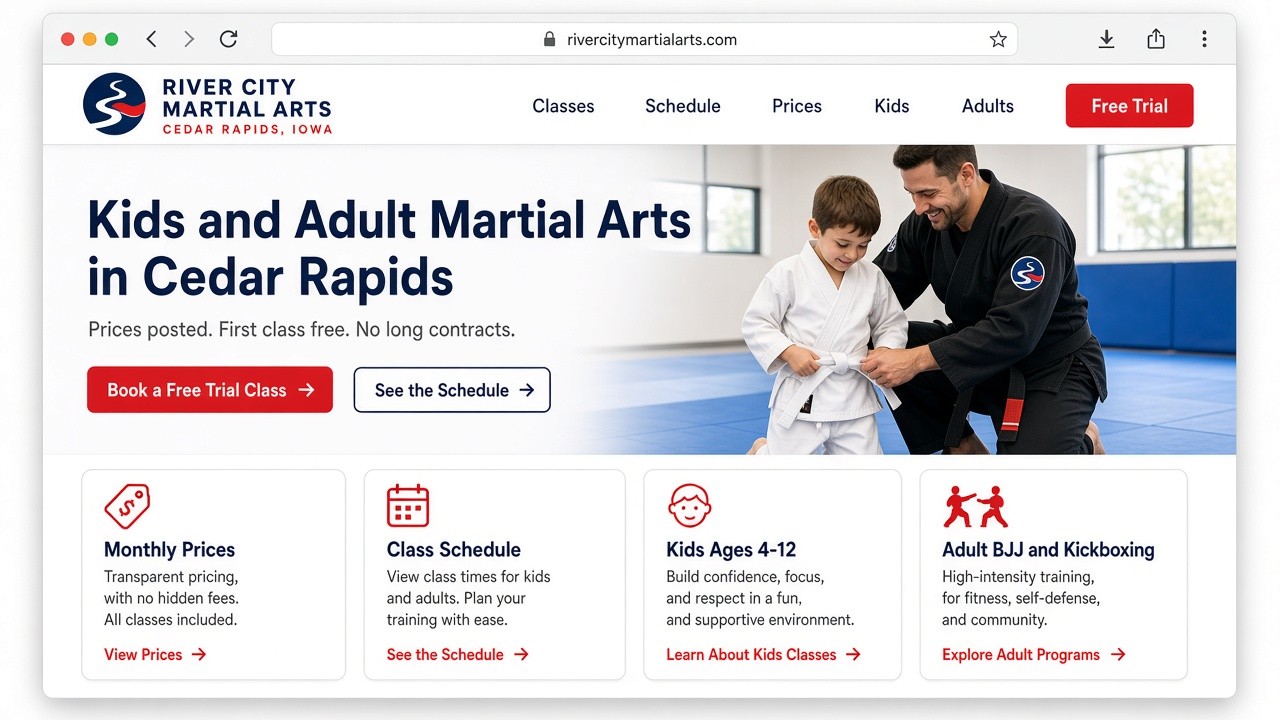
A martial arts studio website should answer what a parent or a nervous adult asks before they ever walk on the mat: what it costs each month, whether they have to sign a contract, when classes are, what belt testing costs, what the first class is like, and who is teaching. Put those answers in plain text on pages you own. That is the marketing. Design is the layout that makes it quick to read on a phone in the school pickup line, and easy for search and AI to cite.
Most studio sites show a flying kick, say “build confidence and discipline,” and then hide everything behind “claim your free intro.” Parents have heard about gyms that lock people into a two-year contract. When you will not post a price, they assume the worst and go somewhere that does.
Post your monthly prices
This is the page studios fight hardest not to write. Some owners worry that a posted price scares people away. In practice, a hidden price scares more people away. Write it:
- Monthly price for kids classes, adult classes, and family plans
- What the price includes: how many classes a week, which programs
- The registration fee, if you charge one, and what it covers
- Uniform cost, and whether the first uniform is included
- Sibling and family discounts, military and first responder discounts
- A date on the page: “Prices updated October 2026”
A line like “Kids classes are $X a month for two classes a week. The first uniform is included. Siblings are $Y” is something a parent can plan around. Use your real numbers.
Say how contracts and cancellations work
The word “contract” is the biggest fear a new martial arts family has. Many have read online about long agreements and canceling by certified letter. Take the fear out with a page:
- Month-to-month, or a set term, and how long
- How to cancel, how much notice, and whether it can be done by email
- Whether you can pause for an injury, a sports season, or summer
- What happens if the family moves
- Whether a billing company handles payments, and its name
If you are month-to-month, say it big. If you do have agreements, say why and say exactly how to get out. That honesty is rare in this industry, and AI tools will quote the studio that spells it out when someone asks “do martial arts gyms make you sign a contract.”
A dated class schedule that is real text
Schedules go stale fast. Summer hours change, a coach moves to Saturday, a class gets added for teens. Most studios post a schedule image from two years ago.
- The weekly schedule as plain text on the page, not a picture or a PDF
- Class names with ages and levels: “Little Dragons, ages 4 to 6”
- How long each class runs
- Holiday closures and snow days, and where you post them
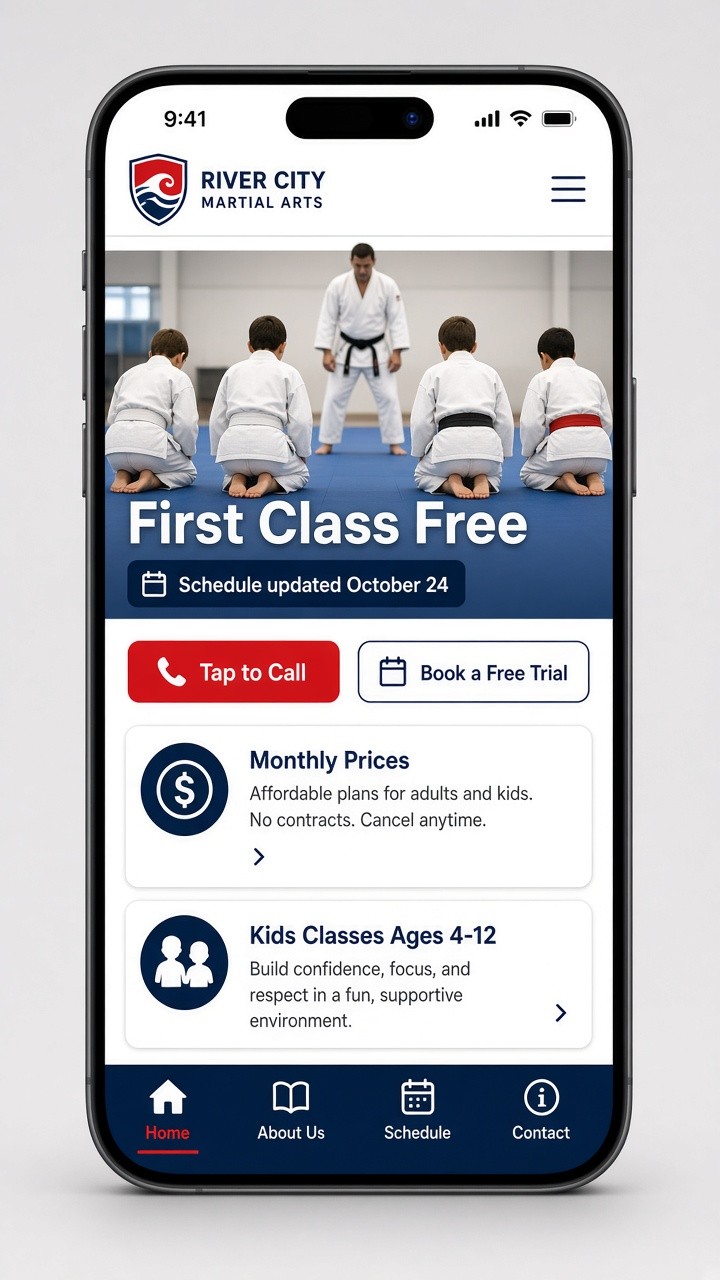
- A date: “Schedule updated October 24”
A dated schedule tells a parent the place is open and run by someone paying attention. It tells search and AI the same thing.
Belt testing: what it costs and how it works
Belt testing fees surprise more families than anything else. Put it on a page:
- How often testing happens and how a student knows they are ready
- What a test costs at each level, and what the fee covers (the belt, the certificate, the tester’s time)
- Black belt testing: how long it usually takes to get there, and the total cost
- What happens if a student does not pass
- Whether you test for stripes in class at no charge
For a Brazilian jiu-jitsu gym, say how belts and stripes are earned and that there is no testing fee, if that is true. A family comparing two studios will pick the one that told them up front.
What the first class is like
Most people walk past a studio for months before they come in. A nervous adult, a shy kid, a parent of a child with ADHD or autism. Walk them through it:
- How to book the free class or trial week
- What to wear and what to bring: water, shorts and a T-shirt, no shoes on the mat
- When to arrive and where to park
- What happens in the first ten minutes, and that nobody gets thrown on day one
- Whether parents can watch, and where they sit
- That there is no sales pitch at the end, or exactly what the talk after class covers
A page like this is the one that gets the trial booked. It is also the page an AI assistant reads when someone asks “what should I expect at my kid’s first karate class.”
Pages for each real reason people come
People do not search for “martial arts.” They search for the reason. Give each program its own short page if you offer it:
- Kids classes by age, and what they work on at each age
- Anti-bullying and how you teach a kid to handle it without a fight
- Adult beginners over 40, and how you keep them from getting hurt
- Women’s self-defense classes, with dates and price
- Brazilian jiu-jitsu, kickboxing, Muay Thai, or judo, with what each one is in plain words
- Kids with ADHD, autism, or other needs, if your coaches have real experience
- Competition team, and what it costs to travel to tournaments
- After-school pickup, with the schools you pick up from and the price
“Adult jiu-jitsu for beginners over 40 in Cedar Rapids” is a page most of your competitors do not have. So is “karate after-school pickup from Wilson and Grant Wood schools.”
After-school and summer camps
Many studios make real money on after-school programs and summer camps and barely mention them online. Parents start looking for summer camps in February.
- The schools you pick up from, the van, and what time kids arrive
- What the afternoon looks like: homework time, snack, class
- Weekly and daily camp prices, dates, and hours
- No-school day camps, with the dates for the local district
- How to sign up and how many spots are left, with a date on it
Who teaches
Parents are trusting you with their kids. Adults are trusting you with their necks. Say it on a page:
- Names, photos, and ranks of the head instructor and coaches
- Who they trained under and how long they have taught
- Background checks for anyone who teaches kids, and first aid and CPR training
- How you handle safety: mat cleaning, sparring gear, rules for rolling
Do not invent titles, lineages, or championships. State what you can back up.
Who is reading the site
A parent, often a mom on her phone at 9 p.m., comparing three studios for a kid who needs something besides team sports.
An adult who has wanted to try jiu-jitsu or kickboxing for years and is scared to walk in out of shape.
Families who just moved to town and want the studio their old one would have recommended.
Search engines and AI assistants. When someone asks ChatGPT, Gemini, Grok, or Google “how much is karate for kids in Iowa City” or “best beginner jiu-jitsu gym near me,” those tools look for plain facts on pages they can read. A video of a board break and “claim your free intro” give them nothing.
What the homepage has to say in the first screen
In plain HTML text, not baked into a graphic:
- Your name, your town, and what you teach: karate, taekwondo, jiu-jitsu, kickboxing
- Who it is for: kids by age, teens, adults, families
- Monthly price, or a link straight to the prices page
- Month-to-month or the contract terms, in one line
- Two clear buttons: Call, and Book a Free Trial Class
Proof in plain text
- How long the studio has been in town and who owns it
- Real reviews on a page you own, plus a link to Google Business
- Short notes from parents, with permission, about what changed: “He used to hide behind me. Now he raises his hand at school.”
- Photos from your own mats, of your own students, with permission
Do not invent star ratings, student counts, or tournament results. State what you can back up.
Content that feeds search and AI without theater
Useful posts for a martial arts studio read like answers from the head instructor after class:
- What martial arts costs in Iowa, and what changes the price
- Karate, taekwondo, or jiu-jitsu: which one fits my kid
- How long does it take to get a black belt
- Am I too old or out of shape to start jiu-jitsu
- What to do if your kid is being bullied
- How to tell if a studio is a good one before you sign anything
Each one answers a real question with your own photo. Snap a picture after a belt test, the new mats going in, or the Saturday open mat, with permission. That is a post. That is the kind of page that gets a studio named when a parent asks an AI assistant where to start.
Why the website matters more now
Websites and SEO are changing. They still matter, and for a local studio they matter more now. Bots now make a large share of web requests. Cloudflare’s Matthew Prince has said bots passed humans on Cloudflare’s network in mid-2026, about 57% bots and 43% humans. That counts HTTP requests, not hours of human attention. People still walk in, tie the belt, and pay the monthly dues. More and more, ChatGPT, Gemini, Grok, and Google’s AI answers decide which studios a family hears about first. Those tools look for clear facts: what it costs, how contracts work, when classes are, and who teaches.
Your website should be the source of record. Facebook, Instagram, Google Business, the booking app, and the billing company’s portal can all point back to it. Keep your true prices, terms, schedule, and coaches on a domain you own, not just on a social page that might not show your post to anyone.
Design rules that fit a martial arts studio
- Fast on a phone: light pages, compressed photos, text first
- Call and Book a Free Trial one tap from any page, plus a text option for parents who will not call
- Navigation: Classes, Schedule, Prices, Kids, Adults, After School, Free Trial
- Prices, terms, and schedule in real text, not images or PDFs
- Your own photos of your own students, not stock fighters
- A schedule note you can update from a phone in two minutes
- You own the domain, hosting, and content
What Upley does for studios like this
Upley builds and hosts websites for Iowa and Midwest businesses. For a martial arts studio that means plain-text pages for monthly prices, contracts and cancellations, a dated schedule, belt testing, the first class, each program, after-school and camps, and the coaches, plus an easy way to post photos from the mat with a few words.
Same Iowa web team that ran Big Ten Web Design, handling design, hosting, and SEO, plus the modern layer so search and AI can find the true file about your studio, what it costs, and who you teach.
If your current site is a flying kick and “claim your free intro,” start with the homepage five facts, a prices page, and a contracts page. Then add the first-class page and a page for each program.
Book 30 minutes
Thirty minutes. Iowa time. No deck.
Iowa City, Cedar Rapids, Quad Cities / Davenport