
A manufactured home service website should answer what an owner, park manager, or buyer asks before they call: what kinds of work you do on manufactured homes, whether you work on older homes, what information from the data plate you need, whether you know the rules in their community, how leveling, anchoring, and skirting work, whether you handle frozen pipes and heat tape, whether you stock windows, doors, and parts sized for manufactured homes, which towns and communities you serve, and how to book. Put those facts in plain text on pages you own. That is the marketing. Design is the layout that makes those facts easy to find and easy for search and AI to cite.
Manufactured homes are built differently from site-built houses. Owners often call a general contractor who does not know the difference, or a handyman who does not have the right parts. The company that says plainly “we work on manufactured homes, and here is how” gets those calls.
Who is reading the site
Manufactured home service traffic comes from a few groups.
Owners in land-lease communities with a problem: soft floors, doors that will not close, a leak under the home, frozen pipes, torn skirting, a roof leak. They search and ask AI things like mobile home repair Iowa City, manufactured home leveling Cedar Rapids, or mobile home skirting near Davenport.
Owners on private land, often rural, who need the same work plus foundation, porch, or addition questions.
Buyers and sellers of manufactured homes who need an inspection, repairs before a sale, or help moving a home.
Community managers and owners who need a reliable contractor for many homes and common problems like water lines and skirting.
Lenders and insurance adjusters who need clear documentation on repairs.
Iowa companies around Iowa City, Cedar Rapids, and the Quad Cities compete the same way manufactured home specialists across the Midwest do: show you know these homes, work well inside community rules, and answer the phone in a cold snap.
What the homepage has to say in the first screen
In plain HTML text:
1. Company name and the towns and communities you serve 2. Core work: leveling, anchoring and tie-downs, skirting, underbelly and plumbing repair, heat tape, roofs, windows and doors, floors — only what you do 3. Phone that reaches someone who books 4. One clear button: Request service 5. Emergency or frozen-pipe note if you take those calls, and licensed and insured if you can keep it honest
Start with the data plate and the home’s age
Manufactured homes carry a data plate and a certification label that tell you the manufacturer, the date, the wind and roof load zones, and more. Older homes built before federal manufactured home standards took effect in the mid-1970s may be treated differently by lenders, insurers, and some communities.
Explain why you ask for this information and where to find it:
- Where the data plate usually is: inside a kitchen cabinet, a bedroom closet, or near the electrical panel
- Where the exterior certification label is on each section
- Why you need the year and size to order windows, doors, and parts
- How the home’s age can affect what repairs make sense and what paperwork a buyer or lender may want
A short page with photos helps owners find the plate before you arrive and helps you bring the right parts the first time. It also answers searches like “where is the data plate on my mobile home.”
Community rules and approvals
Owners in land-lease communities usually need approval from management before exterior work like skirting, decks, steps, sheds, or roofs. Some communities have rules on colors, materials, and contractor insurance.
Say what you do:
- Whether you work in land-lease communities, and name the ones you work in often if they agree
- Whether you provide product sheets and drawings for community approval
- Whether you carry the insurance certificates communities usually ask for
- That you schedule work after written approval
This page reduces stalled jobs and reassures owners who worry about getting in trouble with management.
Leveling, anchoring, skirting, and winter
These are the jobs most specific to manufactured homes. Explain each one plainly.
Leveling. What signs point to a home out of level: doors that stick, cracks at ceiling seams, gaps at trim. How you check level, adjust piers, and what you look for underneath.
Anchoring and tie-downs. Why anchors matter in Iowa wind, how you check and replace straps and anchors, and that installation standards and state rules apply. Tell owners to check current Iowa requirements for manufactured home installation and to ask whether your installers hold any required state license.
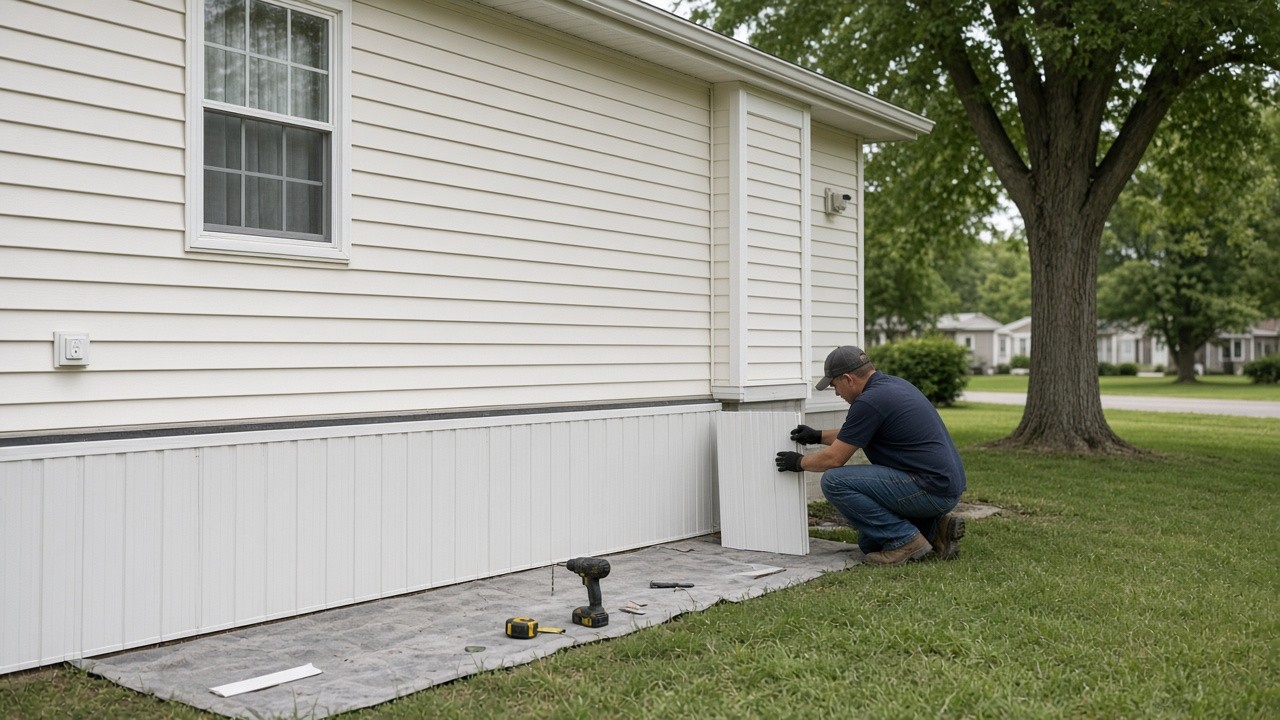
Skirting. Materials you install, venting, access panels, and how skirting helps keep pipes from freezing.
Winter. Heat tape, underbelly insulation repair, frozen water lines, and what owners can safely check before calling. Say whether you take emergency frozen-pipe calls and how you prioritize them in a cold snap.
Parts sized for manufactured homes
Manufactured homes often use windows, doors, water heaters, furnaces, and plumbing parts sized for them. Owners who buy standard parts at a big-box store often find they do not fit.
Say whether you stock or order manufactured home windows, doors, and fixtures, whether you sell parts to owners who do their own work, and how long orders usually take.
Service pages that match real jobs
- Leveling and piers — signs, inspection, adjustment
- Anchoring and tie-downs — inspection and replacement
- Skirting — materials, venting, access panels
- Underbelly and plumbing — water lines, drains, belly board repair
- Heat tape and winter service — frozen pipes, prevention
- Roofs and roof coatings — only what you install
- Windows and doors — sized for manufactured homes
- Floors — soft spots, subfloor replacement
- Home moves and setups — only if you are set up for them
- Service areas — towns and communities with real jobs
Proof that belongs on a URL you own
- Photos of real jobs with town and job type in the caption: piers, new skirting, belly repairs, replaced windows
- Before and after photos of floors and skirting
- Reviews on a page you own, with town and job when allowed, plus a link to Google Business
- License and insurance facts, and any state installer licensing you hold
- Warranty terms in plain text
The request path is the conversion
A good request form asks for:
- Name, phone, email
- Address, town, and community name if any
- Year, size, and manufacturer from the data plate, with a photo if possible
- Owned land or land-lease community
- The problem, with photos
- Whether community approval is needed or already given
- Urgent or planned
Put the form on its own URL so Google Business posts, community managers, and AI answers can link to it. Keep click-to-call in the header.
Content that feeds search and AI without theater
- Where to find the data plate on your manufactured home
- Signs your manufactured home needs leveling
- How to keep manufactured home pipes from freezing in an Iowa winter
- Skirting options, and what community managers usually want to see
- Why standard windows often do not fit manufactured homes
- Short job notes: town, home year, problem, what we fixed
Your website stays the source of record for customers and for AI assistants like ChatGPT, Gemini, and Grok. Google Business, Facebook, and community newsletters can point back to it. Keep your true services, towns, and licensing on a page you own.
Bots now make a large share of web requests. Manufactured home owners still hire specialists, and they still look for proof you know these homes before they call. Search is changing, and machines more and more decide which companies an owner hears about first. Plain-text services, parts, rules, and real jobs on a domain you own keep you in that short list.
Design rules that fit the trade
- Fast on mobile
- Click-to-call in the header, with a winter emergency note in cold months
- High-contrast text and real photos with captions
- Navigation: Services, Leveling and anchoring, Skirting, Winter service, Parts, Communities we serve, Reviews, Request service
- No fake reviews or badges
- You own the domain, hosting, and content
What Upley does for shops like this
Upley builds and hosts websites for Iowa and Midwest service businesses. For a manufactured home service company that means clear pages for the jobs specific to these homes, a data plate page, community and approval pages, a request form that asks the right questions, hosting that stays up for daily crawls, and an easy way to post jobs without turning your crew into marketers.
Same Iowa web team that ran Big Ten Web Design — design, hosting, SEO — plus the modern layer so search and AI can find the true file about your services, towns, and communities.
If your current site says “home repair” and never mentions manufactured homes, start with the homepage five facts, a data plate page, and a winter service page. Then build from the request form.
Book 30 minutes: /half-hour-meeting/ Call 319-535-2508 · aaron@upley.com Iowa City, Cedar Rapids, Quad Cities / Davenport