
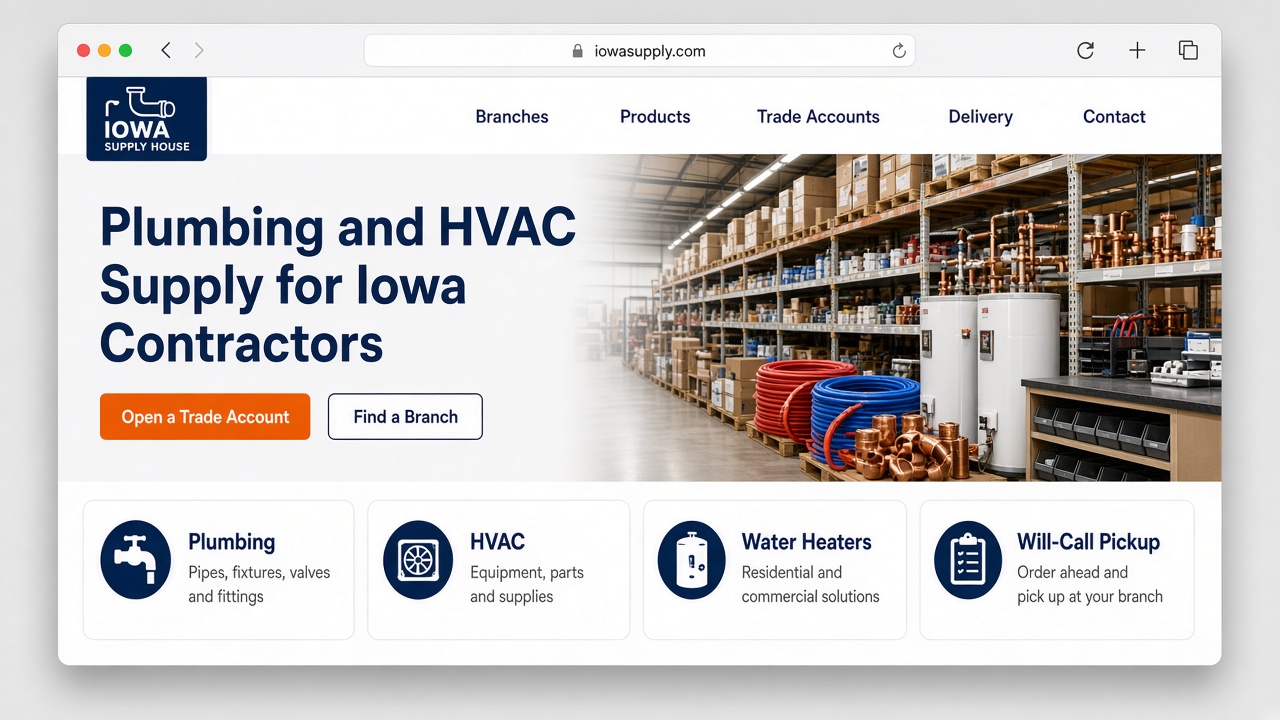
A plumbing and HVAC supply house website has one job: help a contractor know you have what they need, which branch has it, when the counter opens, and how to get an account. Put your branches and hours, the lines you carry, will-call and delivery rules, and how to open a trade account in plain text on a site you own. That is the marketing. Design is making the branch page and the phone number easy to hit from a truck at 6:40 in the morning.
Most supply houses lean on relationships, outside sales, and maybe a manufacturer’s ordering portal. Those still work. But the new plumber who just went out on his own, or the HVAC tech who moved here from Des Moines, does not know your counter guys yet. He searches, or he asks his phone. The supply house whose site answers his questions plainly is the one he walks into first.
Who is reading the site
Supply house websites get a few kinds of readers.
Contractors who already buy from you. They want branch hours, holiday hours, the counter phone number, and whether the branch by the job site stocks the part. If they can find that in ten seconds, they stop calling the wrong branch.
New contractors and new shops. They want to know what lines you carry, how credit works, what it takes to open an account, and whether you deliver to job sites.
Facility and maintenance buyers. School districts, hospitals, apartment managers, and plants buy parts too. They want to know if you take purchase orders, tax-exempt certificates, and net terms.
Homeowners and DIY folks. Some supply houses sell to the public and some do not. Say which, plainly, so you do not get the call or lose the sale.
Search engines and AI assistants. When someone asks ChatGPT, Gemini, Grok, or Google where to get a Rheem water heater same day in Cedar Rapids, or who stocks mini-split line sets near Davenport, those tools look for plain facts on pages they can read. A logo wall and a “call for details” page gives them very little.
What the homepage has to say in the first screen
In plain HTML text, not baked into a graphic:
- What you supply: plumbing, HVAC, hydronics, water heaters, well and water treatment, or all of it
- Who you sell to: trade only, or trade and the public
- Your branches by town, with today’s counter hours
- One clear button: Open a Trade Account, plus a tap-to-call counter number
- Delivery area and cutoff time for next-day or same-day delivery
Keep the photo of your counter or your warehouse aisle. Just put the words on top of it or beside it as real text.
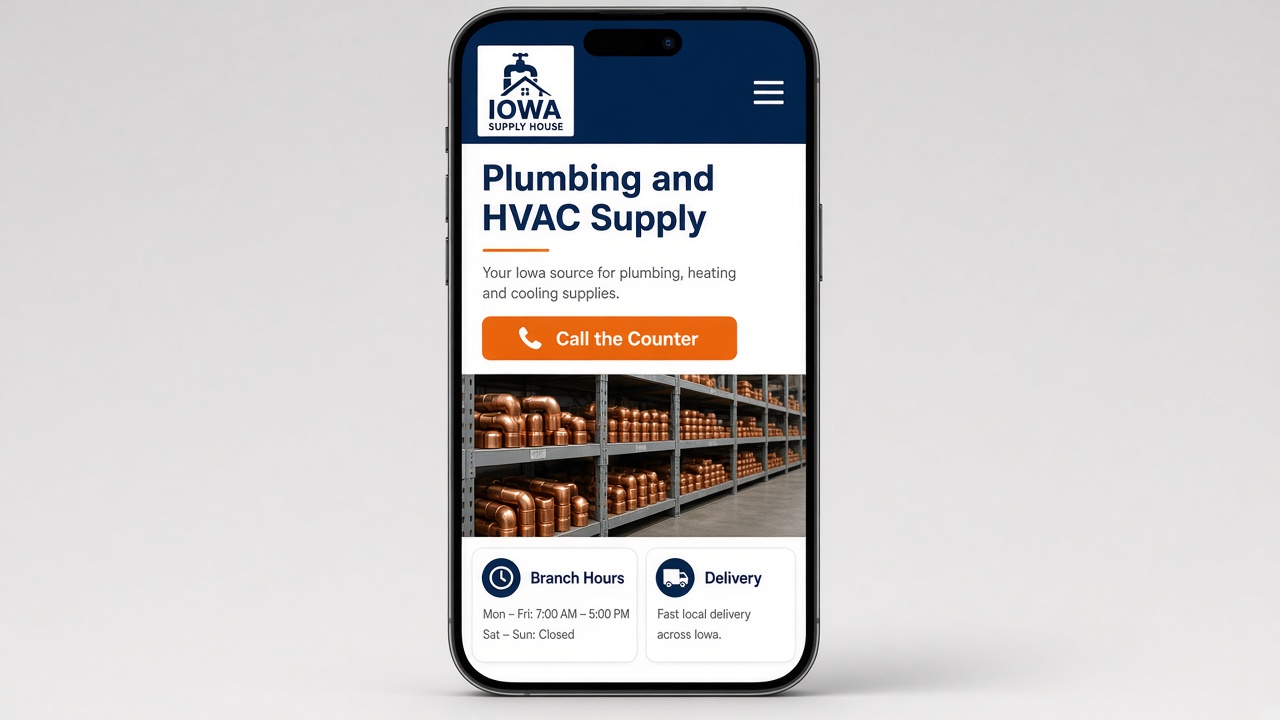
A page for every branch
This is the page contractors look at most, and the one many supply houses skip.
- Street address, a map, and where to park a work truck or trailer
- Counter hours, will-call hours, and holiday hours, kept current
- The counter phone number for that branch, not just the main office
- Branch manager and counter staff names, with the okay of each person
- What that branch stocks deep: water heaters, boilers, ductwork, PEX, commercial plumbing
- After-hours or emergency pickup, if you offer it, and exactly how to use it
A branch page titled “Iowa City branch, Highway 1” with real hours does more for a contractor, and for a search engine, than one locations page with five addresses in a list.
The lines you carry, in words
Contractors pick a supply house partly on brands. Do not hide them in a row of logos.
- A page for each category: water heaters, fixtures, boilers and hydronics, furnaces and air conditioners, mini-splits, ductwork and sheet metal, pipe and fittings, pumps, water treatment, tools
- Under each, the brands you stock in plain text, and which ones you keep on the shelf versus order in
- Warranty and parts help: whether you handle warranty swaps at the counter and how long it usually takes
- Equipment you are a stocking distributor or authorized dealer for, if the manufacturer lets you say so
You do not need a full online catalog with live stock and pricing. A clear “here is what we carry and who to call about it” page beats a broken catalog every time.
How to open a trade account
New contractors are your growth. Make it simple for them.
- Who qualifies: licensed plumbers, HVAC contractors, mechanical contractors, facility departments
- What you need from them: business info, license number if required, tax-exempt certificate if it applies
- How credit and terms work, in general words, and how long approval usually takes
- A short online application or a printable form, plus a person’s name to call
- What they get with an account: account pricing, job accounts, delivery, online invoices
A plain “Open a Trade Account” page saves your credit department the same explanation every week.
Will-call, delivery, and ordering
- How will-call works: call or email the order, when it will be ready, and where to pull up
- Delivery area by town, delivery days, and the order cutoff time
- Job-site delivery rules: who signs, what happens if nobody is there
- Whether you take orders by text, email, or an online portal, and which branch handles it
- Returns and restocking rules, written plainly
If you use a distributor ordering platform, link it from your site. The platform can change. Your branches, hours, and policies should stay on your own domain.
Training, events, and counter days
Supply houses do a lot that never makes it online.
- Manufacturer training and certification classes, with dates and sign-up
- Continuing education hours, if your classes count, and for which license
- Counter days, vendor days, and cookouts, with the date and branch
- New product notes: a new tankless line, a refrigerant change, a code change your customers are asking about
Each event gets its own short page with the date, branch, and how to sign up. Then the past ones stay up with a few photos. That builds a record of your business that search and AI can read.
Proof that belongs on a URL you own
- How long you have been in business and the towns you serve
- Photos of your real counters, warehouses, trucks, and people, with permission
- Notes from contractors about fast will-call or a part found on a Saturday, quoted only with permission
- Community and trade work: apprenticeship programs, trade school support, local association sponsorships
- Your company name, branch addresses, and phone numbers written the same way everywhere
Content that feeds search and AI without theater
Good pages for a supply house read like answers your counter gives every day:
- What to bring to the counter to get the right water heater replacement
- Gas, electric, or tankless: what contractors in our area are installing and why
- What the refrigerant change means for the equipment we stock
- Sizing questions to answer before you order a mini-split
- How to get a part on a warranty claim, start to finish
- Which of our branches stocks commercial plumbing and hydronics
Each one answers a real question. Add a photo from your own counter or warehouse. That is the kind of page that gets a supply house named when a contractor asks his phone who has it in stock nearby.
Why the website matters more now
Websites and search are changing. They still matter, and for supply houses they matter more now. Bots now make a large share of web requests. Cloudflare’s Matthew Prince has said bots passed humans on Cloudflare’s network in mid-2026, about 57% bots and 43% humans. That counts HTTP requests, not hours of human attention. Contractors still need parts this morning, and they still look first. More and more, ChatGPT, Gemini, Grok, and Google’s AI answers decide which supply houses a contractor hears about. Those tools look for clear facts: what you carry, which branch, what hours, who you sell to, and how to open an account.
Your website should be the source of record. Your Google Business listings, manufacturer dealer locators, LinkedIn, and ordering portal can all point back to it. Keep the true branches, hours, lines, and policies on a domain you own.
Design rules that fit a supply house
- Real photos of your counters, aisles, and trucks, compressed so pages load fast on a job site
- Large headings, a tap-to-call counter number, and a Find a Branch button near the top of every page
- Navigation: Branches, Products, Trade Accounts, Delivery, Training, Contact
- Hours, lines carried, and policies in real text, not images or PDFs, so search and AI can read them
- Holiday hours and closures easy for you to update without calling a developer
- You own the domain, hosting, and content, not a template company or a manufacturer program
What Upley does for plumbing and HVAC supply houses
Upley builds and hosts websites for Iowa and Midwest service businesses. For a supply house that means a clean first screen, a real page for each branch with current hours, product pages that list your lines in words, a plain trade account page, delivery and will-call rules, and training pages people can sign up from. We also make it easy to post a few photos from a counter day or a new product delivery with a short caption to your website, social, and Google Business.
Same Iowa web team that ran Big Ten Web Design, handling design, hosting, and SEO, plus the modern layer so search and AI can find the true facts about your business.
If your current site is a homepage, a logo wall, and one locations page, start with the five first-screen facts, a page for each branch, and a trade account page. Then add product pages one category at a time, starting with water heaters.
Book 30 minutes
Thirty minutes. Iowa time. No deck.
Iowa City, Cedar Rapids, Quad Cities / Davenport