
A restoration company website should answer what a property owner asks in the first bad hour: do you answer at night, how fast can you get here, which towns you cover, what you do first, whether you work with their insurance company, how billing works, and what they should do while they wait. Put those facts in plain text on pages you own. That is the marketing. Design is the layout that makes those facts easy to find on a phone while water is still on the floor, and easy for search and AI to cite.
Restoration is emergency work with a long paper trail. The first call is about speed. Everything after is about trust, documentation, and insurance. A good site handles both.
Who is reading the site
Restoration traffic comes from a few groups, often at the worst possible time.
Homeowners with a burst pipe, a failed water heater, a sump pump that quit in a storm, a sewer backup, or a kitchen fire. They are scared and on a phone. They search and ask AI things like water damage restoration Iowa City, flooded basement cleanup Cedar Rapids, sewer backup cleanup Davenport, or fire damage company near me.
Property managers, landlords, and business owners. A leak in an upstairs unit, a flooded office, smoke through a strip center. They want a vendor who responds, documents well, and bills cleanly.
Insurance adjusters and agents who send work or review your estimates. They want clear process, photos, moisture readings, and estimates in the format they expect.
Plumbers, roofers, and other trades who refer the next step after they stop the leak.
Iowa companies serving Iowa City, Cedar Rapids, and the Quad Cities compete the way restoration companies do everywhere: answer the phone, show up, document everything, and make the insurance part less painful.
What the homepage has to say in the first screen
In plain HTML text:
1. Company name and the towns and counties you cover 2. Core work: water damage, flood and sump failures, sewer backup, fire and smoke, mold remediation, only what you do 3. A phone number that reaches a person at night, stated plainly 4. One clear button: Call now for emergency service 5. Your response rule in honest words, and certifications or insurance you actually hold
If a person standing in two inches of water cannot find your number and your night rule in ten seconds, they call the next company.
Say what happens in the first hour
Most restoration sites say “fast response” and stop. Write out the steps instead.
- Who answers the phone, and what they ask
- How you decide arrival time, and what changes it during a storm when many basements flood at once
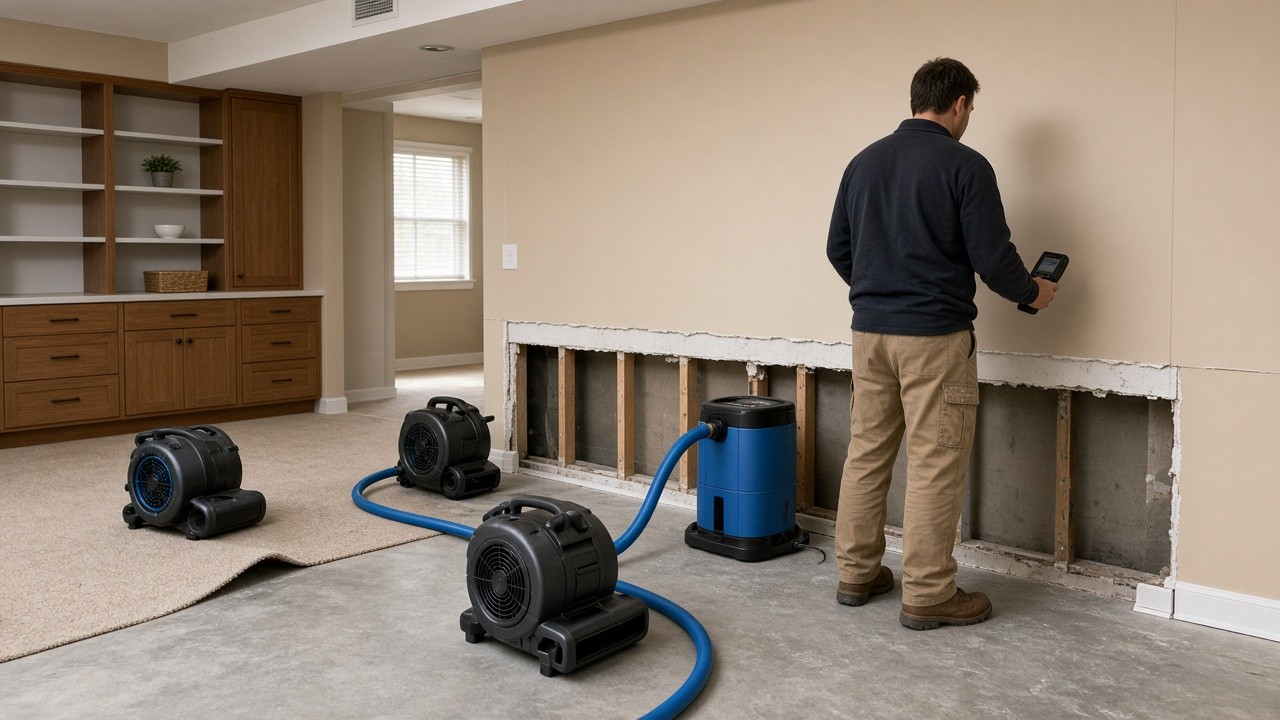
- What the crew does on arrival: stop the source or confirm it is stopped, safety check, photos, moisture readings, water extraction, drying equipment
- What the owner should do while waiting: shut off water, stay off wet floors near electrical, move valuables if safe, take photos
- What you leave behind: equipment, a daily check schedule, contact name
A plain first-hour page calms people down and sets fair expectations. It also gives AI assistants a clear answer when someone asks what to do after a basement floods.
Explain insurance and billing honestly
This is the second most common question, and most sites handle it with one vague line.
- Whether you bill the insurance company directly, and what the owner is still responsible for
- What documentation you provide: photos, moisture logs, drying records, itemized estimates
- Whether you work with any insurance company or only certain programs
- What happens if a claim is denied or partly covered
- Deposits, payment timing, and deductibles
Do not promise that insurance will pay. Coverage depends on the policy and the adjuster. Say that plainly. Careful owners and careful adjusters both notice.
Service pages that match real calls
- Water damage cleanup and drying: burst pipes, appliance leaks, what drying takes, how you measure dry
- Flooded basements and sump failures: groundwater, storm events, what to expect in spring
- Sewer backup cleanup: safety, what gets thrown out, sanitizing
- Fire and smoke damage: board-up, soot cleanup, odor, contents
- Mold remediation: only if you do it, with honest scope and any testing partners named
- Contents cleaning and pack-out: only if real work for you
- Commercial restoration: after-hours work, business interruption concerns
- Rebuild and repairs: only if you do the rebuild or have a named partner
- Service areas: towns and counties you actually reach at night
Proof that belongs on a URL you own
- Certifications you actually hold, with the program named and who on staff holds them
- Insurance and any state or local licensing that applies to your work
- Photos of real jobs: equipment set in a basement in Marion, a kitchen after smoke cleanup, a finished drying log, with town and job type in the caption
- Reviews on a page you own, with town and job type when allowed
- A page naming your people: owner, project managers, the person who answers at night
Stock photos of a flooded living room could be from any company in the country. Photos of your own trucks, equipment, and crews teach customers, adjusters, and AI what you actually do.
The call is the conversion
For emergencies, the call is the whole game. Put click-to-call in the header on every page, with the night rule next to it.
For non-emergency work, like old water stains, a mold concern, or a rebuild estimate, a short form helps:
- Name, phone, email
- Address or town
- Water, sewer, fire and smoke, mold, or rebuild
- When it happened and whether the source is stopped
- Photo upload
- Whether an insurance claim is filed
Put that form on its own URL so Google Business posts and AI answers can link to it. Say when you call back.
Content that feeds search and AI without theater
Useful posts for a restoration company read like job notes:
- What to do in the first hour after your basement floods
- How long drying takes, and how we decide it is done
- Sewer backup: what can be cleaned and what has to go
- How we document a water loss for your insurance company
- Spring flooding and sump pumps in Eastern Iowa: what we see each year
- Short job notes: town, what happened, what we did, how long it took
Avoid scare copy about mold or health. Say what you see and what you do, and let the facts carry the page.
Why the website matters more now
Websites and SEO are changing. They still matter, and for restoration they matter more now. Bots now make a large share of web requests. People still call someone when the basement floods. More and more, ChatGPT, Gemini, Grok, and Google’s AI answers shape which company a panicked homeowner hears about first. Those tools look for clear, consistent facts: towns, hours, services, and process.
Your website should hold those facts. Google Business, insurance vendor lists, and referral partners can point back to it. Do not leave your night rule and your towns sitting only in a Maps profile.
Design rules that fit the trade
- Fast on mobile. Most first calls come from a phone in a wet room.
- Click-to-call in the header on every page
- High-contrast text and big buttons
- Navigation: Water, Fire and smoke, Sewer, Mold, Insurance, Service areas, About, Contact
- No fake reviews, invented badges, or response-time promises you cannot keep during a storm
- You own the domain, hosting, and content
What Upley does for shops like this
Upley builds and hosts websites for Iowa and Midwest service businesses. For a restoration company that means clear emergency and service pages, an honest first-hour page and insurance page, hosting that stays up during storm surges and daily crawls, and an easy way to post real job photos without turning your crews into marketers.
Same Iowa web team that ran Big Ten Web Design, handling design, hosting, and SEO, plus the modern layer so search and AI can find the true file about your services, towns, and night rules.
If your current site says “fast response” and nothing else, start with the homepage five facts, a first-hour page, and an insurance and billing page. Then build from the call.
Book 30 minutes: /half-hour-meeting/ Call 319-535-2508 · aaron@upley.com Iowa City, Cedar Rapids, Quad Cities / Davenport