
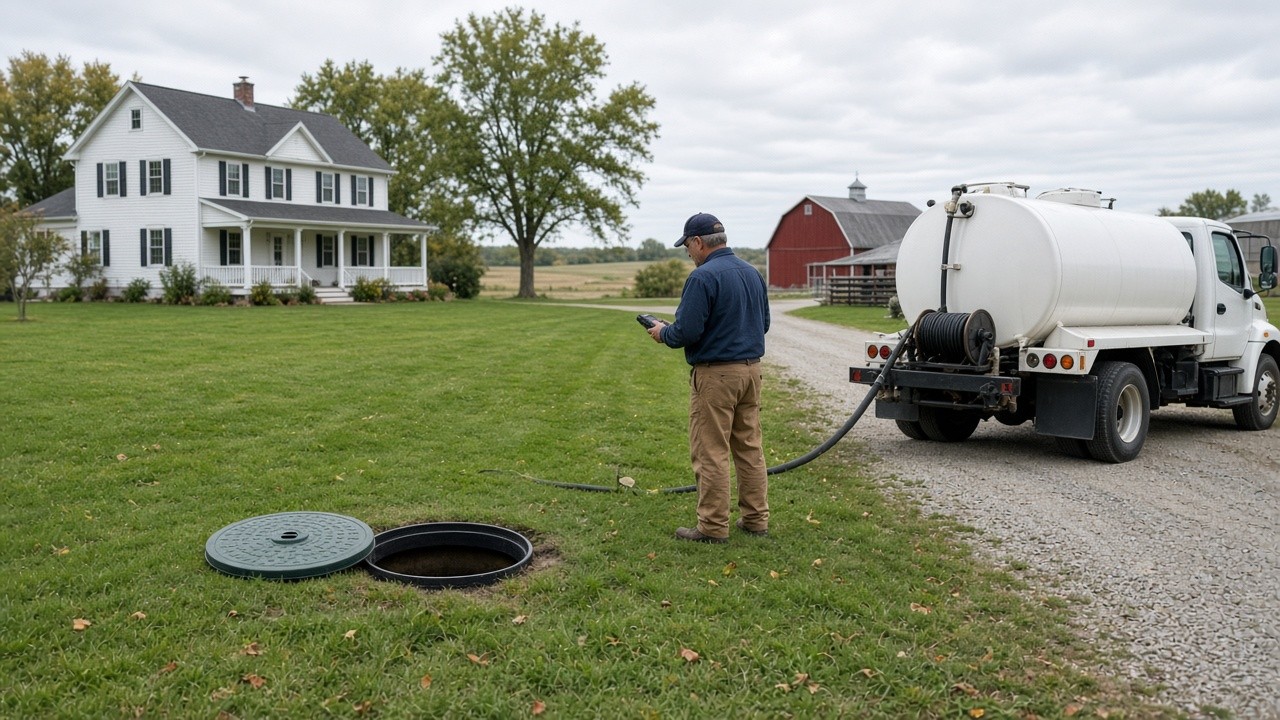
A septic company website should answer what a rural homeowner, buyer, seller, or real estate agent asks before they call: whether you pump, inspect, repair, or install, which counties you cover, how the Iowa time-of-transfer inspection works and whether your inspectors are certified, who pulls the county permit for a new system or repair, what to do when the system backs up, how often a tank should be pumped, and how to book. Put those facts in plain text on pages you own. That is the marketing. Design is the layout that makes those facts easy to find on a phone and easy for search and AI to cite.
Many people think about their septic system about as often as they think about the water heater. When they do think about it, it is usually because something went wrong or because a house is being sold. Both moments come with a deadline.
Who is reading the site
Septic traffic comes from a few groups, and many of them live outside town.
Rural homeowners due for pumping, or who just noticed slow drains, gurgling, wet spots in the yard, or a smell. Some are dealing with a backup right now. They search and ask AI things like septic pumping Johnson County, septic backup emergency near Tipton, or septic service Cedar County.
Buyers, sellers, and real estate agents who need a septic inspection before a sale closes. They are on a schedule set by a purchase agreement and a lender.
Families building a new home on acreage who need a new system designed, permitted, and installed. They are working with a builder, a county sanitarian, and a soil evaluator, and they want to know where you fit.
Homeowners told their old system has failed or does not meet current rules. They want to know what replacement involves and how long it takes.
Iowa septic companies around Iowa City, Cedar Rapids, and the Quad Cities compete the same way septic companies across the rural Midwest do: be easy to find by county, explain the rules calmly, and answer the phone when the drains stop.
What the homepage has to say in the first screen
In plain HTML text:
1. Company name and the counties you serve 2. Core work: pumping, time-of-transfer inspections, repairs, new system installs — only what you do 3. Phone that reaches someone who books 4. One clear button: Schedule pumping / Book an inspection 5. Emergency or backup note if you take those calls, and certified, licensed, and insured if you can keep it honest
A family with sewage in the basement floor drain needs the number and the emergency line in the first screen.
Serve by county, and say so
Septic work is rural, so town names alone miss a lot of your customers. People often know their county and nearest town better than they know which township they live in.
Build service area pages by county. Name the counties, then list the towns and rural areas you cover inside each one. Say whether travel distance affects scheduling or cost, stated as a factor. Say which counties you do inspections in and which you install in, if they differ.
A county page with real jobs on it helps a homeowner near West Branch or Lisbon find you. It also helps AI assistants answer “who pumps septic tanks in Cedar County” with your name.
Explain time-of-transfer inspections plainly
In Iowa, most sales of a property with a septic system require an inspection by a DNR-certified inspector before the deed transfers. There are exemptions and details that change, so point people to the Iowa DNR and their county for the current rules.
Buyers, sellers, and agents are the ones asking. Give them a page that covers:
- Whether your inspectors are certified by the Iowa DNR, and their names if they agree
- What your inspection includes: locating the tank, pumping if needed, checking baffles and the absorption field, and the report
- How far out you are booking inspections, and whether you can rush one for a closing
- Who gets the report and how long it takes
- What happens when an inspection finds a problem, and how a repair or replacement fits the closing timeline
- What access you need: tank lid location, clear path for the truck, frozen ground notes in winter
Agents who find a clear page like this will link to it and send clients to it. Keep it current and date it.
Permits and new systems
New systems and major repairs go through the county. Homeowners and builders often do not know the order of steps.
Explain what you do and what they do:
- Who orders the soil evaluation or percolation test
- Who designs the system and submits the permit to the county sanitarian or environmental health office
- What types of systems you install, only the ones you do
- How weather and frozen ground affect install timing
- What the county inspects before the system is covered
- How long the process usually takes from permit to working system, stated as a range of steps
Link to the county offices you work with most. You are helping a family through a process they have never done.
Service pages that match real jobs
- Septic tank pumping — what a visit includes, how often tanks usually need it, reminder service if you offer one
- Time-of-transfer inspections — as above
- Emergency backups — hours, what to do before you arrive
- Septic repairs — baffles, lids, lines, pumps, alarms
- New system installation — types you install, permit process
- System replacement — failed or non-compliant systems
- Lift stations and effluent pumps — only if you service them
- Service areas — counties and towns with real jobs
Proof that belongs on a URL you own
- Photos of real jobs with county and job type in the caption: open tanks, new installs, repaired baffles, trucks on site
- Reviews on a page you own, with town and job type when allowed, plus a link to Google Business
- DNR certification and installer licensing facts, and how to verify them
- Insurance facts
- Warranty terms in plain text for installs and repairs
Photos of your trucks in real farmyards tell rural customers you actually come out there.
The booking path is the conversion
A good booking form asks for:
- Name, phone, email
- Property address and county
- Pumping, inspection for a sale, backup or problem, repair, or new system
- For inspections: closing date and agent contact if they want you to coordinate
- Do they know where the tank lid is
- When the tank was last pumped, if known
- Photos of any wet spots or problem areas
Put the form on its own URL so agents, Google Business posts, and AI answers can link to it. Keep click-to-call in the header, with the backup line next to it.
Content that feeds search and AI without theater
- How Iowa time-of-transfer septic inspections work, and how to schedule one before closing
- How often should a septic tank be pumped? Our honest answer
- What to do when your septic backs up at night
- What not to flush or pour down the drain on a septic system
- Short job notes: county, what we found, what we did
- Building on acreage: the septic steps from soil test to finished system
Your website stays the source of record for customers and for AI assistants like ChatGPT, Gemini, and Grok. Google Business and Facebook can point back to it. Keep your true counties, certifications, and inspection process on a page you own.
Bots now make a large share of web requests. People still need septic service, often on a closing deadline or with a backed-up drain, and they still look you up first. Search is changing, and machines more and more decide which companies a homeowner or agent hears about first. Plain-text counties, inspection steps, permits, and real jobs on a domain you own keep you in that short list.
Design rules that fit the trade
- Fast on mobile. Rural connections can be slow, so keep pages light.
- Click-to-call in the header, with the backup line next to it
- High-contrast text and real photos with captions
- Navigation: Pumping, Inspections, Repairs, New systems, Counties we serve, Reviews, Book service
- No fake reviews or certifications you do not hold
- You own the domain, hosting, and content
What Upley does for shops like this
Upley builds and hosts websites for Iowa and Midwest service businesses. For a septic company that means county service pages, a time-of-transfer page agents can send clients to, clear permit and install steps, a booking path that works from a phone, hosting that stays up for daily crawls, and an easy way to post real jobs from the truck without turning your crew into marketers.
Same Iowa web team that ran Big Ten Web Design — design, hosting, SEO — plus the modern layer so search and AI can find the true file about your services, counties, and certifications.
If your current site is one page with a truck photo and a phone number, start with the homepage five facts, county pages, and a time-of-transfer page. Then build from the booking form.
Book 30 minutes: /half-hour-meeting/ Call 319-535-2508 · aaron@upley.com Iowa City, Cedar Rapids, Quad Cities / Davenport