
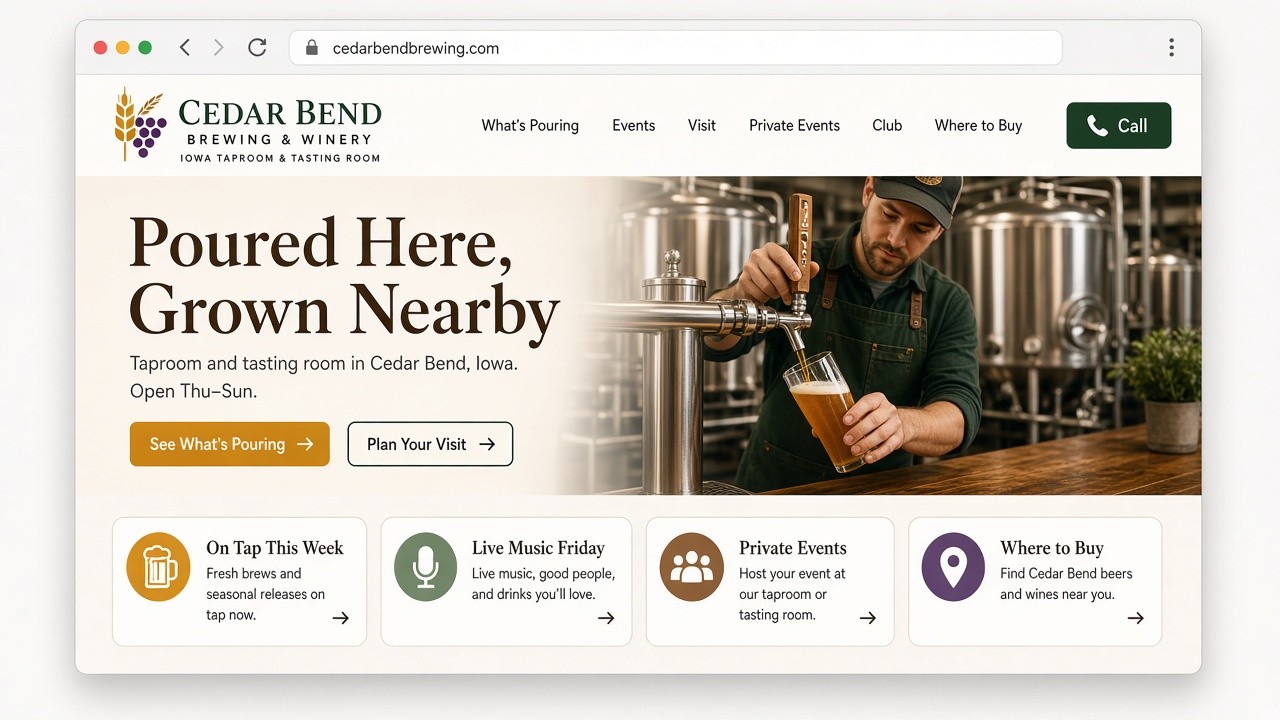
A winery or brewery website should answer what people ask before they pick a place for Saturday: what is pouring right now, when you are open this week, who is playing and which food truck is out back, whether kids and dogs can come, whether a group of twelve needs to call ahead, and where to buy your cans or bottles at home. Put those answers in plain text on pages you own, and keep the pour list dated. That is the marketing. Design is the layout that makes it easy to read on a phone in the car and easy for search and AI to cite.
Most taprooms and tasting rooms live on Instagram, Untappd, and a Facebook events tab. That works for regulars who already follow you. But the couple visiting for a weekend, the bachelorette planner, the HR person booking a team outing, and the person who asks their phone “breweries near me that allow dogs” are not scrolling your feed. They are asking a search engine or an AI assistant. If your site is a pretty homepage with a logo and an age gate, you are not part of that answer.
Who is reading the site
Winery and brewery traffic comes from a few groups.
Locals deciding where to go tonight. They want hours, what is on tap, the music, and the food.
Visitors and day-trippers. They are planning a route through wine country or a brewery crawl. They want hours, location, parking, and whether it is worth the drive.
Groups and event planners. Birthdays, rehearsal dinners, company outings, weddings. They want capacity, rules, rental fees, and how to book.
Stores, bars, and restaurants. They want to know if you self-distribute, who your distributor is, and how to get you on the shelf or on a tap handle.
Search engines and AI assistants. When someone asks ChatGPT, Gemini, Grok, or Google for a winery near Iowa City with live music, or a brewery in Cedar Rapids that serves food, those tools look for plain facts on pages they can read. A tap list baked into a photo of a chalkboard gives them almost nothing.
What the homepage has to say in the first screen
In plain HTML text, not baked into a graphic:
- Your name, your town, and how to find you, especially if you are out in the country
- What you make and pour: beer, wine, cider, mead, spirits, non-alcoholic options, and whether you serve food
- This week’s hours, including seasonal changes
- A link to what is pouring now
- Two clear buttons: See What’s Pouring and Plan Your Visit or Call
Skip the full-screen age gate if you can. A lot of small producers do not need one, and it can stand between a customer and your hours. If your state or your distributor requires it, keep it simple and make sure the page text behind it still loads.
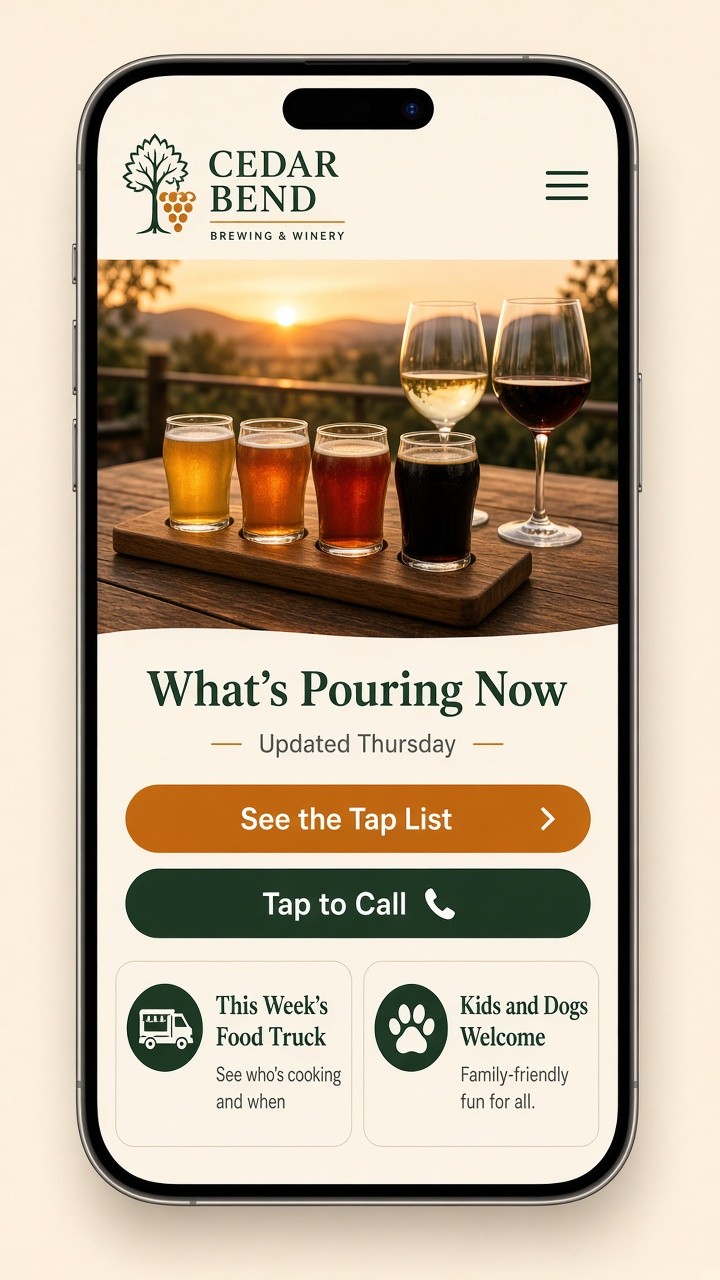
The dated what’s-pouring page is the page competitors skip
This is the one most taprooms and tasting rooms do not keep up on their own site, and it is the one customers want most. They hand it to an app or a chalkboard photo on Instagram. You can own it.
A simple page you update when a keg kicks or a new wine opens does the job:
- A date at the top: “Updated Thursday afternoon”
- What is pouring, with style, ABV, and a one-line description in your own words
- For wine: grape or blend, dry or sweet, and whether it is from your own vineyard or sourced fruit
- What just tapped and what is almost gone
- Non-alcoholic and gluten-reduced options, if you have them
- Flights, pours, and prices
Keep it short and keep it honest. “The hazy is gone until next Friday” saves a disappointed regular and earns trust. Over a season, those updates tell search and AI that your place is open and active, which is a lot more than a dusty homepage says.
Releases, cans, bottles, and wine club
Releases drive the biggest days of the year. Give each one a page:
- What is being released, the date and time, and how many you made, if you want to share it
- Limits per person, pre-sale rules, and pickup windows
- Club or mug club members: what they get, what it costs, and how pickup or shipping works
- Shipping: which states you can legally ship to, or a plain note that you cannot ship
- Gift cards, with a link to buy them
Write the club page for someone who has never joined one. What do I get, how much is it, how often am I charged, and how do I cancel.
Food, music, and the weekly calendar
Most people decide on a taproom or winery because of what is happening that night. Put it on a page you own:
- Food trucks by date, or your kitchen menu and hours if you have one
- Whether outside food is allowed
- Live music by date, with the act and the start time
- Trivia, run clubs, yoga, release parties, and holiday events
- Cover charges, if any
Post the calendar on your site first, then share it to Facebook and Instagram. When someone asks an AI assistant “live music at a winery near Cedar Rapids this weekend,” a dated calendar page on your own domain is the kind of answer it can read.
Visiting: kids, dogs, parking, and getting here
These are the small questions that decide whether a family comes at all. Answer them on one visit page:
- Are kids welcome, and until what time
- Are dogs allowed inside, on the patio, or not at all
- Parking, accessibility, and whether a bus or limo can pull in
- Rides home: local cab or ride options, and a plain nudge to plan one
- Directions in words, especially for rural wineries where GPS gets it wrong
- Weather: patio season, heated spaces, and what happens when it rains
“Dogs welcome on the patio, not inside” is a sentence a lot of people search for. Put it in text.
Private events, groups, and weddings
Group business is steady money. Give it its own pages:
- Spaces you rent, how many people each holds, and what is included
- Group size that needs a reservation, and how to make one
- Rental fees, minimums, or what drives the price
- Food and bar rules: your food, a caterer, or bring your own
- Weddings, if you host them: dates open, rain plan, and what the venue includes
- A simple inquiry form that asks for date, head count, and type of event
Do not hide event pricing behind a PDF. Ranges and plain rules save you a dozen back-and-forth emails.
Wholesale and where to buy
If your cans or bottles are on shelves, tell people where:
- A where-to-buy list by town, kept current
- Bars and restaurants that pour you
- Who your distributor is, or how stores can order direct if you self-distribute
- A contact for accounts, with a name and email
When someone asks “where can I buy Cedar Bend beer in Davenport,” that list is the answer.
Proof in plain text
People want to know you are real and that the drinks are good.
- Who you are, who makes the beer or wine, and how you started
- Your vineyard or ingredients: what you grow, what you source, and from where
- Awards you actually won, with the name and year
- Photos from your own taproom, tanks, and vineyard, not stock glasses of wine
- Reviews on a page you own, plus a link to Google Business
Do not invent medals or post photos that are not yours. State what you can back up.
Content that feeds search and AI without theater
Useful posts for a winery or brewery read like notes from the cellar:
- What is tapping this weekend, and why we brewed it
- Harvest update: how the grapes look this year
- Dry, semi-sweet, and sweet: how to pick a wine on our list
- What a mug club actually gets you
- A first-timer’s guide to a flight
- How we plan a brewery stop for a group of twenty
Each one answers a real question with your own photo. Snap a picture when the new beer hits the board or the grapes come in. That is a post. That is the kind of page that gets a taproom or winery named when someone asks where to go this weekend.
Why the website matters more now
Websites and SEO are changing. They still matter, and for wineries and breweries they matter more now. Bots now make a large share of web requests. Cloudflare’s Matthew Prince has said bots passed humans on Cloudflare’s network in mid-2026, about 57% bots and 43% humans. That counts HTTP requests, not hours of human attention. People still drive out, sit on the patio, and buy a four-pack. More and more, ChatGPT, Gemini, Grok, and Google’s AI answers decide which places a customer hears about first. Those tools look for clear facts: what you pour, when you are open, what is happening, and where you are.
Your website should be the source of record. Instagram, Facebook, Untappd, Google Business, and the chalkboard can all point back to it. Keep your true hours, pour list, events, visit rules, and where-to-buy list on a domain you own.
Design rules that fit a winery or brewery
- Fast on a phone: light pages, compressed photos, text first
- Hours, directions, and Call one tap from any page
- Navigation: What’s Pouring, Events, Visit, Private Events, Club, Where to Buy
- Tap list, hours, events, and policies in real text, not images or PDFs
- Your own photos with short captions, not stock glassware
- A pour list and calendar you can update from a phone in two minutes
- You own the domain, hosting, and content
What Upley does for companies like this
Upley builds and hosts websites for Iowa and Midwest businesses. For a winery or brewery that means plain-text pages for what you make and pour, a what’s-pouring page you can update from your phone, release and club pages, a weekly calendar for food and music, a visit page with kid and dog rules, private event pages, a where-to-buy list, and an easy way to post photos from the taproom with a few words.
Same Iowa web team that ran Big Ten Web Design, handling design, hosting, and SEO, plus the modern layer so search and AI can find the true file about your place, what is pouring, and when you are open.
If your current site is a logo, an age gate, and an Instagram link, start with the homepage five facts, a dated what’s-pouring page, and a visit page. Then add the events calendar and a private events page before the holiday party season.
Book 30 minutes
Thirty minutes. Iowa time. No deck.
Iowa City, Cedar Rapids, Quad Cities / Davenport