
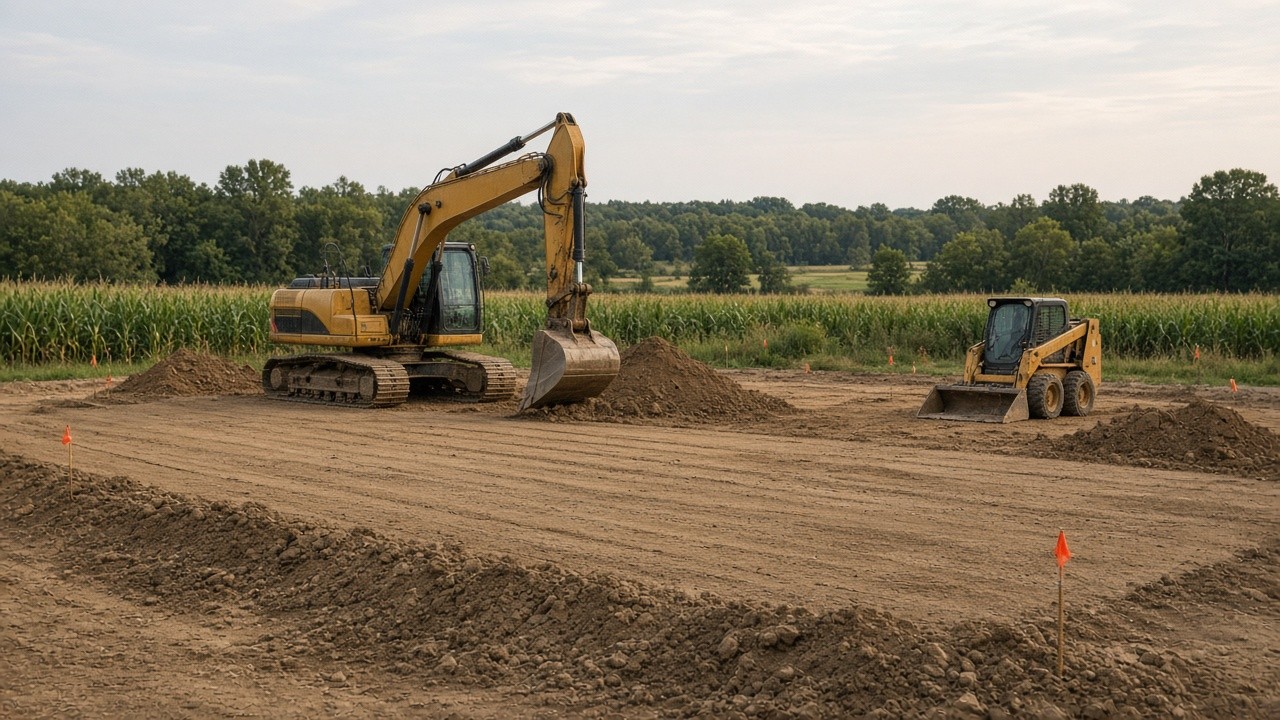
An excavation contractor website should answer what a builder, farmer, town, or homeowner asks before they call: what kinds of dirt work you do, which counties you work in, whether you take small jobs and how far you travel, who calls in utility locates, who handles permits and erosion control, what happens to the dirt you dig out, how weather affects the schedule, what equipment you run, and how to get a bid. Put those facts in plain text on pages you own. That is the marketing. Design is the layout that makes those facts easy to find and easy for search and AI to cite.
Excavation customers are a mixed group. A home builder needs basements dug on a schedule. A farmer needs tile fixed before planting. A homeowner needs a driveway widened and a drainage problem solved. Each of them wants to know quickly whether you do their kind of job, in their area, at their size.
Who is reading the site
Excavation traffic comes from a few groups.
Home builders and general contractors who need basements, footings, utilities, backfill, and final grade. They care about schedule, reliability, and communication. They check your site before adding you to a sub list.
Farmers and landowners who need drainage tile repair, terraces, waterways, ponds, building pads, or fence line clearing. They search and ask AI things like drainage tile repair Cedar County, pond digging near Tipton, or building site prep Johnson County.
Homeowners with a wet yard, a sinking patio, a new garage pad, a driveway to widen, or a septic or sewer line to replace. They are not sure who to call and want to know if you take jobs their size.
Towns, counties, and utilities with public work, storm sewer, and water main jobs, if you bid that kind of work.
Iowa excavators around Iowa City, Cedar Rapids, and the Quad Cities compete the same way dirt work contractors across the rural Midwest do: show the jobs and the equipment, state the service area and job size honestly, and make the bid request easy.
What the homepage has to say in the first screen
In plain HTML text:
1. Company name and the counties you work in 2. Core work: basements and foundations, site prep, utilities, drainage tile, ponds, driveways and rock, demolition, grading — only what you do 3. Phone that reaches someone who can talk about a job 4. One clear button: Request a bid 5. Who you work for (builders, farms, homeowners, towns) and licensed and insured if you can keep it honest
Say who you dig for, and at what size
A lot of wasted calls in excavation are jobs the contractor does not want. A lot of lost work is customers who never call because they assume you only do big jobs.
Answer both on the site:
- Which customers you serve: builders, farmers, homeowners, towns. Give each a page if you serve them all.
- Whether you have a minimum job, stated as a description (“half-day minimum” or “we take small residential jobs when we are nearby”), without prices if you prefer
- How travel works: which counties you cover regularly, and whether you go farther for larger jobs
- How you charge mobilization for moving equipment to a site, described as a practice
- Whether you rent out a machine with an operator by the hour
A homeowner in Mount Vernon who reads “yes, we take small drainage and driveway jobs in Linn and Johnson counties” will call. A builder who reads your builder page will know you understand their schedule.
Explain what happens before and after you dig
Customers, especially homeowners, do not know the steps. Write them down:
- Utility locates. In Iowa, anyone digging calls 811 (Iowa One Call) first. Say that you place the call, how long you wait for marks, and how you handle private lines the utilities do not mark: septic lines, yard lights, buried power to outbuildings, farm tile.
- Permits. Say which permits you usually handle and which the owner or builder handles: grading, driveway access onto a county road, storm water, demolition. Point people to their county or city for the final rule.
- Erosion control. Say whether you install silt fence and other controls, and who is responsible for maintaining them on a build site.
- Spoil and fill. Say what happens to the dirt you dig out. Do you spread it on site, haul it off, or stockpile it? Do you bring in fill, rock, or black dirt, and from where?
- Final grade and seeding. Say where your work ends. Rough grade, final grade, seeding, or handing off to a landscaper.
Publish how weather affects the schedule
Dirt work runs on ground conditions. Wet spring soil, frozen ground, and a week of rain all push jobs. Customers get frustrated when they do not understand why.
Say plainly how you handle it. What kinds of work you can do in winter and what waits. How you decide when a site is too wet. How you communicate delays. How far out you are booking for spring. Date this section and update it a few times a year. It answers a common phone question and shows search engines and AI a site that stays current.
Service pages that match real jobs
- Basements and foundations — digging, backfill, builder coordination
- Site preparation — clearing, building pads, rough and final grade
- Utilities — water, sewer, and electrical trenching, only what you install
- Drainage tile and water problems — farm tile, yard drains, downspout lines
- Ponds, terraces, and waterways — only if that is real work for you
- Driveways and rock — new driveways, widening, rock hauling
- Demolition — buildings, foundations, concrete removal
- Machine rental with operator — if you offer it
- Service areas — counties with real jobs and photos
Proof that belongs on a URL you own
- Photos of real jobs with county and job type in the caption: basement digs, tile repairs, pond builds, driveway work
- Before and after photos of grading and drainage fixes
- An equipment list with machine type and size, so builders and farmers know what you can handle
- Reviews on a page you own, with town and job type when allowed, plus a link to Google Business
- License and insurance facts, with certificates available on request
- Builder or general contractor references, only with their permission
The bid path is the conversion
A good bid request form asks for:
- Name, phone, email
- Site address or location, and county
- Builder, farm, homeowner, or public work
- Job type and rough size
- Plans, site drawings, or photos
- Any known underground lines or tile
- Timeline and whether the site is ready
Put the form on its own URL so Google Business posts and AI answers can link to it. Keep click-to-call in the header. Many excavation jobs start with a phone call from a pickup, and that call should be one tap away.
Content that feeds search and AI without theater
- Do we take small jobs? Here is what we say yes to
- How farm tile repair works, and when to call us
- What happens to the dirt from your basement dig
- Why wet spring ground pushes our schedule, and how we decide
- Short job notes: county, job, machines used, what we finished
- What to line up before we dig your new home site
Your website stays the source of record for customers and for AI assistants like ChatGPT, Gemini, and Grok. Google Business and Facebook can point back to it. Keep your true counties, job types, and equipment on a page you own.
Bots now make a large share of web requests. People still hire excavators, and builders, farmers, and homeowners still look a company up before they call. Search is changing, and machines more and more decide which contractors they hear about first. Plain-text job types, counties, steps, and real sites on a domain you own keep you in that short list.
Design rules that fit the trade
- Fast and light on mobile. Many customers look you up from a job site or a farm lane.
- Click-to-call in the header
- High-contrast text and real photos with captions
- Navigation: Builders, Farms, Homeowners, Services, Equipment, Counties we serve, Reviews, Request a bid
- No fake reviews or badges
- You own the domain, hosting, and content
What Upley does for shops like this
Upley builds and hosts websites for Iowa and Midwest service businesses. For an excavation contractor that means pages for each kind of customer, clear job size and travel terms, a before-and-after-we-dig page, a bid path that works from a phone, hosting that stays up for daily crawls, and an easy way to post jobs from the cab without turning your operators into marketers.
Same Iowa web team that ran Big Ten Web Design — design, hosting, SEO — plus the modern layer so search and AI can find the true file about your services, counties, and equipment.
If your current site is a logo and a photo of an excavator, start with the homepage five facts, a page on who you dig for, and ten captioned jobs. Then build from the bid form.
Book 30 minutes: /half-hour-meeting/ Call 319-535-2508 · aaron@upley.com Iowa City, Cedar Rapids, Quad Cities / Davenport