
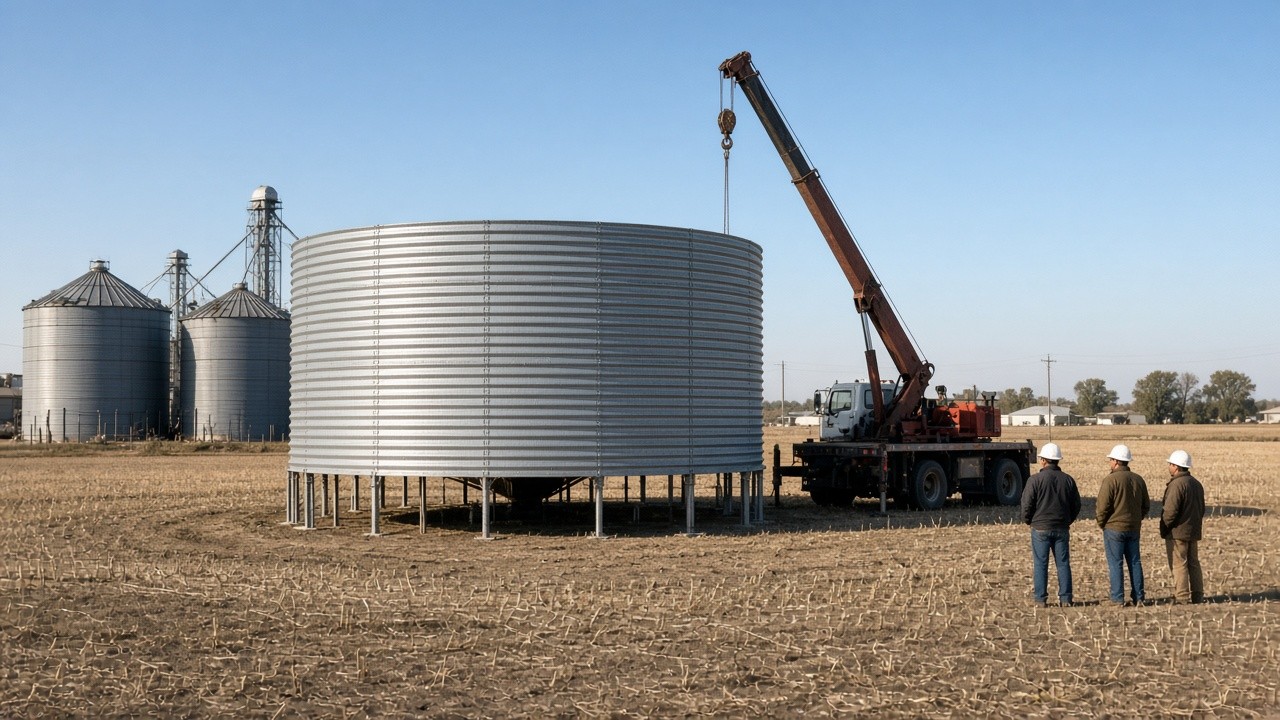
A grain bin and ag construction website should answer what a farmer asks while planning a new site or an expansion: what storage, drying, and handling you build, when a project has to be ordered to be ready before harvest, how you design a system around bushels, drying capacity, and truck traffic, whether you service dryers and legs during harvest, how you handle safety on bins, how financing and ag lender paperwork fit in, which counties you cover, and how to start. Put those facts in plain text on pages you own. That is the marketing. Design is the layout that makes those facts easy to find and easy for search and AI to cite.
Grain systems are planned around one hard deadline: harvest. A farmer who waits too long to order will not have the bin standing when the combine rolls. The contractor whose website explains the planning calendar and the design process earns the winter meetings that turn into summer builds.
Who is reading the site
Grain and ag construction traffic comes from a few groups.
Farmers adding storage, drying, or handling capacity. They are thinking in bushels, drying rates, and how many trucks can unload in an hour. They search and ask AI things like grain bin builder Cedar County, grain dryer installation eastern Iowa, or bin construction near Washington Iowa.
Farmers with a harvest problem right now: a dryer down, a leg or auger broken, a fan out. They need service fast.
Farmers with older bins that need repairs, new floors, fans, aeration, or monitoring, or bins to take down or move.
Ag lenders, landowners, and farm managers who look at your site before they finance or approve a project.
Elevators, co-ops, and commercial operations, if you do larger work.
Iowa contractors around Iowa City, Cedar Rapids, and the Quad Cities compete the same way ag builders across the Midwest do: plan early, design carefully, answer the phone in harvest, and show real sites.
What the homepage has to say in the first screen
In plain HTML text:
1. Company name and the counties you serve 2. Core work: grain bins, dryers, legs and conveyors, aeration and fans, bin repair, harvest service — only what you do 3. Phone that reaches someone, with a harvest service line if different 4. Two clear buttons: Plan a project / Harvest service 5. The current order deadline for builds before next harvest, and licensed and insured if you can keep it honest
Publish the planning calendar
Farmers want to know when to call. Tell them.
Write a dated page that explains:
- When you like to meet with farmers about next year’s projects
- When orders usually need to be placed for a build to be done before harvest
- When site prep, concrete, and electrical need to happen
- When your crews typically build, and how weather affects it
- When you shift to harvest service and stop starting new builds
Update it every year. A clear calendar answers the question “is it too late to put up a bin this year?” before the farmer calls, and it tells AI assistants you are a current, active contractor.
Explain how you design a system
Explain how you think about the whole site:
- Storage. How you size bins to the farm’s bushels and marketing plans
- Drying. How you match dryer capacity to harvest pace and moisture levels
- Handling. Legs, conveyors, augers, and how many bushels an hour the site needs to move
- Truck traffic. Where trucks come in, turn, dump, and leave, and how that affects layout
- Power. Three-phase availability, generator backup, and working with the utility and electrician
- Future growth. Leaving room for the next bin or a bigger dryer
Show a sample site plan drawing with no customer details. Farmers and lenders both want to see that you design the whole site.
Harvest service and safety
Harvest service. Say whether you offer service during harvest, what hours, how you prioritize calls, and whether you stock common parts for dryers, fans, and legs. Farmers remember who came out at night in October.
Safety. Grain bin work carries real risks, and farmers know it. Say how your crews train and work safely, and whether you install safety equipment like ladders, cages, platforms, and lockout points. Point farmers to extension and ag safety resources on bin entry. Keep your claims to what you actually do, and tell people to check current federal and state safety rules for their operation.
Financing and paperwork
Many grain projects are financed. Say what you can honestly say:
- Whether you provide the quotes, drawings, and specs ag lenders usually ask for
- That federal farm storage loan programs exist through USDA’s Farm Service Agency, with a link to the program page, and that farmers should check eligibility with their local office
- Whether a county building permit or zoning review applies to ag structures in your counties, with a note to check locally
- How deposits and progress payments work on your projects, described as a practice
Service pages that match real jobs
- Grain bins — farm storage, sizes you build, floors and aeration
- Grain dryers — installation, controls, service
- Legs, conveyors, and augers — handling system design and installation
- Aeration, fans, and heaters — new and replacement
- Bin monitoring — only if you install it
- Bin repair, floors, and take-down — older bins, moving bins
- Harvest service — hours, parts, priorities
- Commercial and elevator work — only if that is real work for you
- Service areas — counties with real sites and photos
Proof that belongs on a URL you own
- A page for each completed site: county, bushel capacity if the owner allows, dryer type, handling system, and photos
- Construction photos: foundation, ring by ring, legs going up
- Reviews on a page you own, with county and project type when allowed, plus a link to Google Business
- Dealer authorizations only for lines you are actually authorized for
- License and insurance facts
- Warranty terms in plain text for equipment and workmanship
The project path is the conversion
A good project form asks for:
- Name, phone, email
- Farm location and county
- New site, expansion, or repair
- Current storage, drying, and handling
- Target storage and drying capacity, if known
- Power available at the site
- Timeline and whether a lender is involved
A separate harvest service form, or better, a phone number at the top of every page, handles breakdowns. Put each form on its own URL so Google Business posts and AI answers can link to it.
Content that feeds search and AI without theater
- When to order a grain bin to have it ready for harvest
- How we size a dryer to your harvest pace
- Planning a new grain site: truck traffic, power, and room to grow
- Bin floors and aeration: signs it is time to replace
- Short project notes: county, what the farmer needed, what we built
- What to check on your dryer before harvest
Your website stays the source of record for customers and for AI assistants like ChatGPT, Gemini, and Grok. Google Business, Facebook, and farm shows can point back to it. Keep your true counties, calendar, and capabilities on a page you own.
Bots now make a large share of web requests. Farmers still build grain systems, and they still research contractors before they sign in the winter. Search is changing, and machines more and more decide which contractors a farmer hears about first. Plain-text calendars, design steps, counties, and real sites on a domain you own keep you in that short list.
Design rules that fit the trade
- Fast and light on mobile. Farmers look you up from the cab or the shop.
- Click-to-call in the header, with the harvest line next to it
- High-contrast text and real photos with captions
- Navigation: Storage, Drying, Handling, Harvest service, Planning calendar, Projects, Counties we serve, Contact
- No fake reviews or dealer logos you do not carry
- You own the domain, hosting, and content
What Upley does for shops like this
Upley builds and hosts websites for Iowa and Midwest service businesses. For a grain bin and ag construction company that means a planning calendar that stays current, system design pages, project pages by county, a harvest service path, hosting that stays up for daily crawls, and an easy way to post builds without turning your crew into marketers.
Same Iowa web team that ran Big Ten Web Design — design, hosting, SEO — plus the modern layer so search and AI can find the true file about your services, counties, and calendar.
If your current site is a bin photo and a phone number, start with the homepage five facts, the planning calendar, and five project pages. Then build from the project form.
Book 30 minutes: /half-hour-meeting/ Call 319-535-2508 · aaron@upley.com Iowa City, Cedar Rapids, Quad Cities / Davenport