
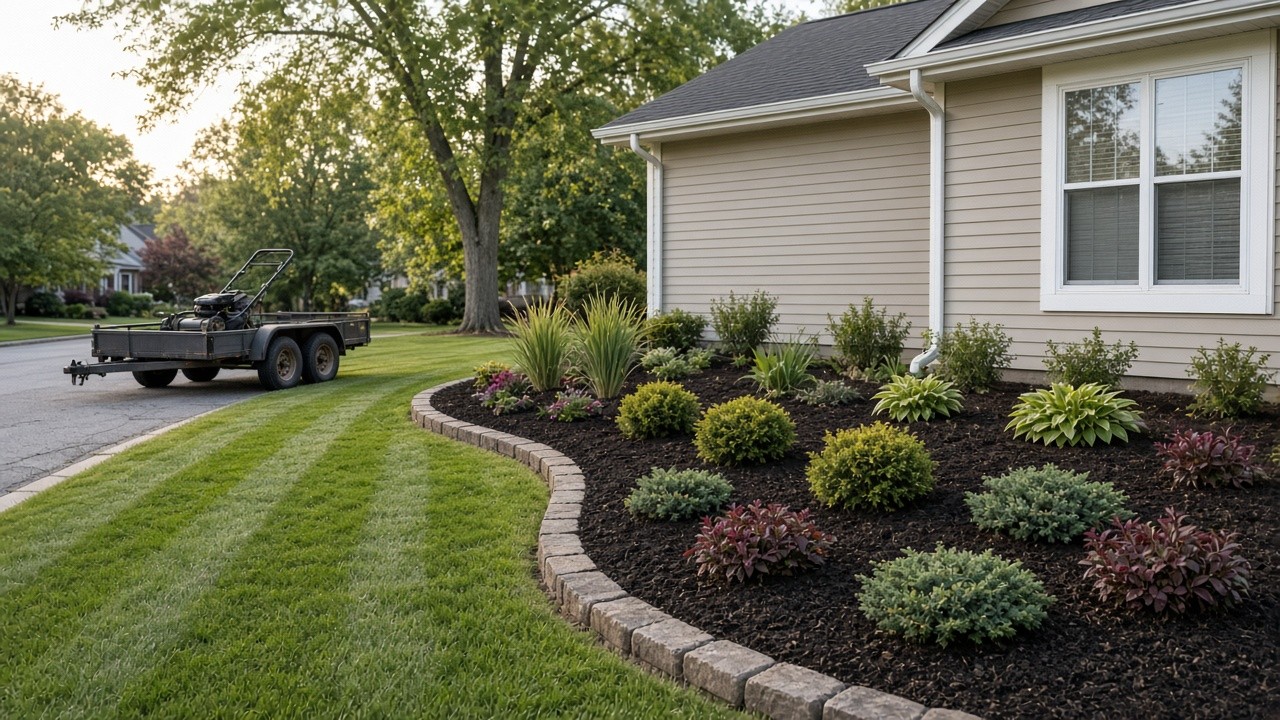
A landscaping or lawn care website should answer what a homeowner or property manager asks before they call: whether you mow, treat, or build, which neighborhoods and towns your crews run through, what a weekly visit includes, how lawn treatments work and who is licensed to apply them, how contracts, billing, and cancellation work, how far out you are booking design projects, and how to get a quote. Put those facts in plain text on pages you own. That is the marketing. Design is the layout that makes those facts easy to find and easy for search and AI to cite.
Many landscaping companies run two businesses under one name. One is recurring service on a route. The other is one-time projects like patios, plantings, and retaining walls. Customers buy them in very different ways, and the website works best when it treats them as two paths.
Who is reading the site
Lawn and landscape traffic comes from a few groups.
Homeowners who want someone else to mow, fertilize, and clean up the yard. They care about price, reliability, and whether you already serve their street. They search and ask AI things like lawn mowing service North Liberty, weekly lawn care Marion, or lawn fertilizer program Bettendorf.
Homeowners planning a project: a new patio, a retaining wall, a planting bed redo, drainage fixes, or a full backyard. They take their time, look at photos, and want to know your design process and schedule.
Property managers, HOAs, churches, and small businesses who need a reliable crew for many properties. They want insurance certificates, crew size, communication rules, and contract terms.
New homeowners in fresh subdivisions who need sod, seed, trees, and beds all at once, often with builder or HOA deadlines.
Iowa companies around Iowa City, Cedar Rapids, and the Quad Cities compete the same way landscapers across the Midwest do: show clean, real yards, prove the route covers the customer’s street, and make the next step obvious.
What the homepage has to say in the first screen
In plain HTML text:
1. Company name and the towns you serve 2. Core work: mowing, lawn treatments, cleanups, landscape design and install, hardscapes, drainage — only what you do 3. Phone that reaches someone who books 4. Two clear buttons: Get lawn service / Start a project 5. Current note (for example, “taking new weekly mowing customers in Coralville” or “booking patio projects for next season”), and licensed and insured if you can keep it honest
Two buttons matter here. A homeowner who wants a weekly mow and a homeowner who wants a paver patio should each find their door on the first screen.
Publish the route and what a visit includes
Recurring customers want to know two things before they sign up: do you come to my street, and what exactly do I get each time.
Say which towns and neighborhoods your crews run through each week. Name them. If you only take new mowing customers in certain areas to keep routes tight, say that plainly. It saves you calls you would turn down anyway.
Then describe a standard visit:
- Mowing, trimming, edging, and blowing clippings off hard surfaces — or whichever of these you include
- What happens on rain days and holidays
- What happens in a dry spell when the grass stops growing
- Whether the same crew usually comes
- How you handle gates, pets, and kids’ toys in the yard
- What costs extra: bagging, leaf cleanup, overgrown first cuts
A page like this answers the questions that fill your voicemail in April.
Be clear about treatments and licensing
Fertilizer, weed control, and grub treatments raise questions about pets, kids, and runoff. Many companies say almost nothing about this online, which makes careful homeowners nervous.
Say what you can say honestly:
- Which treatments you offer and roughly when in the season each one happens
- That your applicators hold the state certification required for commercial pesticide application in Iowa, if they do, and how a customer can verify it
- What you leave behind after a visit: a flag, a door tag, a text, or an email with what was applied
- How long you suggest keeping pets and kids off the lawn, following the product label
- How you handle yards near ponds, gardens, or wells
Stick to label directions and your own practice. Do not make health or safety promises you cannot back up. A calm page here earns trust and gives AI assistants a clear local answer when someone asks how lawn treatment services work.
Contracts, billing, and cancellation
Recurring customers want the terms before they commit. Put them on a page:
- Whether you use a season agreement, a month-to-month plan, or per-visit billing
- How and when you bill, and whether you offer auto-pay
- How to pause service for a vacation
- How to cancel, and how much notice you need
- When the season starts and ends, and whether you send reminders for renewals
You do not need to publish prices to do this well. Clear terms tell people you run an organized business.
Service pages that match real jobs
- Weekly mowing — route towns, what a visit includes, season length
- Lawn treatment programs — steps, timing, licensing, what you leave behind
- Spring and fall cleanups — leaves, beds, gutters if you do them
- Aeration and overseeding — timing, what to expect after
- Landscape design and installation — process, planting, beds, trees
- Patios, walls, and hardscapes — pavers, natural stone, retaining walls — only what you build
- Drainage and grading fixes — downspout lines, dry creek beds, low spots
- Commercial and HOA maintenance — only if that is real work for you
- Service areas — towns with real yards and photos
Proof that belongs on a URL you own
- Project pages for patios, walls, and plantings with town, materials, and a short description
- Before and after photos from the same angle
- Photos a few years after install, so people see how plantings filled in
- Reviews on a page you own, with town and service type when allowed, plus a link to Google Business
- License, certification, and insurance facts, and how to verify them
- Warranty terms in plain text: plant replacement policy, hardscape workmanship coverage
The service and project forms are the conversion
For recurring service, ask for:
- Name, phone, email
- Address
- Service wanted: mowing, treatments, cleanups
- Lot size or a rough description, and anything tricky like steep slopes or fenced areas
- Start date
For projects, ask for:
- Name, phone, email
- Address or town
- Project type: patio, wall, plantings, drainage, full yard
- Photos of the space
- Timeline and whether they have a budget range in mind
Put each form on its own URL so Google Business posts and AI answers can link to the right one. Keep click-to-call in the header.
Content that feeds search and AI without theater
- Which neighborhoods our mowing routes cover this year
- What happens on our lawn treatment visits, step by step
- When to aerate and overseed a lawn in eastern Iowa
- Paver patio or poured concrete: what we tell customers
- Short project notes: town, what the yard needed, what we built
- How we handle a dry August on the mowing route
Your website stays the source of record for customers and for AI assistants like ChatGPT, Gemini, and Grok. Google Business, Facebook, and Nextdoor can point back to it. Keep your true routes, terms, and licensing facts on a page you own.
Bots now make a large share of web requests. People still hire lawn crews and landscapers, and they still check a website before they commit to a season. Search is changing, and machines more and more decide which companies a homeowner hears about first. Plain-text routes, services, terms, and real yards on a domain you own keep you in that short list.
Design rules that fit the trade
- Fast on mobile. People look you up while standing in their own yard.
- Click-to-call in the header
- High-contrast text and real photos with captions
- Navigation: Lawn care, Landscaping, Hardscapes, Service areas, Reviews, Get service, Start a project
- No fake reviews or badges you do not hold
- You own the domain, hosting, and content
What Upley does for shops like this
Upley builds and hosts websites for Iowa and Midwest service businesses. For a landscaping or lawn care company that means separate paths for recurring service and projects, route and terms pages that stay current, hosting that stays up for daily crawls, and an easy way to post finished yards from the truck without turning your crew into marketers.
Same Iowa web team that ran Big Ten Web Design — design, hosting, SEO — plus the modern layer so search and AI can find the true file about your services, routes, and towns.
If your current site is one page with a mower photo and a contact box, start with the homepage five facts, a route page, and two forms. Then build from there.
Book 30 minutes: /half-hour-meeting/ Call 319-535-2508 · aaron@upley.com Iowa City, Cedar Rapids, Quad Cities / Davenport