
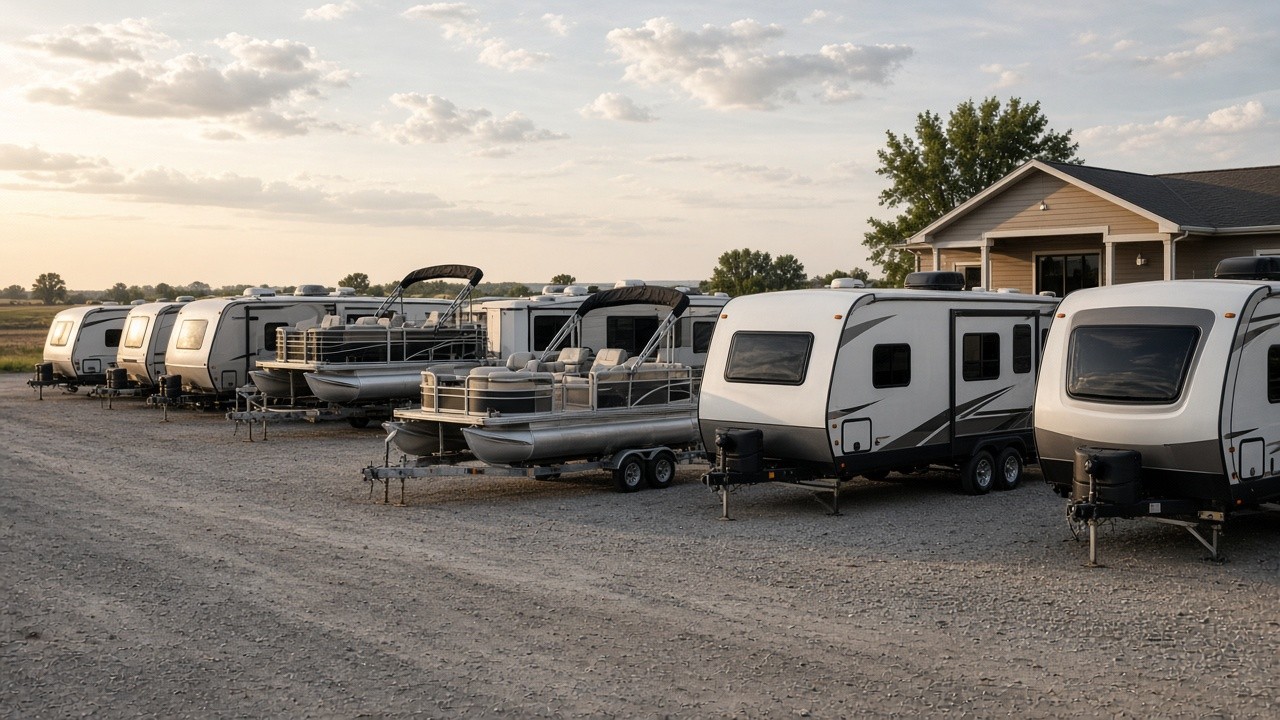
An RV and boat dealer website should answer what a buyer or owner asks before they visit: whether their truck can tow the unit they want, what the new-owner walk-through covers, what is in stock and what can be ordered, how trade-ins and consignment work, whether you offer financing through lenders, when service slots fill before the season, how winterizing and storage work, whether you service units you did not sell, your hours, and how to reach sales or service. Put those facts in plain text on pages you own. That is the marketing. Design is the layout that makes those facts easy to find and easy for search and AI to cite.
RV and boat owners in Iowa live on a short season. They want to buy, fix, and store on a schedule that matches the lake and the campground calendar. The dealer whose website explains the calendar, the towing math, and the service process keeps customers for years.
Who is reading the site
RV and boat traffic comes from a few groups.
First-time buyers looking at travel trailers, fifth wheels, pontoons, fishing boats, or runabouts. They have many questions, starting with what their vehicle can tow. They search and ask AI things like RV dealer Iowa City, pontoon boats Cedar Rapids, or travel trailer for sale near Coralville Lake.
Experienced owners trading up or selling. They want trade-in and consignment terms.
Owners who need service: spring de-winterizing, a roof leak, an electrical problem, a motor that will not start, or fall winterizing and shrink wrap. They want to know how far out the service schedule runs.
Owners who need a place to store the unit over winter, indoors or out.
Campers passing through who need a repair on the road, if you take those calls.
Iowa dealers around Iowa City, Cedar Rapids, and the Quad Cities compete the same way RV and boat dealers across the Midwest do: help buyers choose well, keep the service calendar clear, and make storage simple.
What the homepage has to say in the first screen
In plain HTML text:
1. Dealer name, address, and the areas you serve 2. Core work: new and used RVs, boats, service, parts, winterizing, storage, consignment — only what you offer 3. Phone numbers for sales and service 4. Two clear buttons: Shop units / Book service 5. Sales and service hours, current service note (for example, “fall winterizing appointments now open”), and licensed and insured if you can keep it honest
Help buyers match the tow vehicle
Towing is a question first-time buyers often get wrong. Answer it before they fall for a unit their truck cannot pull.
Write a plain towing page:
- Where to find the vehicle’s towing capacity and payload in the owner’s manual and door sticker
- What dry weight, loaded weight, tongue weight, and pin weight mean
- Why payload runs out before towing capacity for many trucks
- What hitch, weight distribution, and brake controller a trailer usually needs
- For boats, what the trailer adds and how launch ramps affect the choice
Say that the vehicle maker’s numbers control and that you will help check a buyer’s truck. On each unit listing, publish the weights in plain text. AI assistants asked “can my half-ton pull this camper” get a clear local answer, and your sales team spends less time on units that do not fit.
Publish the new-owner walk-through
Many buyers worry they will not know how to use their new RV or boat. Tell them what the walk-through covers:
- How long it takes and who does it
- For RVs: hitching, leveling, water, sewer, electric, propane, slides, awning, and what to do the first night
- For boats: launch and loading, controls, safety gear, fueling, and basic care
- Whether they can come back or call with questions after the first trip
- What paperwork they leave with
This page answers the fear that stops some first-time buyers, and it shows you stand behind the sale.
Service windows, winterizing, and storage
Service windows. Say when your spring and fall service calendars open, how fast they usually fill, and whether you take units you did not sell. Say how you prioritize warranty work, customer-pay work, and road emergencies.
Winterizing and de-winterizing. Say what each service includes for RVs and for boats: water lines, antifreeze, battery, motor and lower unit, fuel stabilizer, shrink wrap. Say what the owner can do and what is best left to the shop.
Storage. Say whether you offer indoor, covered, or outdoor storage, when units must be dropped off and picked up, whether storage includes winterizing, and what the terms are for access during the season. You do not need to list prices to be useful.
Date this section each season. It answers the questions that fill your phone in September and March.
Trade-ins, consignment, and financing
Trade-ins. Say what you need to value a trade: year, make, model, photos, and condition.
Consignment. If you sell units on consignment, say how it works: who handles showings and paperwork, how long a unit stays listed, and how payment works, described as your practice.
Financing. Say whether you arrange financing through lenders, with a note that terms depend on approval. Keep claims cautious and let lenders set the terms.
Service pages that match real jobs
- New RVs — types and floor plans you carry, with weights listed
- Used RVs — current units with photos, weights, and condition notes
- Boats — pontoons, fishing boats, runabouts, only what you sell
- RV service — roofs, electrical, plumbing, appliances, slides
- Boat and motor service — engines, lower units, trailers
- Winterizing and de-winterizing — RV and boat, what is included
- Storage — types, dates, terms
- Consignment and trade-ins — how each works
- Parts and accessories — counter hours, ordering
- Towing guide — as above
Proof that belongs on a URL you own
- Real photos of units on your lot, with weights and features in plain text
- Photos from the service shop: roof repairs, water damage fixes, motor work
- Reviews on a page you own, with town and purchase or service type when allowed, plus a link to Google Business
- Dealer authorizations only for lines you actually carry
- Service technician certifications only if they are real
- Warranty terms in plain text: manufacturer warranties and anything you add
The shopping and service forms are the conversion
For shoppers, a good inquiry form asks:
- Name, phone, email
- Type of unit and size range
- Tow vehicle year, make, model, and engine, or “need help”
- Trade-in: yes or no, with photos
- Timeline and whether they want financing information
For service, a good form asks:
- Name, phone, email
- Unit type, year, make, model
- Service needed, with photos
- Can the unit be towed in, or does it need pickup
- Preferred timing
Put each form on its own URL so Google Business posts and AI answers can link to the right one. Keep click-to-call for sales and service in the header.
Content that feeds search and AI without theater
- Can your truck tow this camper? How to check
- What happens in our new-owner walk-through
- When our spring service calendar fills, and how to get on it
- Winterizing an RV in Iowa: what we do and what you can do
- How consignment works at our lot
- Short service notes: unit type, problem, what we fixed
Your website stays the source of record for customers and for AI assistants like ChatGPT, Gemini, and Grok. Google Business, Facebook, and listing sites can point back to it. Keep your true inventory details, service calendar, and storage terms on a page you own.
Bots now make a large share of web requests. People still buy campers and boats, and they still research towing, service, and dealers before they visit. Search is changing, and machines more and more decide which dealers a buyer hears about first. Plain-text weights, walk-throughs, service windows, and real units on a domain you own keep you in that short list.
Design rules that fit the trade
- Fast on mobile. Buyers browse units at night and owners check service dates from the campground.
- Click-to-call for sales and service in the header
- High-contrast text and real photos with captions
- Navigation: RVs, Boats, Towing guide, Service, Storage, Consignment, Reviews, Contact
- No fake reviews or dealer logos you do not carry
- You own the domain, hosting, and content
What Upley does for shops like this
Upley builds and hosts websites for Iowa and Midwest service businesses. For an RV and boat dealer that means unit pages with weights in plain text, a towing guide, walk-through and service calendar pages, storage terms that stay current, hosting that stays up for daily crawls, and an easy way to post units and service jobs without turning your staff into marketers.
Same Iowa web team that ran Big Ten Web Design — design, hosting, SEO — plus the modern layer so search and AI can find the true file about your units, services, and hours.
If your current site is an inventory feed and a phone number, start with the homepage five facts, a towing guide, and a service calendar page. Then build from the two forms.
Book 30 minutes: /half-hour-meeting/ Call 319-535-2508 · aaron@upley.com Iowa City, Cedar Rapids, Quad Cities / Davenport