
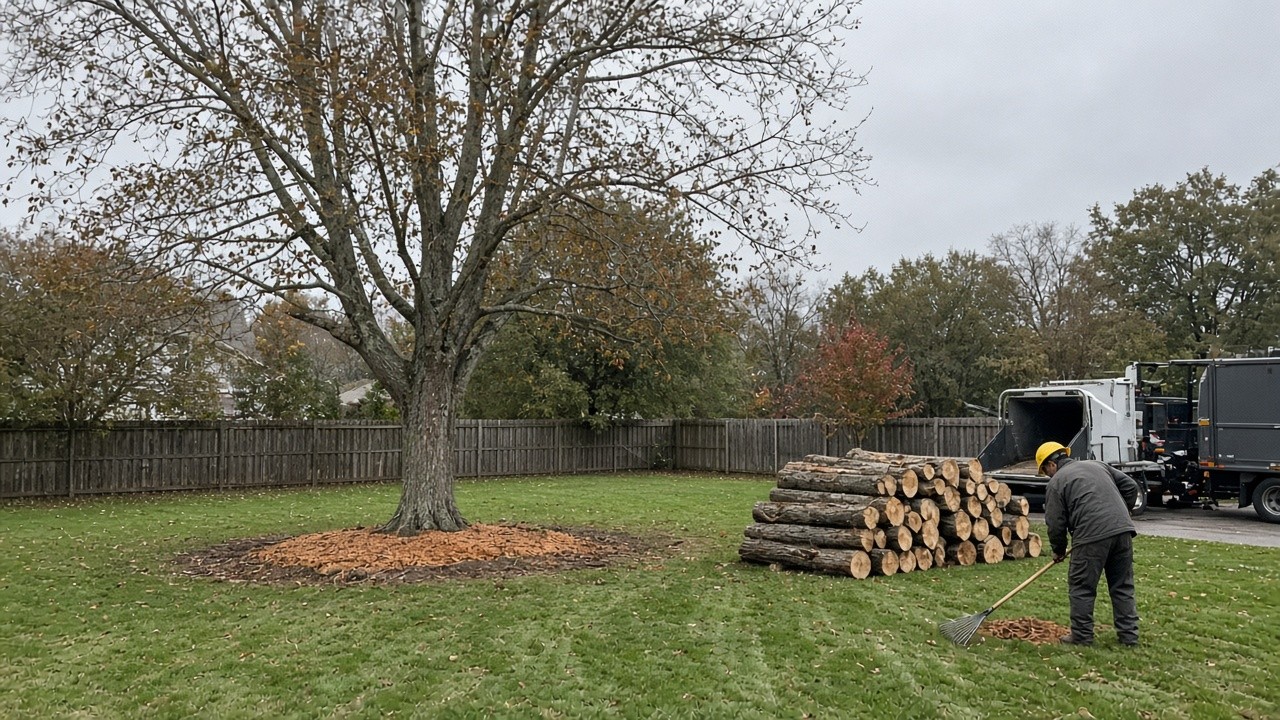
A tree service website should answer what a homeowner asks before they call: whether you remove, trim, or both, what happens with a tree on the house after a storm, what “cleanup” includes, who keeps the wood, whether stump grinding is part of the price, what you do about city trees and trees near power lines, whether you carry insurance and how they can see proof, which towns you cover, and how to get a quote. Put those facts in plain text on pages you own. That is the marketing. Design is the layout that makes those facts easy to find on a phone and easy for search and AI to cite.
Tree work is one of the few home services where a mistake can put a trunk through a roof. Homeowners know that. They are looking for signs that you are careful, insured, and clear about what they are paying for.
Who is reading the site
Tree service traffic comes from a few groups, and the weather sorts them.
Homeowners after a storm with a limb on the roof, a tree across the driveway, or a split trunk leaning toward the house. They need someone soon and want to know if you do emergency work and how you decide who goes first. They search and ask AI things like emergency tree removal Cedar Rapids, tree on house Iowa City, or storm tree cleanup Davenport.
Homeowners planning removal or trimming. Dead ash trees, overgrown maples over the roof, a tree too close to the foundation. They compare quotes and want to understand what each company includes.
Rural owners with windbreaks, timber, fence lines, and big yard trees far from town. They want to know if you travel and whether you handle large or hard-to-reach jobs.
Property managers, HOAs, and cities who need an insured crew with proper paperwork.
Iowa tree companies around Iowa City, Cedar Rapids, and the Quad Cities compete the same way tree services across the Midwest do: prove you are insured and careful, explain the scope clearly, and answer the phone after a storm.
What the homepage has to say in the first screen
In plain HTML text:
1. Company name and the towns you serve 2. Core work: removal, trimming, storm damage, stump grinding, lot clearing — only what you do 3. Phone that reaches someone who can talk about the job 4. One clear button: Get a quote / Storm help 5. Storm-response note if you keep one, and insured if you can keep it honest
After a storm, the number and the storm note need to be on the first screen.
Define the words that cause arguments
Many disagreements after a tree job come from words that meant different things to the homeowner and the crew. Write them down.
- Cleanup. Does it mean all brush chipped and hauled, leaves and small twigs raked, the lawn blown off? Or brush removed and larger debris left? Say what your standard cleanup includes.
- Wood. Do you haul all wood, leave logs cut to a length, or leave it in rounds? Can the homeowner choose? Is there a price difference?
- Stump grinding. Is it included, priced separately, or a separate visit? How deep do you grind? What happens to the grindings?
- Ruts and lawn damage. When heavy equipment crosses a wet yard, what do you fix and what does the homeowner handle?
- Trimming vs topping. Say what kind of pruning you do, and whether you top trees. Many arborists will not, and customers deserve to know why.
A page like this saves you arguments and helps homeowners compare quotes fairly. It also gives AI assistants a clear answer when someone asks what tree removal usually includes.
Say who is responsible for which tree
Homeowners often do not know whose tree it is or who should pay. Answer the common cases plainly and point to the right source:
- Trees on the property line or a neighbor’s tree hanging over. Say what you will and will not cut without the neighbor’s permission.
- City or parkway trees between the sidewalk and the street. Many cities manage those trees or require a permit to prune or remove them. Say which of your towns you know require one and tell people to check with their city.
- Trees near power lines. Say that the utility handles trees touching main lines in most cases and that you do not work near energized lines unless you are qualified. Tell people to call their utility first.
- Insurance claims after a storm. Say whether you provide photos and an itemized invoice for the homeowner’s insurance, without promising what the policy covers.
Storm days and planned work
Explain how you handle a storm. Do you take emergency calls after hours? How do you decide order: trees on houses first, then blocked driveways, then everything else? Do you tarp or do temporary work to stop damage? When do you return to planned jobs?
Then explain timing for planned work. Some pruning is better done in certain seasons. Oaks in Iowa are usually pruned outside spring and early summer because of oak wilt risk. If you follow that guidance, say so and link to the Iowa DNR or extension source. If you handle ash trees affected by emerald ash borer, write a page about removal and, if you offer it, treatment.
Service pages that match real jobs
- Tree removal — process, equipment, cleanup and wood options
- Tree trimming and pruning — what kind of cuts you make, timing notes
- Storm damage and emergency work — hours, priorities, insurance paperwork
- Stump grinding — depth, grindings, separate or combined pricing
- Ash tree removal and treatment — only what you offer
- Lot and fence line clearing — acreage, brush, windbreaks
- Commercial and municipal work — only if that is real for you
- Service areas — towns and counties with real jobs and photos
Proof that belongs on a URL you own
- Photos of real jobs with town, tree type, and job type in the caption
- Before and after shots from the same angle
- Photos of equipment you actually run: bucket truck, crane, tracked lift, chipper
- Certificate of insurance available on request, with a plain line on what you carry
- ISA Certified Arborist credentials only if someone on your crew holds them, with the name and number
- Reviews on a page you own, with town and job type when allowed, plus a link to Google Business
Photos of your own crew working over a real house tell people how careful you are.
The quote path is the conversion
A good quote form asks for:
- Name, phone, email
- Address or town
- Removal, trimming, storm damage, stump grinding, or clearing
- Photos of the tree, including the whole tree and what is near it
- Anything close by: house, power lines, fences, septic field, garden
- Access: gate width, can equipment reach the tree
- Cleanup and wood preference
- Timeline: emergency, soon, or planned
Many tree companies quote from photos first and visit when needed. If you do, say so. Put the form on its own URL so Google Business posts and AI answers can link to it. Keep click-to-call in the header, and put the storm line near the number.
Content that feeds search and AI without theater
- What our tree removal price includes, and what it does not
- When to prune oaks in Iowa, and why we wait
- What to do when a neighbor’s tree falls on your property
- Ash trees and emerald ash borer: remove or treat?
- Short job notes: town, tree, what was near it, how we took it down
- How we decide order after a storm
Your website stays the source of record for customers and for AI assistants like ChatGPT, Gemini, and Grok. Google Business and Facebook can point back to it. Keep your true towns, insurance facts, and scope terms on a page you own.
Bots now make a large share of web requests. People still hire tree crews, often after a scary night, and they still look for proof before they let a crew near the house. Search is changing, and machines more and more decide which companies a homeowner hears about first. Plain-text scope, insurance, towns, and real jobs on a domain you own keep you in that short list.
Design rules that fit the trade
- Fast on mobile. People look you up in the yard, looking at the tree.
- Click-to-call in the header, with the storm note next to it
- High-contrast text and real photos with captions
- Navigation: Removal, Trimming, Storm work, Stumps, Service areas, Reviews, Get a quote
- No fake reviews or credentials you do not hold
- You own the domain, hosting, and content
What Upley does for shops like this
Upley builds and hosts websites for Iowa and Midwest service businesses. For a tree service that means clear pages for each kind of job, a scope page that defines cleanup, wood, and stumps, a quote path that takes photos from a phone, hosting that stays up for daily crawls and storm traffic, and an easy way to post jobs from the truck without turning your crew into marketers.
Same Iowa web team that ran Big Ten Web Design — design, hosting, SEO — plus the modern layer so search and AI can find the true file about your services, towns, and insurance.
If your current site is a phone number and a chainsaw photo, start with the homepage five facts, the scope definitions page, and ten captioned jobs. Then build from the quote form.
Book 30 minutes: /half-hour-meeting/ Call 319-535-2508 · aaron@upley.com Iowa City, Cedar Rapids, Quad Cities / Davenport